 I keep asking myself this every time I click a link and fall into another Telegram rabbit hole:
Who do I actually trust online?
And the honest answer?
I don’t. Not fully.
Because crypto doesn’t really reward trust.
It rewards verification.
At some point, after going down enough late-night research spirals, something clicked for me:
Money on-chain isn’t magic.
It’s just a collection of signed claims.
Who owns what
Who sent what
What is valid
What is not
Everything comes down to one simple idea:
A signature is a statement of truth.
And suddenly, things like Sign Protocol started making more sense to me — not as hype, but as a framework.
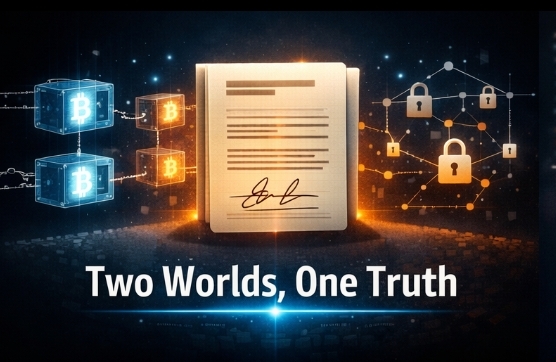
Two Worlds, One Truth
When I look at modern crypto systems — especially stablecoins and digital currency infrastructure — I don’t see “chains” anymore.
I see systems for creating, verifying, and syncing signed states.
Public Side (Layer 1 / Layer 2)
This is where everything is open.
 Every transaction, every balance update, every mint or burn…
is a signed attestation.
Anyone can verify it
No permission needed
Trust comes from visibility
You don’t believe.
You check the signatures yourself.
Permissioned Side (Private Networks)
This is where things get more controlled.
Systems like enterprise blockchains operate differently:
Not everyone can read
Not everyone can write
Access is restricted
But here’s the important part:
The logic doesn’t change.
It’s still signed data.
Participants are still:
Signing state changes
Agreeing on what is true
Maintaining a shared version of reality
Why This Actually Matters
This is the part most people miss.
If both worlds — public and permissioned — are built on the same foundation:
Signed attestations become the common language of truth.
That’s powerful.
Because now:
A balance update is the same concept everywhere
A transfer is the same concept everywhere
A “truth” doesn’t depend on the environment
You’re not running two systems.
You’re running:
One system of truth expressed in two environments.
Speed vs Reality
You’ll hear big numbers thrown around:
“200,000+ TPS”
“High throughput”
“Next-gen scalability”
And sure — if you treat transactions as lightweight signed statements instead of heavy computation, things can move faster.
That part is logical.
But here’s where my skepticism kicks in — and maybe yours should too:
Speed is easy to claim. Consistency is hard to maintain.
Because the real challenge isn’t:
How fast you process data
It’s:
Whether both sides agree on the same truth
The Real Risk Nobody Talks About
What happens if:
The public chain says one thing
The permissioned system says another
If those signed states ever drift apart…
Then what is truth?
That’s the real problem.
Not TPS.
Not marketing.
Not partnerships.
Synchronization of truth is the real battlefield.
And This Is Where It Gets Personal
Because here’s the uncomfortable part:
The more I understand the tech…
the less I trust the noise around it.
I’ve seen the patterns:
Hype cycles
“We’re early” energy
Overconfident threads
Endless “soon”
Crypto is full of things that feel real before they are real.
And the best illusions?
They don’t look fake.
They look reasonable.
So What Do You Actually Trust?
Not influencers.
Not hype.
Not even your own excitement.
You trust systems that allow you to verify truth independently.
That’s why this idea sticks with me:
Don’t treat the chain as the product.
Treat the signature as the product.
Because a signature:
Can live anywhere
Can be verified anywhere
Doesn’t care about the environment
Final Thought
I’m not saying every project gets this right.
And I’m definitely not saying you should trust fast.
But I am saying this:
The future isn’t about louder systems.
It’s about cleaner truth.
And maybe the projects worth paying attention to…
aren’t the ones asking for your belief.
They’re the ones quietly giving you the tools to verify reality yourself.