
The rapid expansion of Web3 has been nothing short of a digital gold rush, yet it has left a trail of fragmented infrastructure in its wake. We have built incredible decentralized financial tools and vibrant communities, but we’ve neglected a fundamental human requirement: efficient, portable trust.
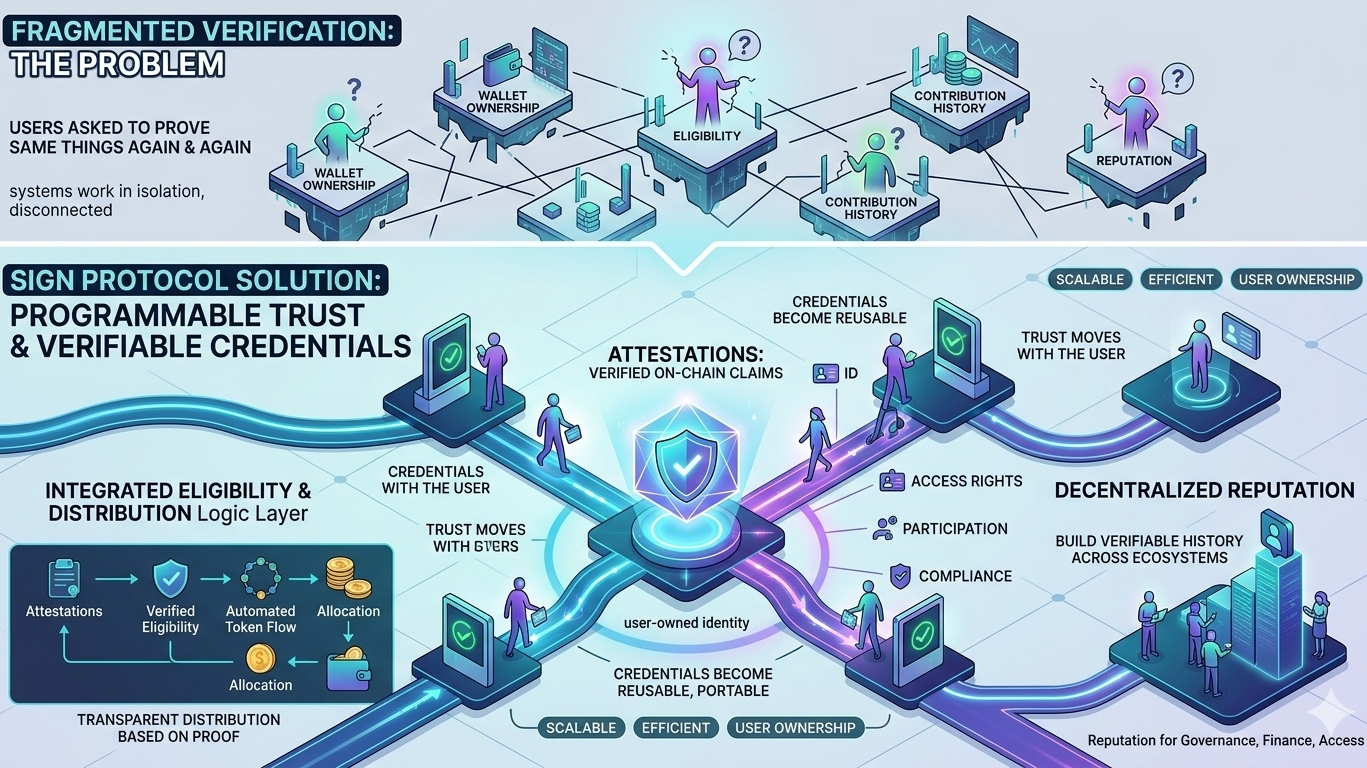
If you have spent any time navigating the decentralized ecosystem, you’ve felt the friction. You are constantly asked to prove who you are, what you own, and what you’ve done—over and over again. Wallet ownership, eligibility for a drop, contribution history, or governance reputation; each platform acts as an island, forcing users to "re-verify" their existence in a never-ending cycle of digital bureaucracy.
SIGN Protocol has arrived to dismantle these silos, shifting Web3 from a collection of disconnected verification models into a unified, fluid infrastructure.
The Death of the "One-Time" Verification
At the heart of the current inefficiency is the way we handle data. Most projects still rely on a patchwork of "Web2.5" solutions: messy spreadsheets for allowlists, fragile APIs for verification, and private internal databases to track eligibility. These methods are not just inefficient; they are fundamentally at odds with the transparency of the blockchain.
SIGN replaces this chaos with Attestations. An attestation is a verified claim recorded on-chain. Think of it as a digital "stamp of truth" that can represent anything from identity and access rights to compliance and past participation. But here is the critical distinction: once an attestation is created, it is permanent and portable. Instead of rebuilding trust on every new platform you visit, your credentials move with you. When you enter a new ecosystem, you don’t start from zero; you bring a verifiable history that the system can recognize instantly. This turns verification from a repetitive chore into a reusable layer of your digital identity.
Where Logic Meets Value: Integrating Distribution
The most profound shift SIGN introduces isn't just knowing who a user is, but acting on that knowledge. Historically, verification and distribution have lived in separate silos. A team verifies a user's eligibility, and then, in a separate manual or semi-automated step, they distribute tokens or rewards.
SIGN integrates these into a single logic layer.
By linking verified credentials directly to distribution, trust becomes programmable. Eligibility triggers action; if your attestation meets the predefined rules of a smart contract, value flows automatically. This removes the "black box" of manual allocations and replaces it with a transparent, auditable framework.
Precision: Tokens go exactly where they are earned.
Transparency: Anyone can audit why a specific wallet received a specific allocation.
Scalability: Projects can manage millions of users without increasing their operational overhead.
Ownership and the Rise of On-Chain Reputation
We often talk about "sovereign identity," but in practice, platforms still hold the keys to our digital reputations. If a platform goes dark, your contribution history often goes with it.
SIGN flips this power dynamic. By putting control of credentials back into the hands of the user, it allows for the development of a universal reputation system. As you participate in governance, provide liquidity, or contribute to DAOs, you are building a verifiable resume that lives on the protocol level, not the app level.
In the next cycle of Web3, reputation will be the most valuable currency. It will determine your interest rates in DeFi, your voting power in governance, and your access to exclusive opportunities. SIGN provides the soil for that reputation to grow across the entire inter-chain landscape.
The Infrastructure Challenge: From Idea to Standard
Infrastructure projects rarely enjoy the "hype" cycles of meme coins or flashy consumer apps, but they are the bedrock upon which the entire industry matures. Web3 isn't just about moving tokens; it’s about coordination. And you cannot coordinate complex human systems without structured trust.
The challenge for SIGN, as with any foundational technology, lies in adoption and interoperability. 1. Adoption: For this to work, builders must integrate SIGN into their stacks, and platforms must agree to trust the attestations generated by the protocol.
2. Interoperability: In a multi-chain world, trust must be portable across different environments (Ethereum, Solana, Layer 2s, etc.).
If SIGN achieves this cross-chain standardization, it will solve one of the greatest friction points in the digital economy.
Building a Deeper Truth
SIGN Protocol is doing something far more significant than fixing a surface-level annoyance. It is reimagining how digital systems verify truth and execute on it.
By creating a continuous cycle where Verification defines Eligibility, which triggers Action, which in turn creates New Records of Trust, SIGN is building the nervous system of the decentralized web.
In an era where trust is often assumed but rarely standardized, a protocol that can program trust into the very fabric of our interactions may well become the most essential layer of the Web3 stack. We are moving away from a world of "prove it again" and toward a world where your contributions, your identity, and your value are recognized everywhere you go.
