
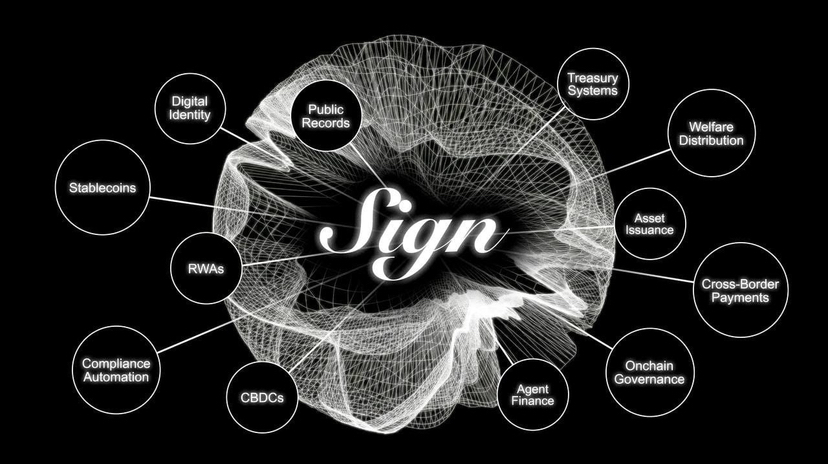
Sign changed the way I think about identity in crypto, though I’m still cautious. Up until now, every app I used treated me like I was starting from scratch. I verify my email, sign a message, maybe go through KYC and then I leave. The next dApp? Same process all over again. Same proofs, same effort, zero memory. It’s exhausting, and it shapes behavior. I start hesitating before committing to anything because I know the friction is coming. I even create multiple wallets just to dodge repeated verification.
Crypto feels ephemeral, and I’ve gotten used to being treated like a ghost.
Token distribution is just as messy. I’ve seen airdrops get gamed over and over. Bots spin up dozens of wallets in minutes, while real users, people who actually engage, get sidelined. I’ve participated in airdrops where everything seems “verified,” and yet I walk away empty handed. It’s frustrating and it erodes trust in the system. When rewards go to automation instead of engagement, incentives stop making sense.
That’s why I started exploring Sign Protocol. At first, I was skeptical too many projects promise better identity or fairer token distribution, only to deliver complexity with no real improvement.
But with Sign, my wallet isn’t just a container for tokens anymore it becomes a repository for verifiable proof. Every credential I earn confirming I’m human, verifying membership in a community can move with me across apps. I don’t have to re prove myself constantly. I can carry trust forward. It’s subtle, but it changes everything about how I experience identity in crypto.
On the distribution side, Sign opens up possibilities I hadn’t seen before. Reusable, hard to fake credentials can make it easier to target rewards to actual users rather than bot-generated wallets. In theory, airdrops could become fairer, aligned with real engagement rather than raw wallet volume.
I can see how this could shift behavior not just for me as a user, but for developers who now have a reliable signal to work with.
But here’s the hard truth: potential isn’t proof. The system only works if adoption actually happens. I have to reuse my credentials instead of treating them as a one off convenience. Developers have to build their verification flows around these proofs, rather than fall back on legacy methods. Token distribution needs to rely on them, not just advertise that it does.
Until these pieces click into place, Sign’s promise is theoretical. The infrastructure is only as valuable as its repeated usage.
Behavior matters too. Even if credentials are technically reusable, I could ignore them for convenience. Developers could still run parallel verification flows. Distributions could still prioritize metrics that are easier to measure, like wallet volume.
The system is only as strong as the habits it encourages, the norms it builds, and the trust it fosters. That’s the real test technical design alone isn’t enough.
For me, the most compelling thing about Sign isn’t flashy airdrops or tokenomics. It’s the idea that my identity, my actions, and my engagement can persist across apps. That I don’t have to start over every time I interact with a new protocol. That there’s the potential for a durable infrastructure layer for trust in a space that historically forgets everything the moment you move on. But potential is fragile.
Its success depends entirely on repeated, practical usage.
I’m cautiously optimistic. The framework makes sense, and I can see how it could solve problems that have frustrated me for years. But crypto has a history of promising good ideas that never scale because adoption stalls or incentives misalign.
With Sign, the infrastructure isn’t just a set of protocols it’s a test of human behavior, developer integration, and consistent usage. Until that happens, the promise of reusable identity and fairer token distribution remains just that a promise.
At the end of the day, my experience with Sign so far is reflective. It reminds me that wallets don’t have to be empty shells, that identity can carry forward, and that token distribution doesn’t have to be gamed to death by bots. But it also reminds me that infrastructure only becomes infrastructure when it’s actively used, repeatedly relied upon, and trusted by the people and applications that depend on it. Until then,
Sign is an experiment worth watching, but not yet a solved problem.
#SignDigitalSovereignInfra @SignOfficial $SIGN
