
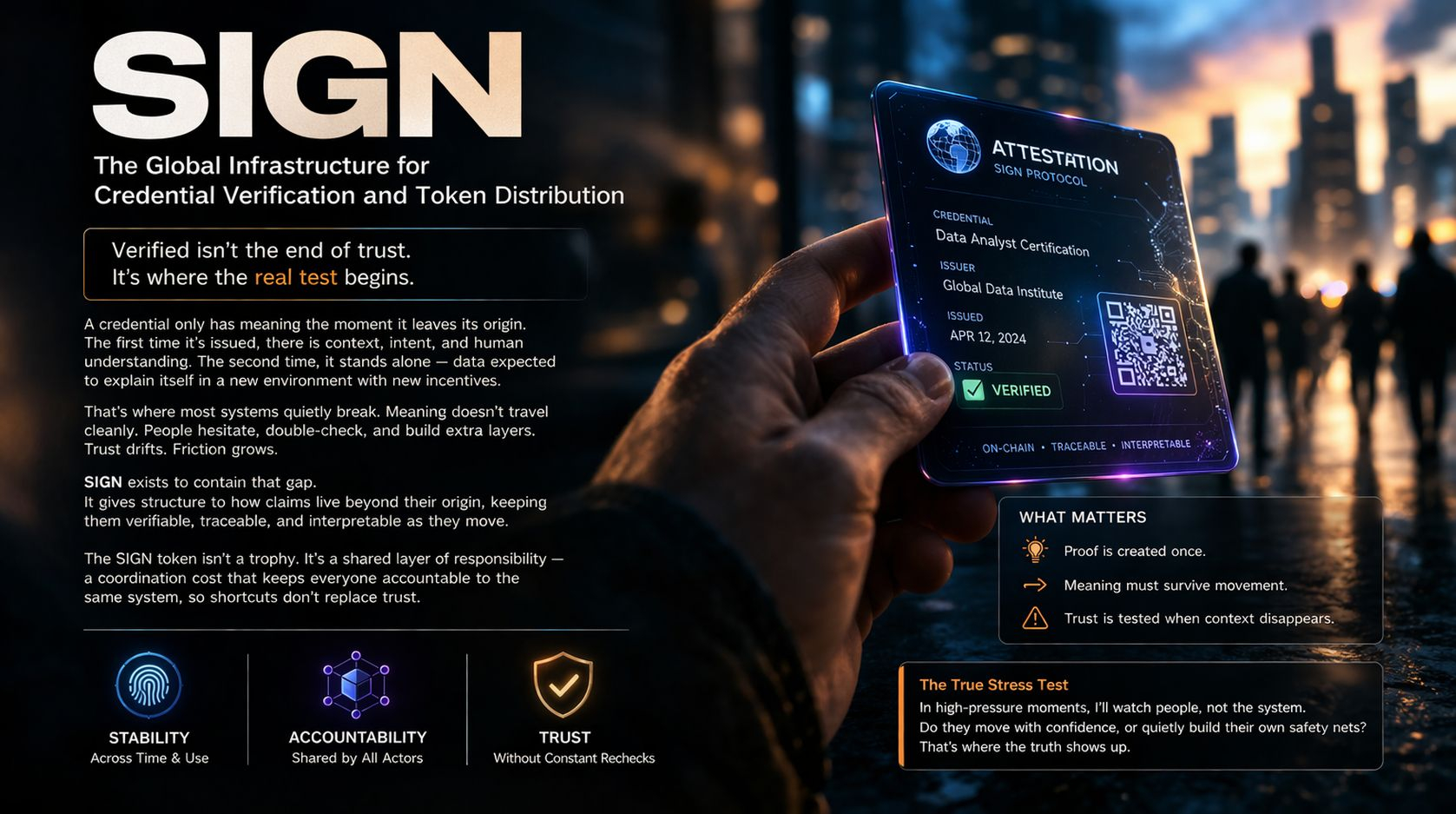
It kept bothering me how easily we accept something as “verified” and just move on. Like once a box is checked, the thinking part is over. That always feels a little too convenient. Not wrong exactly—just incomplete. Because in real life, things don’t stay clear for long. They get reused, passed around, interpreted by people who weren’t there at the start.
I think that’s where most systems quietly struggle. Not at the moment something is created, but later, when it has to stand on its own. The first time a credential exists, there’s context behind it. Someone knows why it was issued, what it means, what it doesn’t mean. But the second time it’s used, all of that is gone. It’s just a piece of data expected to explain itself.
And we act like that’s enough.
But it rarely is.
So what happens? People compensate. They double-check. They add their own layers. They hesitate just a little before trusting what’s in front of them. That hesitation is small, but it adds up. Over time, it turns into friction. Into systems on top of systems. Into this quiet lack of confidence no one really talks about.
I keep coming back to that feeling—the gap between something being technically valid and actually being trusted.
Because those are not the same thing.
Trust isn’t just about proof. It’s about how that proof holds up when it moves. When it leaves its original environment and enters a new one, with different expectations, different risks, different incentives. That’s where things get messy. Not because the data is wrong, but because meaning doesn’t travel as cleanly as we pretend it does.
And most people don’t focus on that part. They focus on creating the proof, not on what happens after.
Sitting with that for a while, SIGN starts to feel less like a solution and more like an attempt to deal with that exact gap. Not by pretending everything can be perfectly understood, but by giving structure to how claims live beyond their origin. How they can be checked, traced, and interpreted without constantly starting from zero.
It’s a subtle shift. But an important one.
Because the problem isn’t just “can this be verified?
It’s “will this still make sense later, to someone else, under pressure?
That’s where things usually fall apart.
And then there’s the token. Not as something exciting or speculative, but as something more grounded. Almost like a shared layer of responsibility. A way to keep everyone involved slightly accountable to the same system, instead of drifting into their own versions of it.
Because if there’s no shared cost, people take shortcuts.
And if everyone takes shortcuts, the system slowly stops meaning what it claims to mean.
Still, I don’t think this fully resolves anything. It just makes the tension more visible. And maybe that’s the point. Some problems don’t disappear—they just become easier to see.
So I’m not looking for perfection here.
I’m waiting for a moment of stress. When things are fast, messy, and slightly uncertain. When people don’t have time to overthink.
That’s when I’ll pay attention.
Not to the system itself, but to the people using it.
Do they trust it enough to move without hesitation?
Or do they quietly start building their own safety nets again?
That answer will say more than any design ever could.
#SignDigitalSovereignInfra @SignOfficial $SIGN
