
I’ve been around crypto long enough to stop getting excited every time a new project says it’s building the future.
Most of the time it’s the same pattern.
A new token, a recycled story, a lot of noise, and a vague promise that this time the infrastructure really matters.
Lately it’s gotten even worse.
Everything is either tied to AI, identity, coordination, or some grand idea about fixing the internet.
After a while, it all blends together.
That’s part of why SIGN stood out to me a bit.
Not because it feels like some huge breakthrough.
And not because it comes with the usual dramatic claims.
It just seems to be working on a problem that actually feels real.
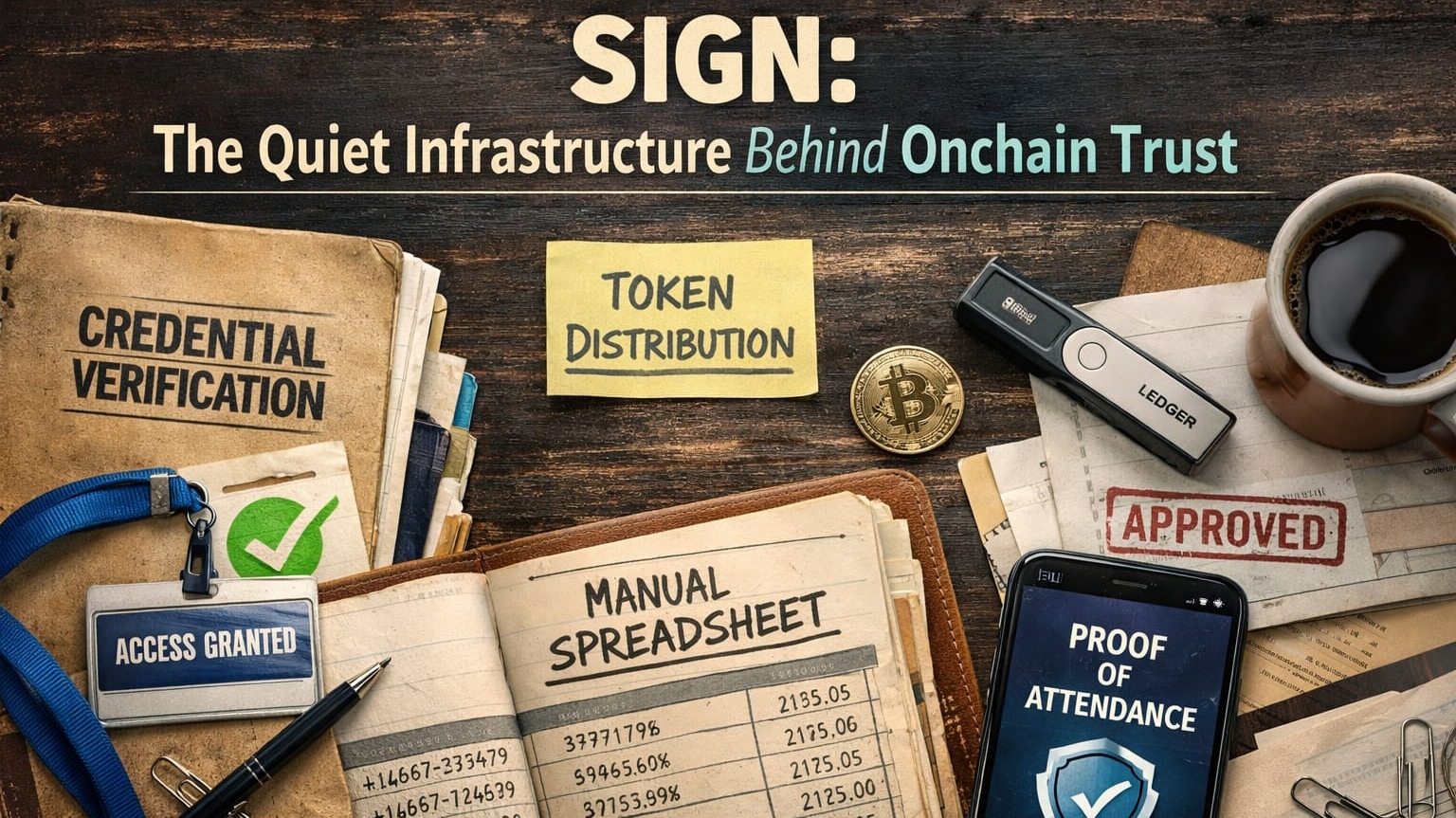
At its core, SIGN is about credential verification and token distribution.
That may not sound very exciting.
But honestly, that’s probably a good sign.
A lot of crypto still struggles with really basic coordination.
Who should receive rewards? Who actually contributed? Who qualifies for access? Who is a real participant and who is just gaming the system?
These sound like simple questions until money gets involved.
Then everything gets messy.
Anyone who has spent enough time onchain has seen it happen.
Airdrops get farmed. Reward systems get exploited. Communities try to do something fair, and it turns into a strange competition between bots, insiders, and people who are just better at working around rules.
And to be fair, it’s not always because people are malicious.
Sometimes the system itself is just badly designed.
A lot of these processes still happen through a mix of spreadsheets, forms, wallet submissions, Discord roles, manual reviews, and a lot of trust that things were handled correctly.
It works, sort of.
But it always feels fragile.
That’s where SIGN starts to make sense to me.
The project seems to be focused on helping projects and communities verify certain credentials — who did something, who attended something, who belongs to a group, who earned a role — and then use that information when distributing tokens or access.
It’s not a flashy idea.
It’s more like trying to fix a part of crypto that people usually ignore until it breaks.
And that part matters more than people admit.
Because crypto talks a lot about fairness, open participation, and decentralization.
But when it’s time to actually decide who gets rewarded, things often become very centralized, very manual, and very unclear.
That gap is where a lot of frustration lives.
So I can understand why infrastructure around verification and distribution could matter.
Still, this is also where I become careful.
Verification always sounds clean in theory.
In reality, somebody still has to decide what counts.
What counts as a contribution?
What counts as proof?
Who issues the credential?
Who decides which users are real and which ones are not?
Those decisions don’t disappear just because they’re moved onchain.
And token distribution is even harder.
Crypto loves the word “fair,” but fair distribution is usually much more subjective than people want to admit. Every system creates edge cases. Every filter leaves someone out. Every reward model can be gamed in ways no one predicted at the start.
So I don’t think a project like SIGN magically solves trust.
What it might do is make these processes a little more structured, a little more transparent, and maybe a little less chaotic.
That would already be useful.
Because the truth is, crypto has spent years building markets faster than it has built good systems for coordination.
There’s no shortage of places to trade, speculate, borrow, mint, or farm.
But the quieter mechanics — proving participation, recognizing contribution, distributing value properly — still feel underdeveloped.
That’s why SIGN feels at least somewhat different to me.
It’s not chasing a fantasy.
It’s looking at a very ordinary problem inside crypto and saying: this part still doesn’t work very well.
I respect that more than I respect most big narratives.
That doesn’t mean it will succeed.
A lot of infrastructure projects make perfect sense on paper and then never really become essential. Sometimes adoption is weak. Sometimes standards never form. Sometimes the market just moves on to the next distraction before the real work has time to matter.
That could happen here too.
So I’m not saying SIGN is the answer.
I’m not even saying it’s proven.
But I do think credential verification and token distribution are real problems, and projects trying to improve that layer are at least dealing with something concrete.
In a market full of performance, that still counts for something.
Maybe SIGN ends up becoming important.
Maybe it stays niche.
Maybe it fades like a lot of other infrastructure projects before it.
But for now, it feels like one of the few projects that is easier to take seriously than to hype.
And these days, that’s usually enough for me to keep watching.