
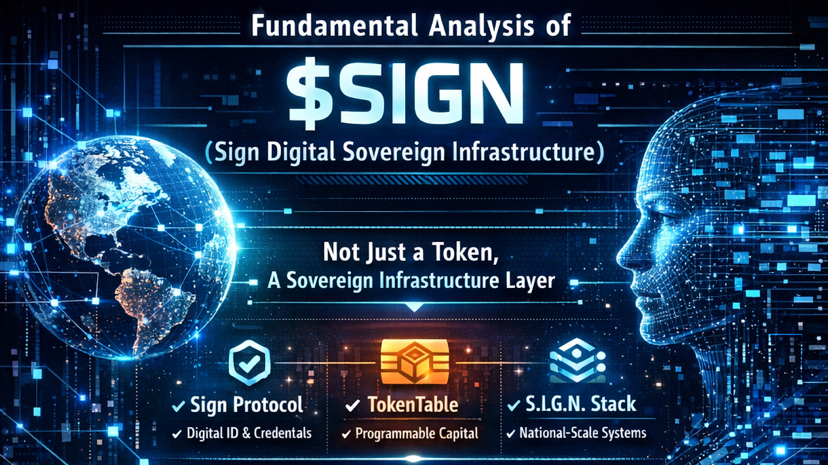
In a crypto market full of hype-driven projects, $SIGN stands out as something more serious — an infrastructure play focused on solving one of Web3’s biggest missing pieces: trust, identity, and verifiable data.
Instead of chasing trends like meme coins or short-term DeFi hype, Sign is building something deeper — a sovereign-grade digital infrastructure layer that could potentially power governments, institutions, and large-scale systems.
🔍 What SIGN Actually Does
At its core, $SIGN is not just a token — it’s part of a broader ecosystem designed to handle digital identity, credentials, and programmable capital systems.
The project revolves around:
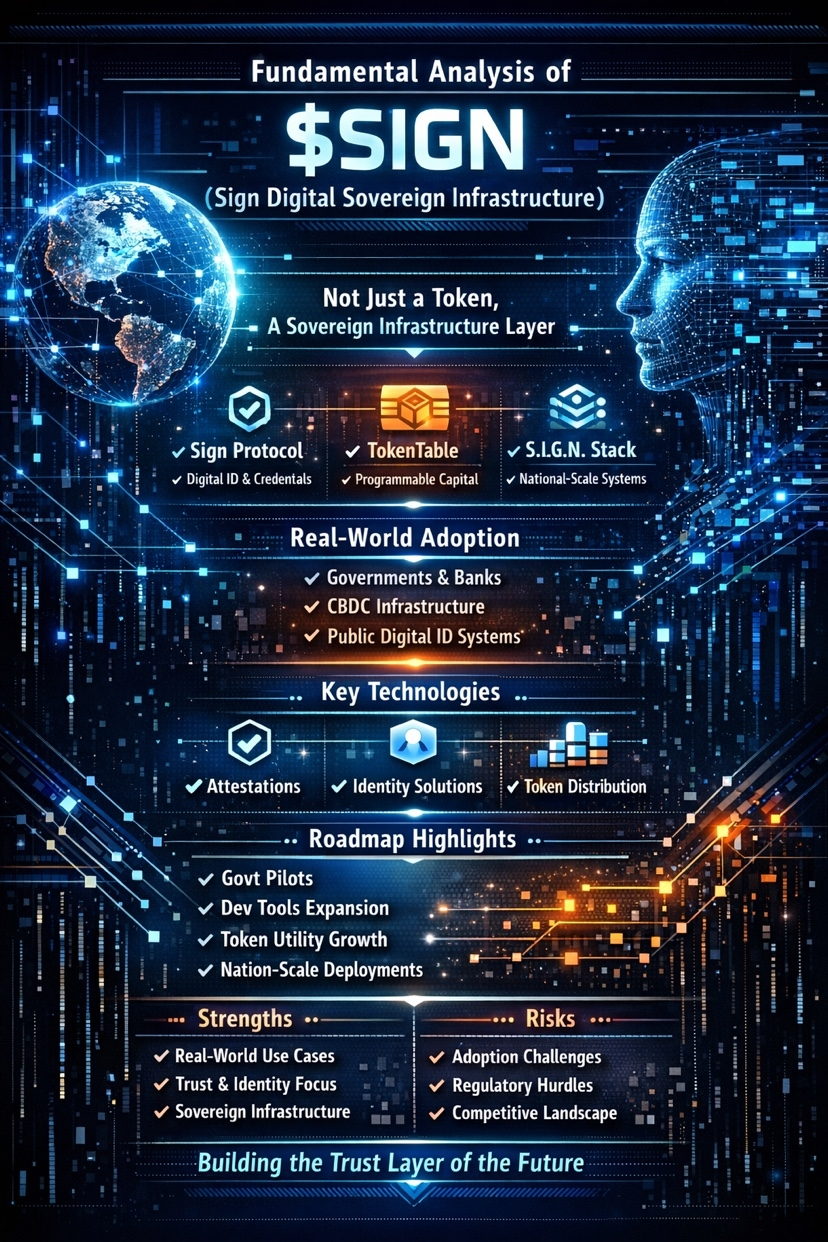
Sign Protocol → an omni-chain attestation system
TokenTable → smart contract-based token distribution
S.I.G.N. Infrastructure Stack → full national-scale digital framework
This means instead of just moving money, Sign focuses on verifying truth on-chain — like identity, credentials, ownership, and eligibility.
👉 In simple terms:
While most blockchains track transactions, Sign tracks trust.
🌍 Real-World Focus (Biggest Strength)
One of the most bullish aspects of SIGN is real-world adoption angle.
Unlike many crypto projects that stay inside the Web3 bubble, Sign is targeting:
Governments
National banks
Public infrastructure systems
They’ve already explored partnerships with institutions like national banks and ministries, showing intent to build nation-level digital systems.
This includes:
Digital identity systems
CBDC (Central Bank Digital Currency) infrastructure
Public aid & capital distribution systems
👉 This is huge — because real adoption = long-term value.
🏗️ Technology & Architecture
Sign’s architecture is quite advanced compared to typical crypto projects.
Key Components:
1. Sign Protocol (Core Layer)
Creates verifiable on-chain credentials
Works across multiple blockchains
Enables privacy + selective disclosure
2. Dual Infrastructure Model
Public blockchain layer (transparency)
Private layer (compliance & privacy)
3. Three Core Systems (S.I.G.N.)
💰 Money (CBDCs & stablecoins)
🪪 Identity (digital ID & credentials)
📊 Capital (grants, incentives, tokenized assets)
👉 This makes Sign more like a digital country infrastructure, not just a protocol.
📈 Tokenomics & Utility
The $SIGN token plays a central role in the ecosystem:
Governance (community decisions)
Payment for services
Incentives & rewards
Network participation
Key highlights:
Total supply: 10 billion tokens
~40% allocated to community incentives
👉 This shows a community-first growth strategy, which is important for long-term sustainability.
🚀 Developments & Recent Progress
SIGN has already made notable progress:
✅ Token Generation Event (2025)
✅ Whitepaper launch with full infrastructure vision
✅ Government-level use case exploration
✅ Rapid market attention (price surge in 2026)
The project has also been gaining traction as a “sovereign infrastructure layer” — a narrative that’s becoming increasingly important in crypto.
🛣️ Roadmap & Future Outlook
While detailed timelines evolve, the direction is clear:
🔮 Short to Mid-Term:
Expansion of Sign Protocol integrations
More ecosystem tools for developers
Growth in token distribution use cases (airdrops, vesting systems)
🌐 Long-Term Vision:
Adoption by governments and institutions
Deployment of national-scale digital identity systems
Becoming a standard trust layer for Web3 + real-world systems
👉 If successful, Sign could become what Ethereum is for smart contracts — but for identity & trust infrastructure.
⚖️ Strengths vs Risks
✅ Strengths:
Real-world utility (not just speculation)
Strong infrastructure narrative
Government-level use cases
Unique focus on identity + data verification
⚠️ Risks:
Adoption depends on governments (slow process)
Complex tech → harder for retail understanding
Competition in identity (DID) space
💭 Final Thoughts
SIGN is not a “quick flip” coin — it’s a long-term infrastructure bet.
If the future of Web3 truly depends on:
digital identity
verifiable credentials
trust layers
…then projects like Sign could become critical backbone systems.
👉 In simple words:
SIGN isn’t trying to be popular — it’s trying to be necessary
#SİGN #TrumpSeeksQuickEndToIranWar #CLARITYActHitAnotherRoadblock #OilPricesDrop