
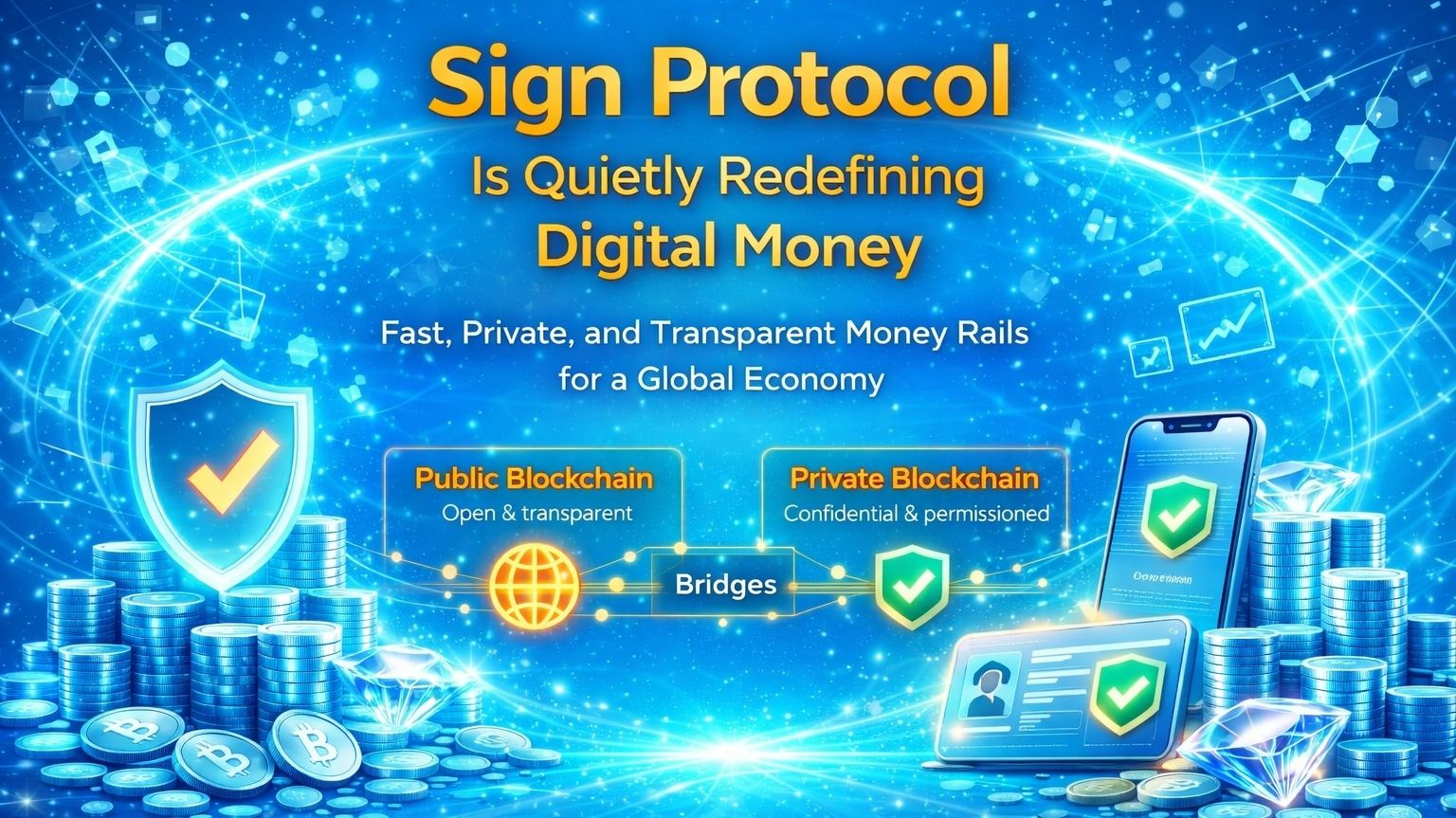
@SignOfficial I recently came across something that completely changed how I think about digital money.
Last week, I was talking to a friend, Ali — a small business owner in Karachi. He imports goods regularly, and like many others, he struggles with cross-border payments. Transfers take days, sometimes get blocked, and fees can be unpredictable. On top of that, he worries about privacy. He doesn’t want his financial activity exposed, yet banks keep demanding more documentation.
That conversation stuck with me.
Because this isn’t just Ali’s problem. It’s something millions of people deal with every day.
Another friend, Sara, who runs an online store, recently tried to pay an overseas supplier. What should have been simple turned into hours of delays, verification steps, and unnecessary friction. These aren’t isolated issues — they’re structural.
And that’s where things started to shift for me.
While exploring @SignOfficial and $SIGN, I realized it’s not trying to be just another crypto project. It’s tackling something deeper — how money systems actually function in the real world.
The idea is surprisingly practical.
Instead of forcing a single system to do everything, Sign introduces a dual-rail model:
A public blockchain for transparency, ideal for cross-border payments and corporate use
A private, permissioned system for sensitive transactions like CBDCs
On the private side, transactions remain confidential. But when needed, regulators can access them. It’s not about hiding data — it’s about controlling who sees what, and when.
That balance is what makes it interesting.
Now imagine this in practice:
Ali sends money abroad. The transaction starts within a private, secure system. Then it seamlessly moves into a public stablecoin layer for fast global settlement. The entire process happens quickly, without exposing unnecessary personal data.
No delays. No friction. No compromise.
Behind the scenes, this system is powered by a flexible architecture (built on enterprise-grade frameworks like Hyperledger Fabric), allowing fast execution, configurable privacy, and strong governance.
But what stood out to me wasn’t just the technology.
It was the usability.
For users like Ali and Sara, it simply means:
Faster payments
Lower friction
Better control over personal data
For regulators, it means:
Auditability
Compliance visibility
System-level trust
And that balance is rare.
What’s even more interesting is how the ecosystem is starting to grow. Platforms like Binance Square are already pushing awareness through CreatorPad campaigns, rewarding users for engaging and learning.
This isn’t just theory anymore. It’s slowly becoming real.
Looking ahead, systems like this could reshape how countries think about money itself — making it more efficient, more secure, and more aligned with real human needs.
Because at the end of the day, money shouldn’t feel complicated.
It should just work.
And if solutions like this continue to evolve, we might finally be moving toward a system where money works for people — not against them.