
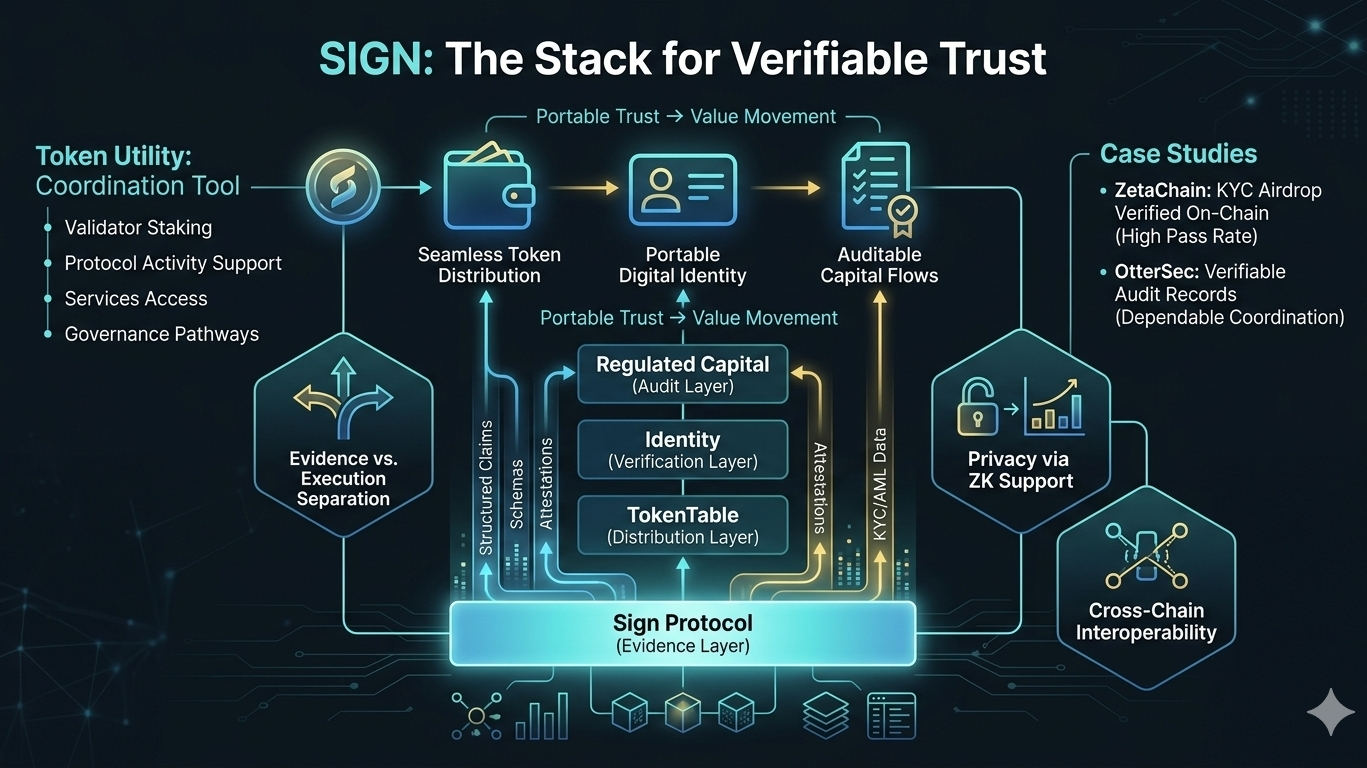
"Most crypto projects start with a loud bang, but SIGN is distinct in its approach, focusing on solving the quiet, yet challenging problem of portable trust. While looking into the project, I kept returning to the idea of a shared verification layer that can move seamlessly across apps, chains, and institutions without losing meaning. SIGN envisions verification as a stack for money, identity, and capital, with the Sign Protocol at its core, holding attestations together.
"To understand SIGN, it's crucial to look beyond a single product and see it as a system of roles. Sign Protocol structures claims, linking statements to an issuer, a subject, and a schema. TokenTable handles distribution – who gets what, when, and under what rules. The broader SIGN vision integrates these components into infrastructure that supports regulated money flows, identity checks, and auditable capital distribution.
"What struck me most was SIGN's architecture. It separates evidence from execution, reducing dependency on a single ledger and allowing for greater adaptability. Crucially, privacy isn't an afterthought, with support for selective disclosure, hybrid public-private attestations, and zero-knowledge proofs. This is vital in compliance-heavy settings where verifiable minimum disclosure is preferred over total transparency.
"The SIGN token itself is designed for utility, acting as a coordination tool tied to protocol activity, supported services, and governance, especially in validator contexts. This makes its role practical and integral to the system's function, rather than decorative. In the world of crypto, finding this balance where the token matters without undermining trust is a significant achievement.
"SIGN positions itself at the intersection of critical crypto narratives: infrastructure for machine-readable trust, AI infrastructure, decentralized coordination, privacy technology, and Web3 rails for identity and distribution. Real-world case studies, such as ZetaChain's KYC-gated airdrop and OtterSec's verifiable audit records, demonstrate the system's effectiveness in actual coordination.
"While challenges remain in areas like institutional adoption, validator incentives, and regulation, SIGN's success will likely be measured by steady, repeated use. The project's impressive 2024 figures – over 6 million attestations and distributing over $4 billion in tokens – hint at its potential to become boring, dependable, and hard-to-replace infrastructure.
"Ultimately, SIGN reminds us that crypto is not just about assets, but also about coordination. By making verification, distribution, and identity parts of a single trustworthy system, SIGN points towards a future where digital systems don't just move value faster, but also prove things cleaner and share responsibility safer, making trust travel farther."
Sign Protocol: Building the Trust Layer
[Image showing a visual representation of how Sign Protocol creates portable trust, linking assertions to issuers, subjects, and schemas within a broader system]
Sign Protocol Stack
Money
Identity
Capital
Sign Protocol (Evidence Layer)
Attestations
Sign Protocol Roles
* Claims: Structured statements linking an issuer, a subject, and a schema.
* Distribution: TokenTable manages who gets what, when, and under what rules.
* Broad Vision: Regulated money flows, identity checks, and auditable capital distribution.
Sign Protocol Architecture
* Evidence Layer: Separated from execution to reduce dependency on a single ledger and increase adaptability.
* Privacy: Support for selective disclosure, hybrid public-private attestations, and zero-knowledge proofs for verifiable minimum disclosure.
SIGN Token Utility
* Protocol Activity: Tied to network use.
* Supported Services: Powers ecosystem offerings.
* Governance: Play a role in validator-related decisions.
SIGN Impact
* Machine-Readable Trust: Essential for AI, decentralized systems, and privacy.
* Seamless Coordination: Real-world applications like KYC-gated airdrops and auditable records.
* Quietly Indispensable: Potential to become unseen, yet durable infrastructure like a dependable layer others rely on.
In conclusion, SIGN represents a significant shift towards verifiable trust in the crypto space. While facing expected adoption challenges, its focus on practical utility, privacy, and systemic approach positions it for long-term impact. By facilitating clean verification and shared responsibility, SIGN paves the way for a digital landscape where trust is seamless and portable.
Check out the latest crypto news and analysis on our website!