
 Sign Protocol caught my attention for a simple reason—I’ve seen too many systems fall apart the moment someone asks them to explain themselves.
Not fail. Not crash. Just… fail to explain.
That’s a different kind of problem, and it’s more common than people admit.
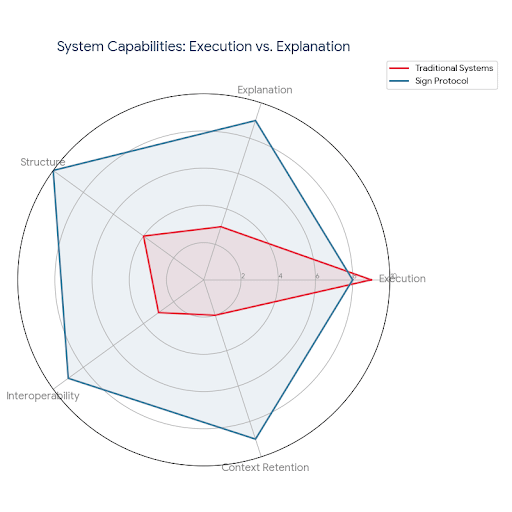
Most systems today are very good at execution. You tell them to move funds, they move funds. You define a rule, they apply it. Clean, fast, predictable. On the surface, everything works exactly as intended.
But I’ve been in enough post-incident reviews to know how quickly that confidence fades. You start asking basic questions—why did this transaction go through, who approved this state change, what conditions were actually checked—and suddenly the clarity disappears.
You get fragments. Logs that don’t line up. Context that was never recorded. Decisions that made sense at the time but can’t be reconstructed cleanly later.
It’s not a rare edge case. It’s the default.
The industry doesn’t talk about this much because it’s not a glamorous problem. It’s easier to focus on throughput, scalability, UX. Verification tends to get pushed to the side, treated as something you can patch in later.
In my experience, that never really works.
Once a system is live, retrofitting proper verification is painful. You’re dealing with assumptions baked into data models, missing context, inconsistent formats. You end up with layers of fixes that don’t quite solve the core issue.
Which is this: most systems record activity, but they don’t record meaning.
That’s where Sign Protocol is at least pointing in the right direction. It treats actions as something that should produce structured, verifiable evidence—not just events in a log.
That distinction matters more than it sounds.
A log can tell you that something happened. It’s timestamped, maybe signed, maybe immutable. But it rarely tells you whether the action was valid under the right conditions. It doesn’t carry enough context.
So you’re left interpreting after the fact. And interpretation is where things get messy.
I’ve seen this play out in token distributions more times than I’d like. The contract executes perfectly. Funds go out exactly as coded. Weeks later, someone questions the eligibility criteria. Now you’re digging through datasets, trying to justify decisions that weren’t clearly encoded as verifiable evidence in the first place.
Same with access control systems. Permissions are granted correctly according to the system’s logic—but the reasoning behind those permissions isn’t always transparent or portable. Move that data somewhere else, and it loses meaning.
Audits are another good example. A report exists, maybe even signed. But if you want to programmatically verify what was checked, what standards were applied, or how conclusions were reached, you usually can’t. It’s all locked in static output.
These aren’t failures of execution. They’re failures of structure.
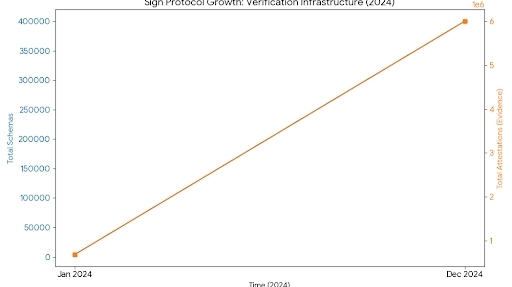
What Sign Protocol seems to be doing is forcing structure where it’s usually optional. Define schemas. Standardize how attestations are created. Make the data portable and queryable across systems.
It’s not exciting work. It’s the kind of thing most teams avoid until they feel the pain.
But without that structure, data doesn’t age well. It becomes harder to interpret over time. Teams change, systems evolve, and the original context disappears. What’s left is technically accurate but practically useless.
That’s something I’ve run into repeatedly—data that exists, but can’t be trusted because nobody can confidently explain it anymore.
The idea of attestations isn’t new. We’ve had signatures, certificates, proofs for a long time. What’s usually missing is consistency. Everyone defines things slightly differently, which makes interoperability difficult.
And once you lose interoperability, you’re back to siloed trust. Each system becomes its own source of truth, and integrating them turns into a negotiation.
That doesn’t scale.
What I find interesting about Sign Protocol isn’t that it introduces something entirely new. It’s that it tries to standardize something that’s been handled inconsistently for years.
Will that work? Hard to say.
Standards only matter if people adopt them, and adoption is always the hardest part. Most teams won’t invest in better verification until they’ve already been burned by not having it.
That’s just how this industry tends to move.
But the pressure is building. Systems are getting more interconnected. Regulatory expectations are increasing. Users are less willing to accept opaque processes, especially when real value is involved.
At some point, “it worked” stops being enough.
You need to be able to show why it worked—and prove that it should have.
That’s not a small shift. It changes how systems are designed from the ground up. You can’t bolt that on at the end.
I don’t see Sign Protocol as a complete solution. It’s more like a step toward acknowledging the problem properly. Treating verification as a first-class concern instead of an afterthought.
And honestly, that alone puts it ahead of a lot of projects I’ve seen.
Because if you’ve ever had to defend a system’s behavior without clean, structured evidence, you already know how fragile things can get.
Execution is easy.
Explanation is where systems are tested.
@SignOfficial #signdigitalsovereigninfra $SIGN
