
This morning I woke up with a thought that’s been quietly building in my mind for a while…
What exactly is @SignOfficial trying to build?
At first glance, I assumed it was just another attestation layer — something we’ve seen many times in crypto. Nothing groundbreaking. But the deeper I looked, the more it felt like the real story is happening somewhere else.
When we talk about digital identity, we usually imagine a single system — a database where everything is stored. But in reality, that’s not how the world works.
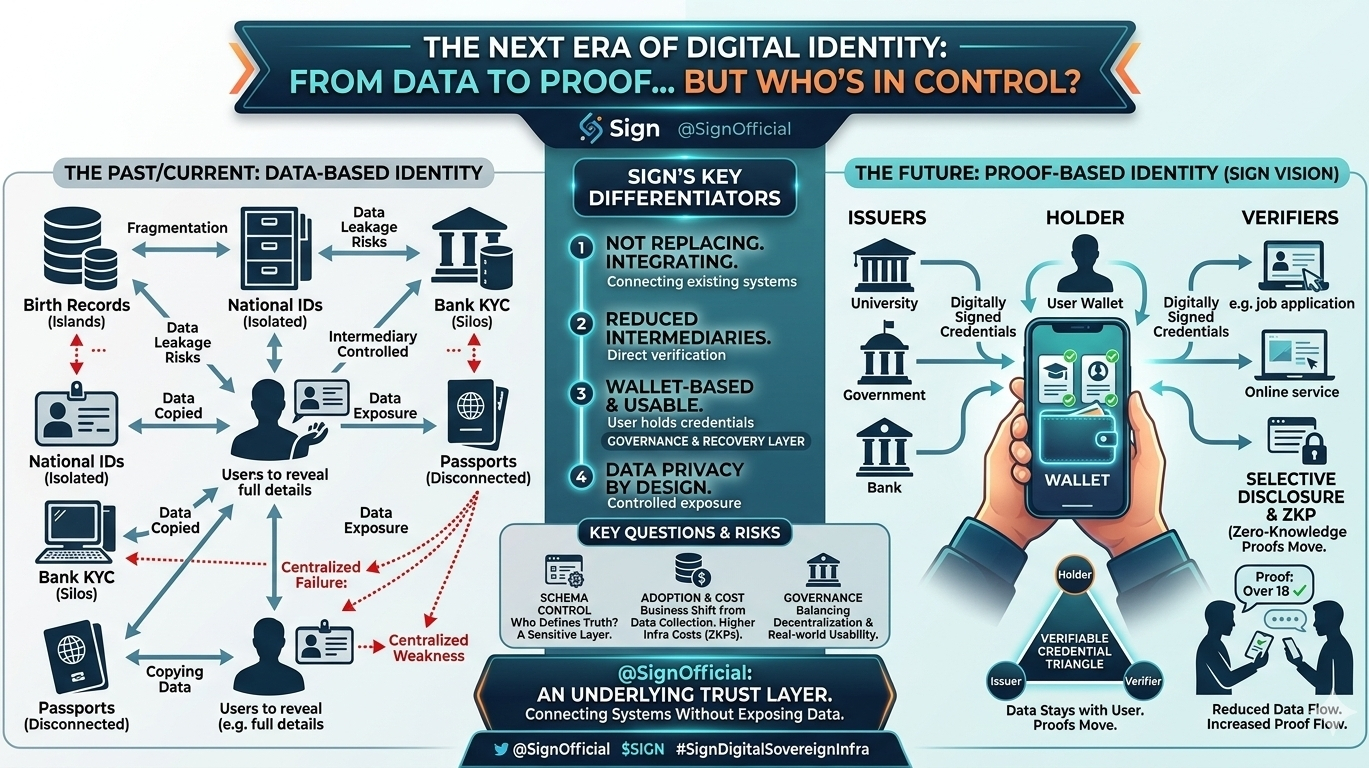
No country starts from zero. Systems already exist — birth records, national IDs, bank KYC, passports. The problem isn’t absence… it’s fragmentation. Each system operates like its own isolated island.
This is where Sign takes a different direction.
Instead of rebuilding everything, they’re trying to connect what already exists.
Not replace — integrate.
But that raises an important question:
This “connection layer” idea has been attempted before… so why hasn’t it worked?
They outline three models — centralized, federated، اور wallet-based.
And honestly… all three come with trade-offs.
The centralized model is simple — everything in one place. But that simplicity is also its biggest weakness. A single point of failure. One breach, and everything is exposed.
Sign shifts the perspective here:
Don’t store the data — give it back to the user as credentials.
Less database… more proof.
The federated model has a different issue. Systems can communicate, but there’s always an intermediary — a broker sitting in between. And that broker sees everything: logins, verifications, activity trails.
Sign proposes direct verification — reducing unnecessary intermediaries between issuer and verifier.
It sounds clean. But how clean it stays in practice… that’s still an open question.
Then comes the wallet-based model, which is personally the most interesting.
Here, the user holds their own credentials.
Conceptually, it’s powerful.
But practically? Fragile.
What if the phone is lost?
What if access is gone?
Sign introduces something critical here — a governance layer.
Not just technology, but policies and recovery structures.
This is subtle, but extremely important. Because pure decentralization often struggles with real-world usability.
Now the real core — the VC (Verifiable Credential) layer.
It’s a simple triangle: issuer, holder, verifier.
For example, a university issues your degree as a digital credential. You store it in your wallet. When needed, you present it for verification.
Simple… but powerful.
And then comes the most interesting concept — selective disclosure.
Before, proving something like your age meant exposing your entire ID.
Now?
You just prove one condition: you’re 18+.
Nothing more.
It sounds small, but it’s a major shift.
Because now you’re not sharing data — you’re proving a condition.
This is where ZKP (Zero-Knowledge Proofs) become real.
You prove something is true… without revealing the underlying data.
The system trusts the result — without ever touching the information.
That’s not just privacy.
That’s controlled exposure.
But here’s where tension appears again…
Who defines what counts as a valid proof?
Who decides the structure of truth?
This is where Sign’s schema system comes in — defining how data is structured and verified.
And honestly, this is a sensitive layer.
Because if schema control becomes centralized, then even if the proof system is decentralized… the power to define “truth” is not.
A subtle risk — but a real one.
Another thing that stood out to me:
Sign is trying to reduce data flow and increase proof flow.
Earlier: data moved everywhere.
Now: data stays… proofs move.
The idea is elegant.
But adoption is the real test.
Because businesses have always built value on collecting data.
If they no longer have the data… can they still operate effectively with just proofs?
That’s not a small shift.
There’s also the economic side.
Proof-based systems bring higher infrastructure and computation costs. ZKPs, especially, are still not cheap.
So while the architecture is strong… the cost dynamics are still evolving.
In the end, what I feel is this:
@SignOfficial is not just building a product.
It’s aiming to become an underlying trust layer — a fabric that connects systems without exposing data.
The vision is powerful.
The execution is complex.
And honestly, projects like this are hard to evaluate.
You can’t judge them by hype.
But you also can’t ignore them.
I’m not fully convinced yet…
But I can’t dismiss it either.
Because the problem is real.
And they’re clearly addressing it at the right layer.
The rest comes down to one thing:
Execution.
And that’s what makes this worth watching 🚀
$SIGN #SignDigitalSovereignInfra
