
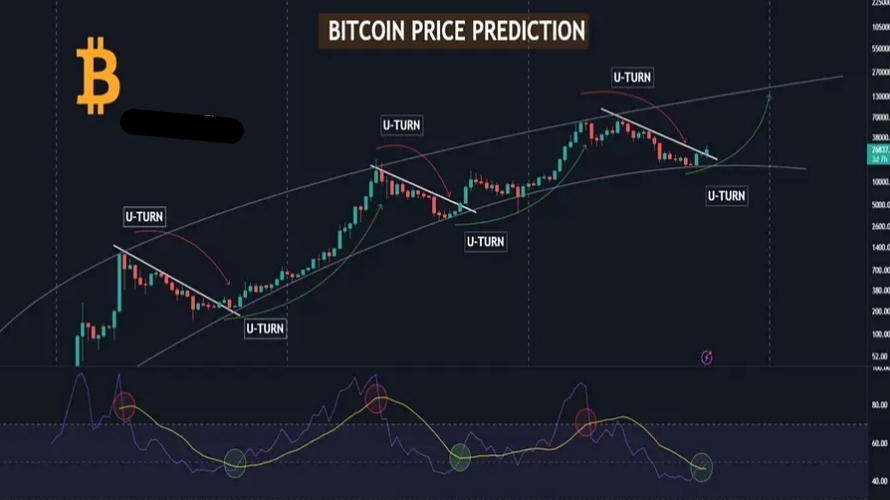
Bitcoin (#BTC ), the world’s leading cryptocurrency, continues to attract attention from traders, investors, and financial institutions alike. Its price movements are often unpredictable, yet they tend to follow certain patterns influenced by market psychology, macroeconomic factors, and technological developments. As the market evolves, many are asking the same question: what is the next direction for Bitcoin?
To understand Bitcoin’s potential next move, it is important to first look at its recent behavior. Typically, Bitcoin moves in cycles consisting of accumulation, uptrend, distribution, and downtrend phases. After a period of consolidation, where price moves sideways, Bitcoin often makes a strong move in either direction. If the current market is in a consolidation phase, a breakout—either bullish or bearish—may be approaching.
One major factor influencing Bitcoin’s direction is global economic conditions. When inflation rises or traditional markets show weakness, investors often turn to Bitcoin as a hedge or alternative asset. On the other hand, when interest rates increase or the economy stabilizes, some investors may shift back to traditional assets, causing Bitcoin to slow down or decline. Therefore, macroeconomic trends play a key role in determining whether Bitcoin will move upward or downward.
Another important factor is market sentiment. Crypto markets are heavily driven by emotions such as fear and greed. When the market is filled with optimism, more buyers enter, pushing prices higher. Conversely, during periods of fear or uncertainty, selling pressure increases, leading to price drops. Tools like the Fear and Greed Index often help traders gauge overall sentiment and predict possible reversals.
Technical analysis also provides clues about Bitcoin’s next move. Key support and resistance levels act as barriers where price often reacts. If Bitcoin manages to break above a strong resistance level with high volume, it usually signals a bullish continuation. On the other hand, if it fails to hold a critical support level, a bearish trend may follow. Indicators such as moving averages, RSI (Relative Strength Index), and volume trends can help traders identify these signals.
Additionally, institutional involvement has become a major driver of Bitcoin’s price. Large companies, investment funds, and even governments have started showing interest in Bitcoin. When institutions accumulate Bitcoin, it often leads to price stability and long-term growth. However, sudden sell-offs by large holders, also known as “whales,” can cause sharp price corrections.
Looking ahead, Bitcoin’s next move will likely depend on a combination of these factors. If buying pressure increases and key resistance levels are broken, #BTC could enter a new bullish phase. However, if macroeconomic conditions worsen or selling pressure rises, a short-term correction is also possible.
In conclusion, while no one can predict Bitcoin’s exact direction with certainty, understanding market structure, sentiment, and key indicators can provide valuable insights. For traders and investors, the best approach is to stay informed, manage risk wisely, and be prepared for both upward and downward movements in this highly dynamic market.
