
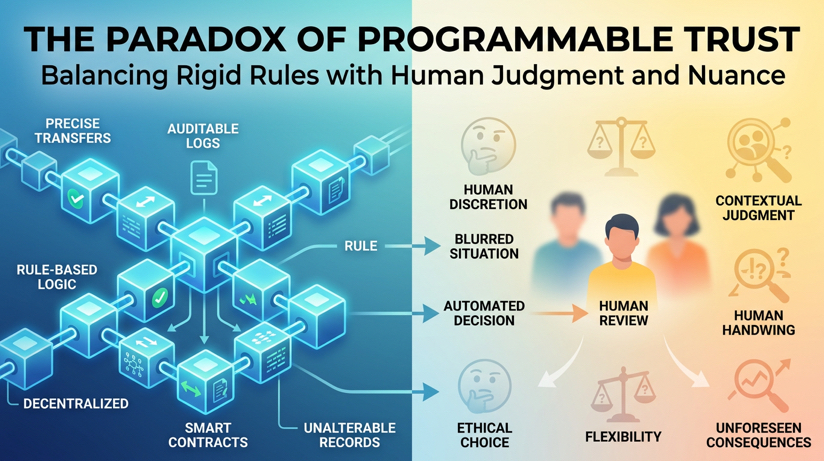
I used to think putting decisions into code would make systems better by default.It is tempting to assume that embedding every action in code automatically improves governance.
Sign Protocol does precisely this: each transfer carries a cryptographic attestation, recording who receives funds, under what rules, and for what reason. The logic is airtight. The audit trail is perfect yet, the very precision that makes the system appealing also exposes an overlooked tension.
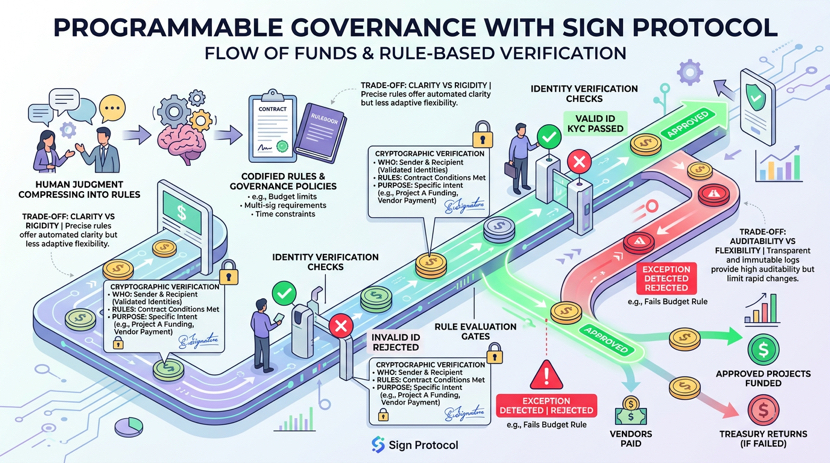
Human institutions rarely operate in absolutes. Discretion ambiguity, and situational judgment are often the glue that holds complex programs together. A subsidy might bend rules for a region in crisis a grant committee may adjust allocations based on subtle circumstances. These are not flaws they are features of governance in a messy unpredictable world. Sign compresses this nuance into schemas. The moment a rule is codified and enforced deterministically, flexibility is lost. Decisions become mechanical, and exceptions require explicit reprogramming rather than judgment.
Tying distributions to verified identities amplifies another subtle risk. While it reduces duplication and fraud, it also channels power through existing identity infrastructures. Any gaps, errors, or biases in those systems propagate directly into access to funds. Someone without complete records is treated as ineligible, not because of intent or circumstance, but because the system cannot interpret nuance. Accuracy becomes absolute, and error becomes systemic.
The dual-rail model private ledgers for confidential data and public chains for audit adds another layer of complexity.Observers can confirm that rules were followed, but the rationale behind them remains opaque. Transparency measures compliance, not deliberation. The system reveals what it enforces, not why it was deemed right in the first place.
Over time, the cumulative effect may be behavioral. Institutions adopting such a system might design programs around what is programmable, not what is ideal. Efficiency determinism and auditability grow but adaptability and contextual judgment shrink.Codifying accountability reshapes the very lens through which decisions are made.
This is the paradox of programmable capital it promises clarity and rigor while quietly narrowing the domain of what can be enacted. Sign Protocol does not simply track money it structures judgment. Its innovations are real and valuable, particularly for large scale, high-stakes programs.But the trade off is subtle a perfectly auditable system may be technically flawless while quietly brittle excluding those who fall outside pre-coded categories and constraining institutional judgment in ways few consider.
In the end, the clarity it bring is inseparable from the rigidity it imposes.
Sign Protocol illuminates the power of codifying trust but also the quiet, enduring limits of doing so.
#SignDigitalSovereignInfra $SIGN @SignOfficial #signprogrammable