I havee been building in Web3 for a while now, and if you have been in the space long enough, you know how it goes. At first, you are all hyped about solving the obvious problems gas.fees. scalability.throughput......
But let us be real: those are the easy ones to talk about.
The actual issue the thing that makes Web3 systems fall apart is the part people rarely discuss.
It is the coordination. The who gets what and how you prove it.
This is where it gets messy and where systems tend to break........
I have been there myself.
I have run grant programs.
It always starts with clear criteria and structured applications.
Everything looks great….....until the submissions pile
up, and soon,
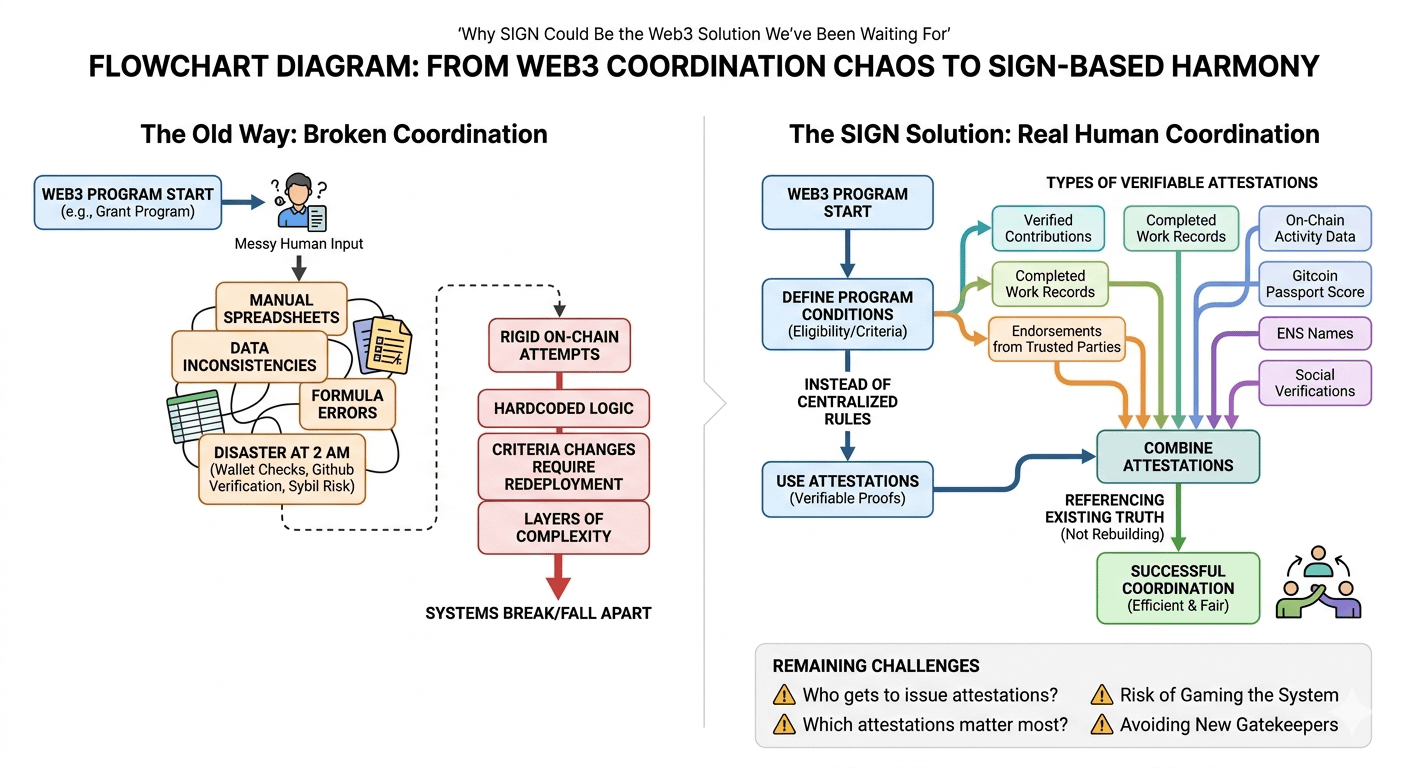
you are juggling data in spreadsheets, trying to make sense of who deserves funding. It is a disaster. The formulas break, the data gets inconsistent, and you are pulling your hair out at 2 AM, trying to check GitHub profiles and wallets, just to make sure you are being fair. Even then, you miss things like Sybil accounts or rewarding activity instead of raal contribution. Itis chaos.......
I even tried pushing everything onchain,
thinking that would solve the problem.
You know, hardcode the logic,
make it deterministic.
But guess what?
It doesnot work that way. The moment your criteria change (and they always do), you arre either redeploying everything or patching things up until the system is just as messy as it was before. If your data isnot fully onchain from the start, youare adding layers of complexity that make everything worse.
That’s when I found S:I:G:N
and honestly, it was a game changer.
At first,
I thought it was just another identity layer, but once I dug deeper, I realized it was much more than that. This isnot just about identity. This is about coordination. Real, messy, human coordination. Who qualifies?
Who gets paid?
Who has access?
And how do you prove it without everything falling apart?
Here’s the beauty of S:I:G:N:
It doesnnot force everything into one rigid system. Instead of trying to centralize everything,
S:I:G:N uses attestations and that’s what changes the game. Rather than saying,
“this contract decides everything,”
you define the conditions that must be true, and then attach verifiable proof for each condition. It is as simple as that. You are not rebuilding truth every time; you are referencing it........
Imagine you are running a grant program.
Instead of manually reviewing everything or relying on weak signals from wallets,
you define eligibility with combinations of attestations.
These could be anything:
verified contributions,
completed work
,
endorsements whatever signals you trust.
And the best part?
These signals dont have to come from your own system.
They can come from anywhere, as long as they are verifiable.
The system doesnot force a single identity on you either. You donot have to compress everything into one profile, controlled by one framework. Instead, its about stitching together what already exists your GitHub, your onchain activity
your contributions elsewhere into a cohesive whole.
You build on top of whats already there, rather than starting from scratch every time.
But hey,
Im not saying S:I:G:N is perfect. There are still big questions to answer. Who gets to issue attestations? Which ones really matter? What happens when people start gaming the system?
Thats the thing. If too much power gets concentrated in the hands of a few attesters, we are just creating new gatekeepers. And we all know how that ends........ But despite these risks, S:I:G:N still feels like a major step forward. It is not a silver bullet that fixes all of Web3’s trust issues, but it is definitely a solution that can handle real world complexity without falling apart every time the rules change.
After dealing with broken spreadsheets,
last minute fixes,
and rigid contracts for years,
honestly, this is a breath of fresh air.
S:I:G:N might not solve everything,
but it is a huge step in the right direction.
And in a world where coordination can be a nightmare, that alone feels like progress.