
I used to think governance was something systems could figure out later.
In the early phases, it always felt secondary, build the protocol, attract users, and let coordination emerge over time. The assumption was simple: if the technology worked, structure would follow.
But experience didn’t support that.
What I noticed instead was hesitation. Systems launched with strong narratives, yet participation remained shallow. Decisions stalled. Responsibility blurred. And over time, activity fragmented rather than deepened.
That’s when the doubt began.
Looking closer, the issue wasn’t a lack of innovation. It was a lack of operational clarity.
Many systems claimed decentralization, but control often concentrated quietly through admin keys or informal coordination. On the surface, they looked open. In practice, they depended on a few actors.
The ideas sounded important. But they didn’t translate into sustained usage.
At some point, my perspective shifted.
I stopped evaluating systems based on what they promised and started observing how they operated. Not governance frameworks on paper, but how authority was defined, exercised, and constrained over time.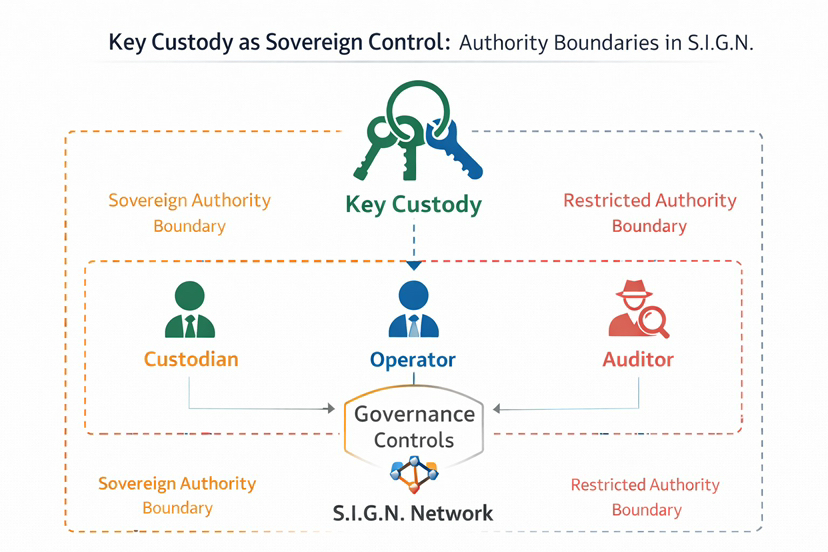
The question became quieter:
Does this system function without requiring constant coordination overhead?
When I came across @SignOfficial and its $SIGN governance model, it didn’t immediately feel different.
But upon reflection, what stood out wasn’t complexity, it was structure.
It raised a more grounded question:
What does it take for a system to be governable, not just deployable?
#SignDigitalSovereignInfra approaches governance as a layered system, policy, operational, and technical, each defining a boundary of control.
The policy layer defines authority and approval conditions. The operational layer enforces processes, compliance, and continuity. The technical layer executes those constraints through key custody, system controls, and enforcement mechanisms that cannot be bypassed.
Key custody, in this model, defines the boundary of sovereign control, determining who can act, and under what constraints those actions remain valid.
Governance becomes executable, not interpretive.
This structure mirrors systems that already operate at scale.
Financial networks, for example, separate regulation, operations, and execution. Trust emerges not from visibility, but from consistent enforcement across layers.
Sign follows a similar pattern, but introduces cryptographic verifiability and structured auditability.
Audit readiness is not periodic, it is continuous. Governance actions remain traceable and verifiable over time, allowing systems to operate without sacrificing accountability.
At the same time, the model is not rigid. It can be adapted across jurisdictions, aligning governance structures with local regulatory and institutional requirements.
What changes here is subtle but important.
Participation becomes structured rather than assumed.
This begins to matter more as systems move beyond experimentation.
In regions building digital infrastructure, systems are evaluated not on design, but on whether they can operate reliably under real constraints, compliance, scale, and accountability.
A system that cannot define control, enforce decisions, and maintain auditability cannot sustain trust in these environments.
What I’ve also noticed is how differently the market interprets this.
Attention tends to follow visibility, new features, announcements, surface activity. Governance rarely fits into that.
But governance determines whether systems persist.
There is a difference between attracting users and coordinating them over time. The latter requires discipline, clear roles, enforceable processes, and operational guarantees.
Even with a strong model, adoption is not guaranteed.
If governance is not embedded into workflows, it remains optional. If developers do not integrate role based controls, structure weakens. If interactions are not repeated, coordination does not stabilize.
There is also a threshold.
Governance only becomes meaningful when participation is sustained. Without repetition, even well designed systems remain theoretical.
What this made me reconsider is the relationship between systems and behavior.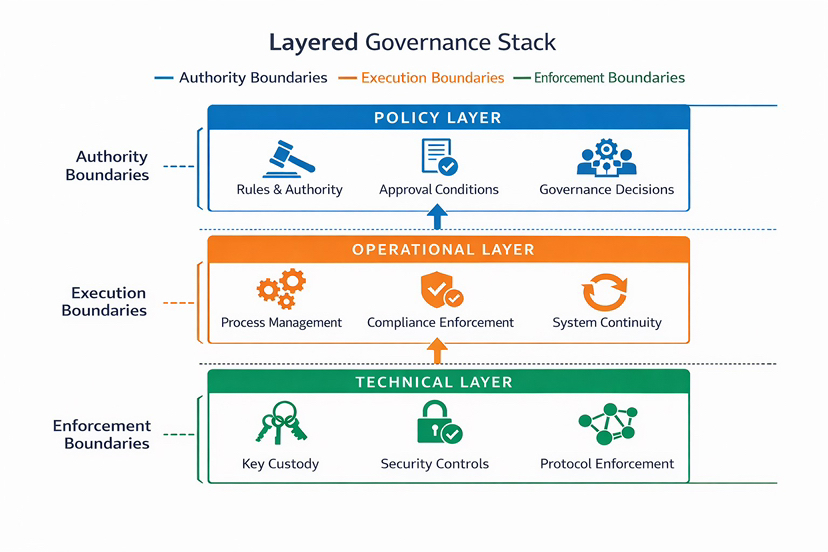
Governance is not control, it is constraint that enables coordination.
It reduces ambiguity. It creates predictability. It allows systems to function without constant renegotiation of trust.
At this point, I look for different signals.
Not governance frameworks, but governance execution.
Not stated roles, but enforced boundaries.
Not theoretical decentralization, but systems where authority is clearly defined, constrained, and auditable over time.
I no longer think systems fail because of weak technology.
More often, they fail because coordination is undefined.
Because governance is assumed rather than designed.
Because participation is possible, but not structured.
The systems that last are not the ones that promise openness, but the ones that define responsibility.
And the difference between a system that can be used and a system that can be relied upon is simple:
It behaves the same way, every time.