
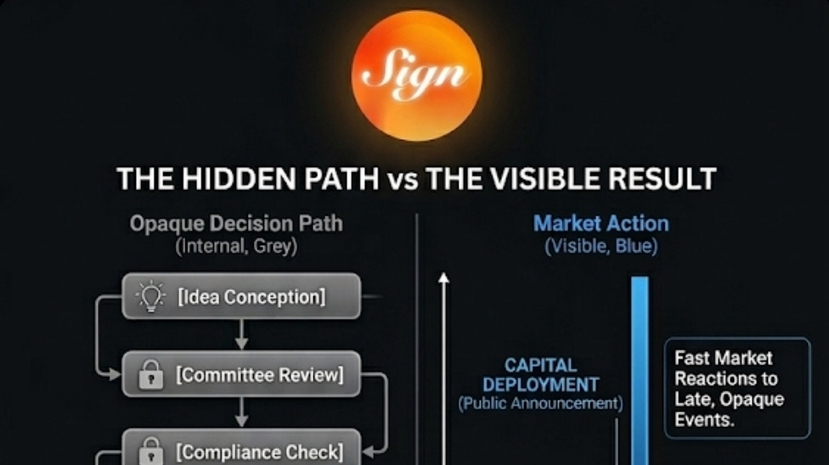
I keep coming back to SIGN whenever people talk about “global infrastructure for credential verification and token distribution” not because it proves the idea works, but because it exposes both the ambition and the cracks at the same time.
On the surface, SIGN represents what this space is trying to become: a layer where credentials aren’t just issued, but actually used. Where proof doesn’t sit idle in a PDF or a database, but flows into decisions who qualifies, who gets access, who receives distribution. It’s a shift from static verification to active consequence.
And that’s exactly why it forces a harder question: are we actually ready for this kind of system?
Because if I’m honest, my starting point isn’t optimism. It’s frustration with how unnecessarily broken the current system already is.
Today, proving something basic your degree, your identity, your work history still feels stuck in another era. You’re digging up PDFs, emailing institutions, waiting days or weeks for manual checks that may or may not even be thorough. A scanned document somehow still counts as legitimate proof, even though it’s one of the easiest things to fake.
It’s inefficient, inconsistent, and full of gaps. Not in a subtle way—in a structural way.
And that creates a strange dynamic: honest people deal with friction, while dishonest actors find ways around it. The system isn’t secure, and it’s not user-friendly either. It’s just familiar.
So when projects like SIGN propose a global infrastructure to fix this, I get the appeal. A shared, verifiable layer where credentials are portable, tamper-resistant, and instantly usable across contexts—that’s not a trivial upgrade. That’s a rethinking of how trust moves online.
But this is where the tension starts to show.
Because the promise is clean, almost too clean: instant verification, user-owned credentials, seamless distribution. No intermediaries. No delays.
The reality is anything but.
People forget passwords. They lose wallets. They misclick. They don’t back up keys. They don’t want to think about cryptography just to prove they graduated or completed a job. And when something breaks, there’s often no fallback. No recovery flow that feels human. Just a system that assumes you did everything right.
That gap—between ideal systems and real behavior—is where most of these solutions start to struggle.
SIGN, to its credit, sits in a slightly different position. It’s not just trying to answer “is this person real?” It operates downstream—where that answer gets turned into outcomes. Who gets included in a token distribution. Who qualifies for access. Who carries proof forward.
That’s a more honest layer to work on.
But it’s also a more dangerous one.
Because once credentials start driving consequences, the cost of error increases. It’s no longer just about verifying something—it’s about what happens if verification fails, or if someone is excluded due to technical friction, bad data, or simple user mistakes.
Now you’re not just building infrastructure. You’re shaping outcomes.
And that makes the complexity harder to ignore.
For something that’s supposed to reduce friction, most of these systems—including parts of SIGN’s ecosystem—still feel heavy. You’re not just presenting a credential; you’re managing wallets, signing transactions, navigating unfamiliar interfaces, sometimes even paying fees just to participate.
It assumes a level of technical comfort that most people simply don’t have—or don’t want to have.
There’s also the constant trade-off between usability and security. The more secure the system becomes, the less forgiving it is. The more you try to simplify it, the more you reintroduce trust or central points of failure.
There’s no perfect balance here, but too many projects act like it’s already solved.
Then there’s tokenization—the part that feels the most questionable.
SIGN leans into token distribution as a natural extension of credentialing, and in theory, it makes sense. If you can prove something, you can be rewarded for it. Clean, logical.
But real human behavior doesn’t always follow clean logic.
Not everything needs to be financialized.
There’s an assumption baked into a lot of these systems that incentives improve participation. Sometimes they do. But sometimes they distort it. When credentials become tied to tokens, people start optimizing for rewards instead of meaning.
It shifts the question from “Is this valuable?” to “Is this profitable?”
And most users aren’t asking for that shift.
They want recognition. They want proof that holds weight. They want systems that work. Turning every action into a potential financial event adds complexity, volatility, and another layer of decision making that many people simply don’t want.
Tokens don’t just reward they complicate.
They introduce regulatory uncertainty, pricing dynamics, and risk exposure into systems that were supposed to make life simpler.
If the goal is seamless verification, adding financial layers feels like solving one problem while quietly creating three more.
And then there’s the idea of “global.”
A global infrastructure assumes shared standards, interoperability, and some level of alignment across regions. But right now, we’re far from that. Projects even strong ones like SIGN are building within their own frameworks, their own assumptions, their own ecosystems.
There’s no universal agreement on credential formats, revocation systems, or verification methods.
Regulations differ. Definitions of identity differ. Trust itself differs depending on where you are.
So instead of one unified layer, we risk building multiple parallel systems that don’t fully connect—recreating fragmentation under a more advanced label.
And accessibility remains an open problem.
These systems assume stable internet, modern devices, and a baseline level of digital literacy. That’s not universal. If participation requires navigating wallets, signatures, and token mechanics, you’re automatically filtering out a large portion of the world.
Infrastructure that claims to be global can’t quietly exclude.
Despite all of this, I don’t think the idea is flawed.
Owning your credentials matters. Being able to prove something about yourself without relying entirely on slow, centralized institutions that’s meaningful. SIGN, in particular, is interesting because it recognizes that verification alone isn’t enough. It tries to connect proof to outcomes, which is where real world systems actually operate.
That’s a step forward.
But right now, it still feels like we’re overbuilding.
Too many layers. Too many assumptions. Too much focus on what’s possible, and not enough on what’s usable. Systems are being designed as if people will adapt to them, instead of the other way around.
And they won’t.
People choose simplicity. They choose what feels intuitive. The best infrastructure disappears into the background you don’t notice it, you just rely on it.
Most of these systems don’t disappear. They demand attention. They expose their complexity. They make the user carry the weight of the system.
That’s not progress. That’s friction in a new form.
The promise is still compelling: instant, portable, user-owned credentials that remove friction.
But the execution including in projects like SIGN still feels like a work in progress that leans too heavily on technical elegance and not enough on human reality.
Until that balance shifts—until these systems feel invisible, forgiving, and genuinely simple—they won’t replace what exists today.
They’ll just sit next to it, offering an alternative that makes sense in theory, but struggles in practice.
But still I m watching sign..
#SignDigitalSovereignInfra @SignOfficial $SIGN
