
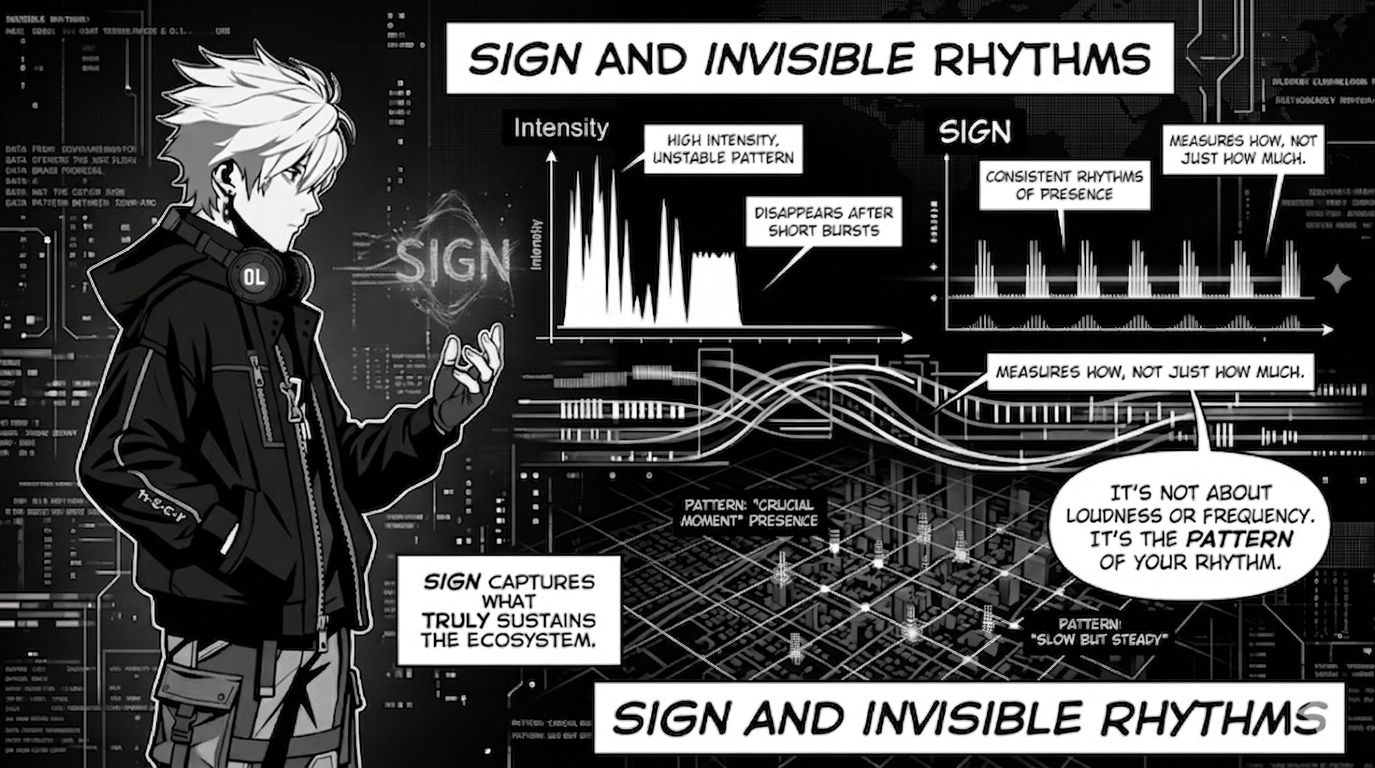
There’s something often overlooked when we look at activity in digital spaces: we tend to focus on how often or how much someone shows up, but rarely on how they show up over time. In reality, everyone has their own rhythm. Some appear intensely and then disappear, some move slowly but consistently, while others show up at specific moments that turn out to be crucial.
The problem is, most systems don’t read this rhythm. Everything gets reduced to numbers, how many times someone appears, how many interactions they make. In the end, what we see is intensity, not pattern. And often, that creates an incomplete picture.
This is where SIGN starts to take a different approach. It doesn’t just look at “how much,” but also at “how.” Patterns of presence begin to be recognized as meaningful in their own right. Small, repeated consistency, regular pauses, even well-timed appearances, all of these start to form a deeper layer of identity.
What’s interesting is how this shifts the way we interpret activity. Someone who doesn’t show up frequently might still have a more stable impact than someone who appears active all the time. SIGN helps capture that stability, without forcing people to change how they naturally interact.
This approach also feels more human. Because at the core, people aren’t consistent in a uniform way, we move in rhythms. There are active phases and quiet phases. SIGN doesn’t force everyone into the same pattern; instead, it reads the patterns that already exist.
At the same time, this makes systems more fair in how they understand contribution. They are no longer biased toward those who appear the busiest, but begin to recognize who actually sustains the flow of the ecosystem.
What emerges is a shift in how presence is understood, not as how loudly it is expressed, but how well its rhythm aligns with the surrounding ecosystem. @SignOfficial #SignDigitalSovereignInfra $SIGN
