

i've data structures sem last year. professor gave us a problem on merkle trees. i understood the concept binary hash tree and root is a fingerprint of all the data below it. fine. then he asked: how do you prove that one specific leaf belongs to this tree with out revealing the whole tree? i sat with that for a while. the answer is a merkle proof you just share the sibling hashes along the path from your leaf to the root. the verifier recomputes and checks. no need to see everything else.
i actually got that one right. which made it weirder when i couldn't immediately see how it applied to token distribution. then i read tokentable's merkle distributor docs and it clicked.
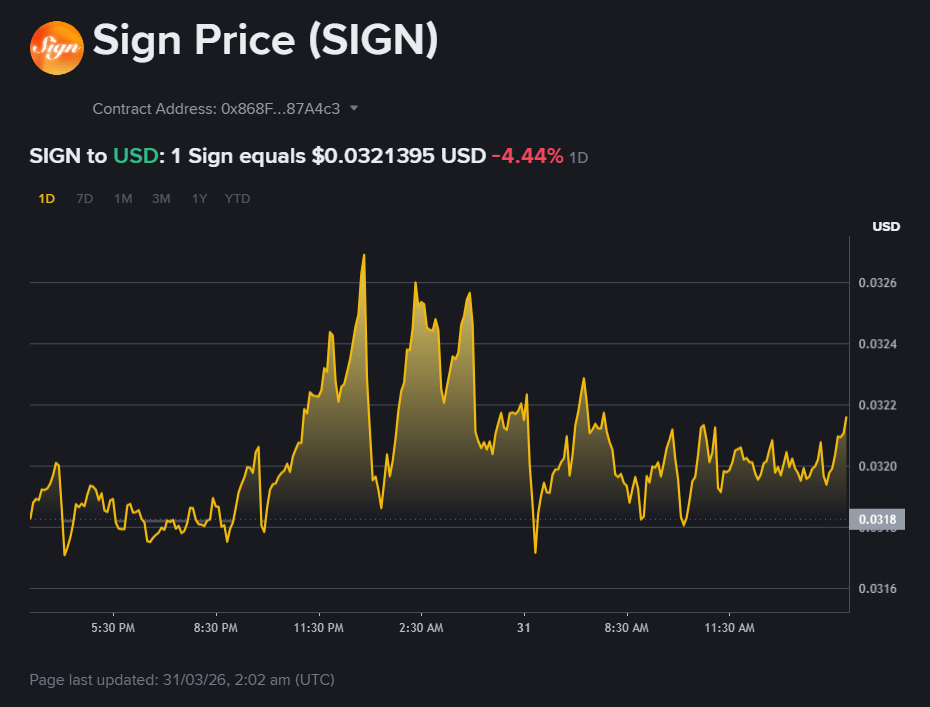
$SIGN is at $0.032 today. market cap $52.4M. 1.64B circulating out of 10B max supply. March 31, 2026. sign page link
so here's what tokentable's merkle distributor is actually doing. instead of storing every recipient's allocation on-chain which would cost enormous gas at 40 million addresses the project stores only one thing on chain: the merkle root. that single hash commits to the entire allocation list without putting the list on chain. when you come to claim and you submit your allocation amount plus the merkle proof for your address. the contract recomputes the root from your proof and checks it matches. if it does, you get your tokens. if not and you get nothing. no one can fake a proof for an amount they weren't allocated. the gas cost doesn't scale with the number of recipients it stays flat per claim.
starknet used this. zetachain used it. notcoin's distribution went through tokentable. the $4B distributed figure isn't one big deployment. it's the same infrastructure running across 200+ different projects each using their own merkle root. i found that more interesting than the headline number.
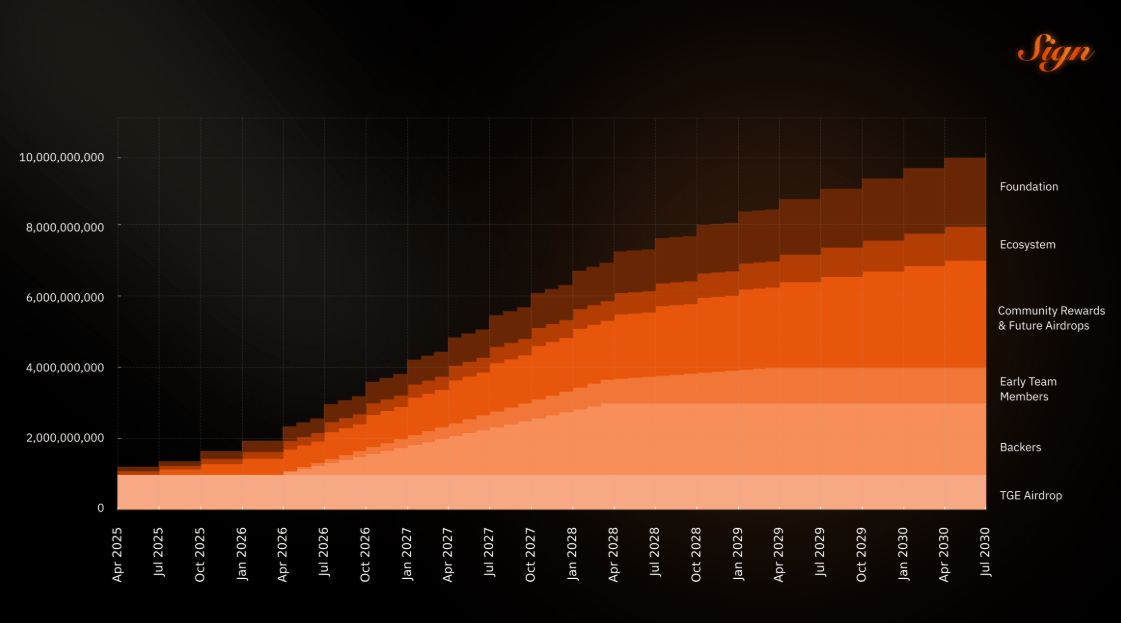
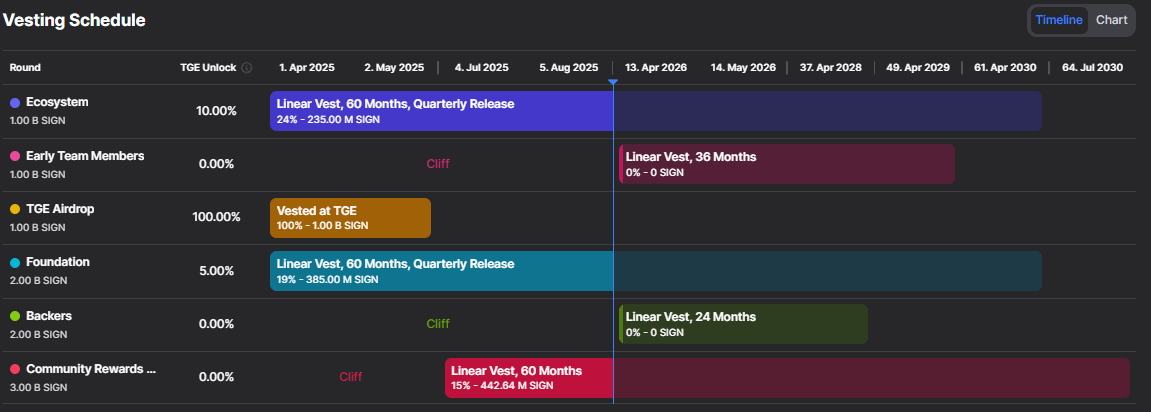
now the part i actually want to understand tokenomics.10 billion total supply. 1.64 billion circulating right now and so 16.4% is out. the other 8.36 billion is still locked. community incentives make up roughly 40% of total supply that 4 billion tokens sitting in the largest bucket. team and investors have their own vesting schedules running from TGE in april 2025. the next unlock i'm tracking is may 15, 2026. from the unlock schedule images i've been watching. 8.07 billion tokens remain locked as of late march. that a significant number.
and here is what I can not fully work out yet: SIGN's actual utility loop. tokentable usage does not require holding SIGN. projects pay fees in their token type in some cases. the attestation piece yes and they pay in $SIGN, but they are still early on this piece. so my question and which has been sitting in my head is: what is driving SIGN demand structurally before the big unlock waves? the product metrics are real: $15M in revenue $4B in distributed 40M wallets served. but revenue to the protocol does not necessarily equate to token demand without a clear fee to token system, which I have not found a clear answer on anywhere.
the risk that i’m concerned with the most is not the size of the unlock. it timing. May 15th unlocks before any big government announcement. if attestation adoption continues to be early stage through Q2 2026 and then the supply will not have natural demand to match. Other token distribution platforms not standing still I don’t see tokentable giving up its position and at least not currently.
three things i'm keeping an eye on via signscan: the number of new projects deploying monthly through the tokentable. the volume of attestation fees via actual sign protocol usage. and which deployment and the uae or thailand one and moves to live infrastructure. the latter impacts the thesis far more than any price movement.
what your read the whether in SIGN token and demand model tight enough before may ? comments it.😊
#SignProtocol #Token #blockchain #SignDigitalSovereignInfra $SIGN @SignOfficial