
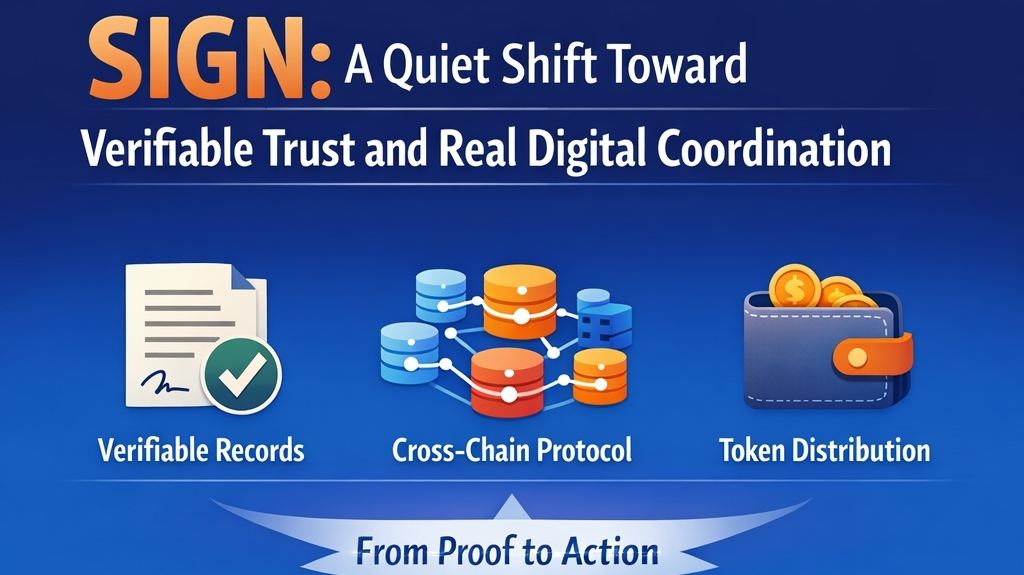
I keep thinking about how easily we trust things online without really knowing why. A form gets approved, a wallet receives tokens, an account is verified, and we move forward without asking what actually happened behind the scenes. It all feels smooth until something breaks, and when it does, there’s this quiet confusion that settles in. We start wondering who checked what, what rules were followed, and whether anything was truly verified at all. That feeling, that small moment of doubt, is where something like SIGN begins to matter, not as a loud solution, but as a different way of thinking about trust itself.
What draws me into SIGN is that it doesn’t try to turn trust into something magical or abstract. It treats it as something that should exist in a visible and structured form. Instead of relying on assumptions or reputation, it leans toward creating records that can be checked, understood, and reused. I’m not just talking about storing data, but about storing meaning in a way that doesn’t fade or depend on memory. It feels like the project is quietly asking why we keep rebuilding trust from scratch every time we interact with a system, and whether that cycle can be broken in a more thoughtful way.
In its early form, SIGN wasn’t trying to be a complete ecosystem. It started with a smaller idea around attestations, which are essentially verifiable claims. One party says something about another, and instead of that statement living in a closed system or being accepted blindly, it becomes something structured and signed. At first glance, it feels simple, almost too simple, but when you sit with it, the idea starts to expand. If a claim can be verified, then it can be trusted more easily. If it can be trusted, then it can be reused. And if it can be reused, then systems don’t have to start over every time. That’s where things begin to shift, slowly and naturally, without forcing it.
The way SIGN handles this is by separating how information is defined from how it is recorded. Before anything can be proven, it needs a shared structure, something that ensures everyone understands it in the same way. That’s where schemas come in, acting like a quiet agreement about what a piece of information actually means. Then come the attestations, which follow those rules and turn them into real, verifiable records. These aren’t just entries in a database, they are signed statements that can be checked later without needing to trust the person who created them. There’s something grounding about that, because it replaces uncertainty with something you can actually verify.
What makes the system feel more real is its flexibility. Not everything is forced into a single model. Some data lives fully on-chain, where it is transparent and permanent but more expensive. Some lives off-chain in decentralized storage, which is more practical but still reliable. And sometimes it’s a mix of both, where the proof exists on-chain while the details are stored elsewhere. This balance feels intentional, because real-world systems are never one-dimensional. They require trade-offs, and SIGN seems to accept that rather than ignore it.
At some point, it becomes clear that proving something is only part of the journey. The other part is what happens after the proof exists. If someone is eligible for something, whether it’s a reward, access, or a financial distribution, then the system should be able to act on that proof without unnecessary steps. SIGN connects these ideas in a way that feels natural, allowing verified information to directly influence outcomes. It reduces the gap between knowing and doing, which is something most systems struggle with. We’re used to verification happening in one place and action happening somewhere else, often with friction in between. Here, it feels more connected, as if the system understands the full flow rather than just one part of it.
As the system grows, it also becomes more layered, not in a confusing way, but in a way that reflects how complex trust actually is. Some information needs to be public, while other information needs to stay private. Some interactions happen within a single environment, while others cross multiple systems. SIGN doesn’t try to force everything into a single path. It allows different approaches to exist within the same framework, which makes it feel adaptable rather than rigid. There are even more advanced ideas like zero-knowledge proofs, where something can be verified without revealing everything, and programmable logic that allows rules to be embedded directly into how claims are created or used. These aren’t just technical features, they are responses to real-world needs.
When I think about whether something like SIGN is actually working, I don’t find myself looking at surface-level signals. What feels more important is whether it’s being used in ways that matter. Are people creating structures that others adopt? Are claims being reused instead of recreated? Are systems becoming smoother and less repetitive? These are quieter signs, but they say more about the system’s health than anything else. They show whether it’s becoming part of real workflows, not just existing as an idea.
At the same time, it’s impossible to ignore the risks. Any system that tries to structure trust has to be careful about how that structure is used. If something is defined poorly, it can lead to misunderstandings. If privacy isn’t handled properly, sensitive information could be exposed. And if parts of the system become too dependent on centralized components, it could weaken the very trust it’s trying to build. There’s also the human side, which is always unpredictable. People might misuse the system, misunderstand it, or treat it casually, and that can affect the quality of everything built on top of it.
Still, when I step back and look at the bigger picture, SIGN doesn’t feel like it’s trying to create a completely new reality. It feels like it’s trying to improve something that already exists but doesn’t work as well as it should. It points toward a future where proof becomes something you can carry with you, where systems don’t keep asking the same questions again and again, and where trust doesn’t have to be rebuilt every single time. It’s not a dramatic vision, but it’s a meaningful one.
There’s something calm about the way SIGN approaches all of this. It doesn’t rely on noise or exaggeration. It focuses on structure, on clarity, on making things a little more reliable than they were before. And maybe that’s what makes it stand out in a space that often moves too quickly. If it continues to grow in a thoughtful and steady way, it could become one of those systems that quietly supports everything else in the background. Not something people talk about every day, but something they depend on without even realizing it. And in a world where trust often feels uncertain, that kind of quiet reliability might matter more than anything else.
#SignDigitalSovereignInfra @SignOfficial $SIGN
