
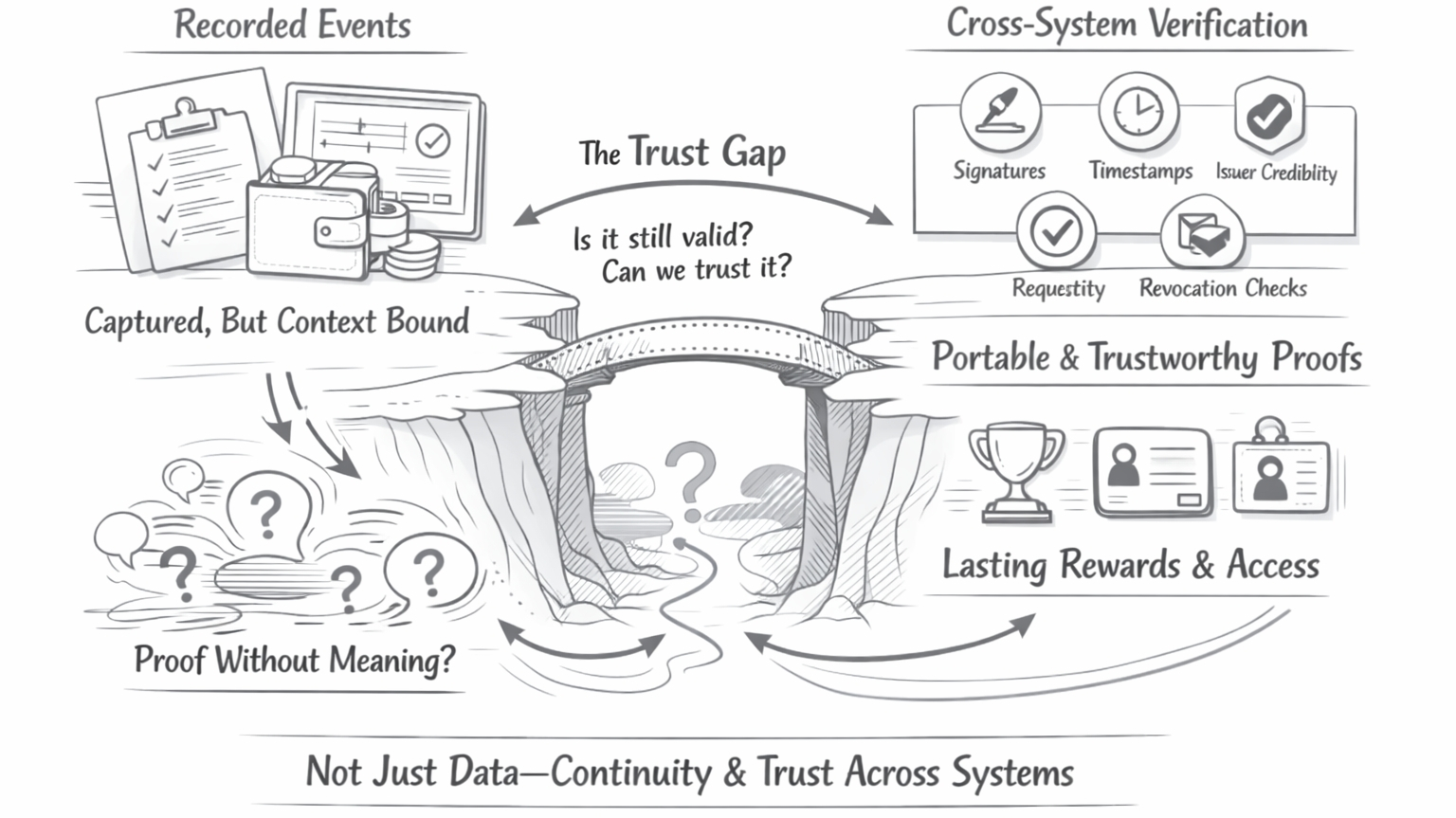

If you think about it, everything is being recorded. Activity, accounts, transactions, timestamps, ownership history, participation, membership states—it’s all there. So memory itself isn’t really the issue. The real question is whether any of that information can later act as proof somewhere else, in a completely different context, for a different purpose, and for another system trying to interpret it.
And that gap… is bigger than it first appears.
When something happens in the moment, it feels clear and solid. Someone completed an action. A wallet held something. A user participated early, contributed, verified, or qualified. At that time, the meaning is obvious because the system that recorded it understands it.
But things start to get complicated later—when that same record has to be used somewhere else. At that point, it’s no longer enough for the record to simply exist. It has to hold its meaning outside the environment where it was created.
You can usually spot systems that are good at recording events but not at preserving meaning. Everything looks fine until that proof needs to travel. Then the questions begin: Who issued this? What does it actually prove? Is it still valid? Has anything changed? Can it be revoked? And most importantly—can another system trust it without having to rebuild the entire story from scratch?
That’s where it gets interesting.
A lot of digital infrastructure is great at capturing moments, but not as strong at carrying those moments forward. Someone contributes, but over time the recognition fades or becomes unclear. A credential gets issued, but outside its original system it feels like just another file. A participation record exists, but no one is quite sure how much weight it should carry elsewhere.
So the issue isn’t that the record is missing—the issue is that trust around the record doesn’t travel with it.
That’s why credential verification matters more deeply than people usually assume. It’s not just about detecting something fake. It’s about making sure a past fact can still do something useful in the present. And that’s harder than it sounds, because over time, every proof starts attracting questions—about who issued it, whether they’re credible, whether it’s still valid, and how it should be interpreted.
Token distribution runs into a similar challenge, just in a slightly different way. People often describe distribution as movement—like the main job is simply transferring tokens from one place to another. But in reality, distribution also depends on memory.
A system needs to remember why someone deserves something. It has to remember what condition was met. It has to link that transfer back to an earlier fact—and preserve that logic clearly enough so others can understand it later.
Otherwise, the token might arrive, but the reason behind it feels weak or unclear.
That’s the part many people overlook. Without memory, distribution starts to feel arbitrary. And without durable context, verification becomes repetitive. That’s why the two are connected—they’re both trying to solve the same underlying problem:
How do you take something that happened at one point in time and make it clear, trustworthy, and portable enough that it can still trigger a valid outcome later?
At some point, it becomes clear this isn’t just about storing data—it’s about continuity.
Not abstract continuity, but practical continuity. The kind that allows a claim to survive across systems. The kind that lets a record still carry meaning after it leaves its original environment. The kind that ensures a reward, access right, or recognition can still be traced back to a proof—without needing to reinterpret everything from scratch.
And that continuity depends on subtle, often overlooked things. Attestations. Signatures. Timestamps. Issuer credibility. Revocation mechanisms. Shared formats. Just enough standardization so that two different systems can look at the same record and reach the same understanding.
It may not sound dramatic—but this is exactly where digital trust either holds together or falls apart.
There’s also a human side to this.
People don’t really care if a system has strong memory in a technical sense. What they care about is whether they have to repeat themselves. Whether something they already proved still counts. Whether their past contribution still matters. Whether a qualification still works elsewhere. Whether an earlier action still unlocks what it was meant to unlock.
Bad infrastructure forces repetition. Good infrastructure removes the need for it.
So the question slowly shifts.
At first, it sounds like: can we verify a credential, or can we distribute a token? But over time, it becomes something deeper: Can digital facts remain useful across time, across systems, and across different standards of trust?
Can a proof stay alive long enough to matter? Can a record continue to carry consequences instead of becoming just an archived entry?
That second question feels much closer to the truth.
Because most systems don’t fail due to a lack of data. They fail because data loses its shape as it moves. It becomes disconnected from the conditions that once made it meaningful.
So when I look at SIGN from this perspective, I don’t see something loud or flashy. I see an attempt to make digital memory more actionable. To help records retain their weight a little longer. To allow proof to stay useful long enough for something real to happen because of it.
And infrastructure like that often becomes important long before it becomes visible.
@SignOfficial #SignDigitalSovereignInfra $SIGN
