
"Introduction"
In the digital era, data is the new gold. But a major question always remains: “Can we trust the data we see online?” Whether it’s someone’s identity, supply chain receipts, or financial records, verifying data has always been difficult.
Today, we will compare the old method and the new decentralized approach, and see how Sign Protocol $SIGN is transforming this entire system.
"The Old Way: Centralized Verification"
Until now, to verify data, we have depended entirely on intermediaries (middlemen) or centralized authorities.
How does the Centralized system work?
Imagine you need to verify your identity. You give your data to a bank, government agency, or a large tech company (like Google or Facebook). They store this data on their private servers and, when needed, confirm who you are.
Problems with this Method:
1. Siloed Data: Every institution has its own separate database. Data does not “talk” to each other.
2. Trust Issue: You have to blindly trust that institution not to misuse your data.
3. Security Risk: Centralized databases are favorite targets for hackers. If one server is hacked, the data of millions of people can be stolen (Single Point of Failure).
"The New Way: Sign Protocol ($SIGN) - Decentralized Attestation"
Sign Protocol presents a completely new concept. Instead of trusting a single institution, it utilizes blockchain technology. Sign Protocol is an Omni-chain Attestation Protocol.
How does the Decentralized system work?
Data on the blockchain is open, but through “Attestations,” we can verify the truthfulness of the data without disclosing the actual data itself. When data is ‘signed’ (attested) on the blockchain, it becomes immutable (unchangeable). Anyone can verify who signed this data and when.
Key Technology: Zero-Knowledge Proofs (ZKP)
Sign Protocol’s greatest strength is the use of Zero-Knowledge Proofs (ZKP). ZKP is a mathematical technology that completely protects privacy.
Example: You need to prove that you are over 18 years old, but you do not want to show your date of birth (DOB). Through ZKP, Sign Protocol can prove that “Yes, this person is 18+” without revealing your actual DOB.
"Comparison: At a Glance"
Instead of a table, here is a direct comparison of features:
* Trust Model: Traditional Verification relies on Centralized Authority (Bank, Government). Sign Protocol relies on a Decentralized Blockchain Network.
* Data Control: In Traditional Verification, the Authority controls your data. In Sign Protocol, the User owns and controls the data.
* Interoperability: Low for Traditional Verification (Data is stuck in one database). High for Sign Protocol (Omni-chain, works across blockchains).
* Privacy: In Traditional Verification, middlemen see all your data. Sign Protocol is Privacy-preserving (via ZKP).
* Security: Traditional Verification has a Central point of failure. Sign Protocol is distributed and secure.
"Why It Matters"
$SIGN is not just a token; it is the foundation of a new digital infrastructure. Digital Sovereignty means we have a right to our data. Sign Protocol promotes this very Digital Sovereignty. When data is verified and secure, scams decrease, and trust increases.
In the coming time, we will use Sign Protocol to verify real-world identification (credentials), academic degrees, healthcare records, and financial transactions.
"Conclusion”
The centralized system has become outdated. Sign Protocol ($SIGN) has shown us how essential blockchain is, not just for financial transactions, but for data and trust as well. The coming future is transparent and secure!
#SignDigitalSovereignInfra $SIGN @SignOfficial 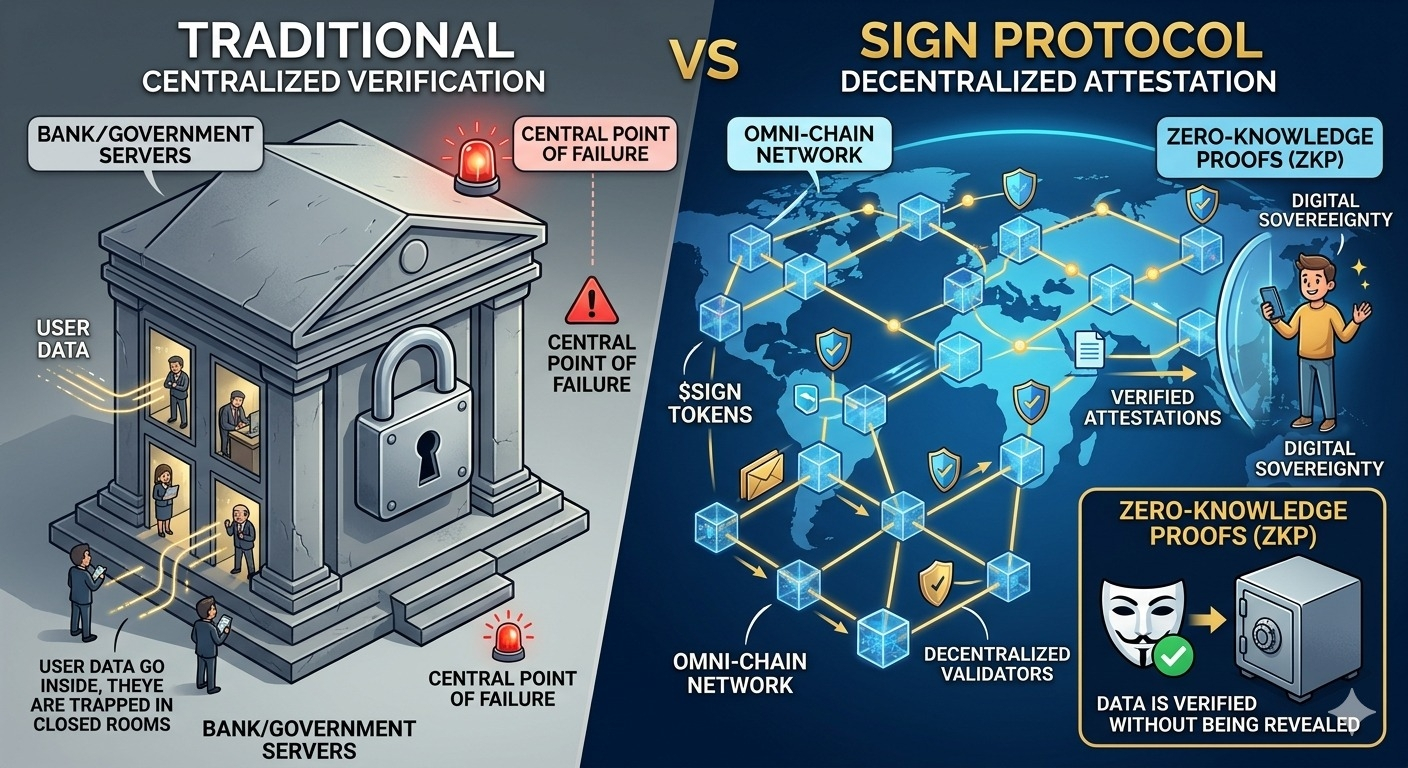
Disclaimer: DyOR. This is information, not financial advice.
