
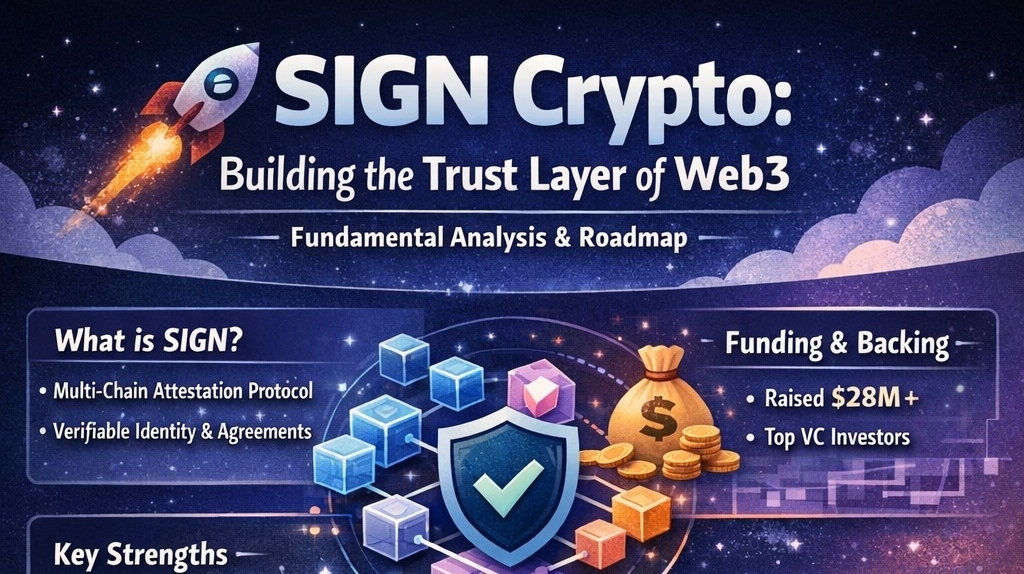
$SIGN (SIGN) is positioning itself as a foundational layer in the evolving Web3 infrastructure narrative of 2026, where the market is increasingly rewarding projects with real-world utility rather than speculation. At its core, Sign operates as an omni-chain attestation protocol, enabling users, institutions, and governments to verify data, identity, and transactions across multiple blockchains. ([Medium][1]) This places it in a critical niche—digital trust infrastructure—which is becoming essential as blockchain adoption expands into finance, governance, and identity systems.
From a fundamental perspective, Sign’s strongest value driver is its real-world use case. Unlike many tokens that rely purely on DeFi or speculative narratives, Sign is building infrastructure for verifiable credentials, token distribution, and identity systems. Its TokenTable and Sign Protocol products allow large-scale, transparent token allocations and on-chain attestations, already serving millions of users globally. ([CoinMarketCap][2]) This gives the project a tangible utility layer, which is increasingly important in a maturing crypto market.
Recent developments suggest strong momentum. In early 2026, the project gained significant attention after a major price surge linked to protocol upgrades and growing interest in its “sovereign infrastructure” narrative. ([CoinMarketCap][3]) This concept—positioning Sign as a digital backbone for national-level systems such as identity verification and potentially CBDCs—marks a shift from Web3 experimentation to institutional integration. Partnerships or pilot programs with governments like Kyrgyzstan and Sierra Leone reinforce this thesis, signaling early-stage but meaningful adoption beyond the crypto-native ecosystem. ([CoinMarketCap][3])
Financially and structurally, the project has strong backing. With over $55 million raised across funding rounds and support from major industry players like YZi Labs, Sign demonstrates both investor confidence and the ability to scale its development efforts. ([Ventureburn][4]) Additionally, its revenue growth—from $1.7 million in 2023 to $15 million in 2024—indicates early product-market fit, a rare metric in the crypto space. ([Bitget Wallet][5])
In terms of development, Sign appears highly active and technically ambitious. The protocol is designed to operate across multiple chains—including Ethereum, BNB Chain, Solana, and others—making interoperability a core strength. ([Medium][1]) Its open-source approach and developer tools (SDKs, APIs) further suggest a long-term strategy of ecosystem expansion rather than closed-system growth. This aligns with broader 2026 trends where scalable, cross-chain infrastructure is becoming the backbone of blockchain adoption.
The roadmap reflects a phased, infrastructure-first strategy. Early milestones focused on cross-chain integrations and schema standardization for attestations. This was followed by developer tooling such as SDKs and dashboards to simplify adoption. ([Bitget Wallet][5]) Looking ahead, the roadmap implicitly points toward three key directions: deeper enterprise and government integration, expansion of identity-based applications, and the rollout of consumer-facing platforms such as a potential “SuperApp” ecosystem hinted at by the team. ([CoinMarketCap][3])
However, despite strong fundamentals, risks remain. Token unlock events—such as the release of a significant portion of supply in early 2026—can create short-term selling pressure and volatility. ([CoinMarketCap][3]) Additionally, the success of the project depends heavily on adoption at scale. Competing identity and attestation protocols, as well as regulatory uncertainty around digital identity systems, could impact long-term growth.
In conclusion, Sign stands out as a fundamentally strong but still emerging infrastructure project. Its focus on trust, identity, and large-scale token distribution aligns closely with where the crypto market is heading in 2026—toward real-world integration and institutional use. If the team successfully executes its roadmap and converts early partnerships into large-scale adoption, SIGN could evolve into a key player in the next generation of blockchain infrastructure.