

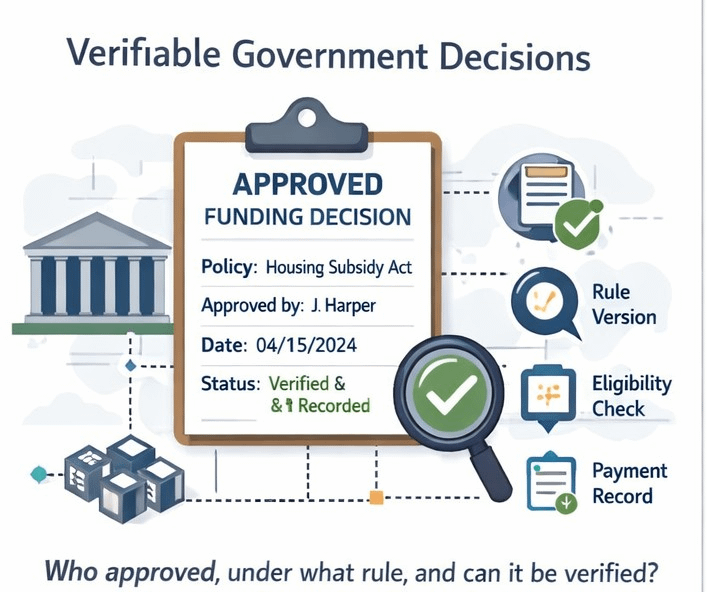
I keep coming back to a simple question about government decisions and what they leave behind for people like me to check. I do not mean a press release or a portal message or a PDF that might be replaced later. I mean a record that shows who approved what under which rule and whether that decision can still be verified after the moment has passed. That is why I find Sign interesting. In its own documentation Sign Protocol describes itself as an evidence and attestation layer that lets institutions define structured schemas issue verifiable attestations anchor evidence across systems and later query or audit those records. In plain terms an attestation is a signed statement tied to a defined format. It might show that a person is eligible that a payment was executed or that a program followed a particular rule version. What matters is not only that the event happened but that the meaning of the event is preserved in a form that other systems can verify later. Just as important Sign says it is not a single blockchain or a closed vendor silo. It presents itself as a protocol layer that standardizes how claims are structured signed stored and checked across different environments which feels more grounded than pretending one ledger will somehow fix government on its own.
I used to think this kind of language belonged mostly to crypto theory. What makes it feel more concrete now is that governments and public institutions are already moving toward digital credentials in ordinary life. The EU’s digital identity framework entered into force in 2024 and member states are expected to offer at least one wallet by 2026 while the system continues to evolve through implementing regulations technical frameworks and large pilot programs. NIST is also working on verifiable digital credentials and mobile driver’s licenses and treats them as secure interoperable and privacy preserving identity tools. OECD has been describing digital identity as core public infrastructure and has noted that countries are increasingly adopting wallets and credentials that let people share verified attributes online and offline. What surprises me is how quickly this has moved beyond the narrow idea of digital ID. Korea now offers a mobile resident registration card with the same legal validity as the physical national ID card and a recent European Student Card pilot tested verifiable credentials across nine countries. That tells me this is no longer just about logging into a website. It is becoming part of how status eligibility and official facts move between institutions.
That broader shift is exactly why the phrase proof before policy lands for me. Once benefits permits subsidies and public payments move into digital systems the old model of trust us because the records exist somewhere in the back office starts to feel thin. The World Bank recently argued that tamper proof real time audit trails could help governments follow public funds from commitment through disbursement and reduce the gaps created by fragmented records and paper heavy processes. I find it helpful to look at Sign through that lens because the important question is not whether government can digitize a decision since that part is already happening. The harder question is whether the digital decision leaves behind evidence that can be inspected without turning every dispute into a scavenger hunt. In Sign’s model that could mean the rule itself is versioned the approval is signed by an authorized actor the eligibility check is recorded as a structured claim and the resulting payment or denial can be traced back to those earlier steps. That is my inference from the way its schema and attestation model is described and I think it points in the right direction even if the real test is operational rather than conceptual.
Still I do not think verifiable records solve the deepest problems of government. A perfectly signed decision can still be unfair and a clean audit trail can still reflect bad rules bad data or bad judgment. Privacy is another tension I would not wave away because systems that make public action easier to verify can also become too invasive if they collect more than they should or too opaque if only insiders can inspect the proof. That is why I pay attention to the quieter parts of this discussion such as selective disclosure revocation trust registries and governance choices as well as the reminder from institutions like the World Bank that technology works only when it is paired with real process reform. So when I think about making government decisions verifiable with Sign I do not hear a promise that software will manufacture trust. I hear a narrower and more believable idea which is that digital government should leave better evidence than it usually does now and that power becomes easier to challenge audit and understand when proof is built in at the moment a decision is made rather than reconstructed afterward.
@SignOfficial #SignDigitalSovereignInfra $SIGN
