
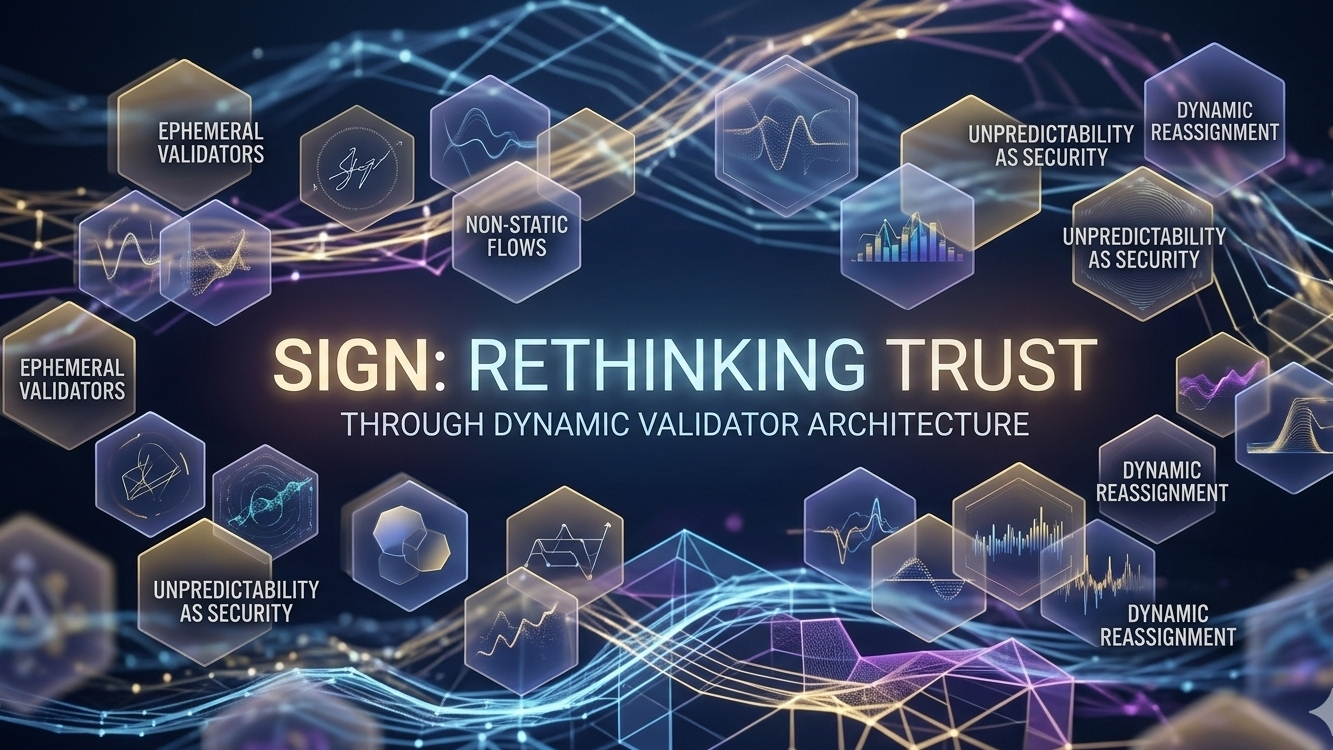
Most blockchain systems begin with a quiet assumption: that trust, once distributed, can remain relatively stable. Validators are selected, identities are known or semi-known, and over time patterns emerge who validates what, who communicates with whom, and how consensus flows through the network. This stability is often treated as a strength. In practice, it can become a surface for exploitation.
SIGN challenges that assumption at its core. Instead of optimizing for persistent roles and predictable validator relationships, it treats stability itself as a liability. The system is designed around continuous change validators, communication paths, and verification flows are deliberately non-static. The goal is not just decentralization, but unpredictability as a security primitive.
Traditional blockchain security models rely heavily on economic disincentives and redundancy. If a validator behaves maliciously, it is penalized. If a subset fails, others compensate. While effective to a degree, this model assumes that adversaries are constrained by cost and that network structure remains largely observable. Over time, however, observable structure becomes intelligence. Patterns of validator selection, frequency of participation, and network topology can be studied, mapped, and eventually targeted.
SIGN introduces a different perspective: what if the network never allowed such patterns to solidify?
In this design, validators are not long-lived participants in a fixed sense. They exist as part of a rotating set, where participation is ephemeral and continuously reassigned. Selection is not merely randomized once, but re-randomized repeatedly, with each cycle altering the composition of the validating set. This reduces the window of opportunity for coordinated attacks. An adversary cannot rely on prior knowledge of validator behavior because that behavior is not consistent over time.
More importantly, the communication layer follows the same principle. Validators do not repeatedly interact with the same peers in predictable ways. Contact pathways are rotated, reshuffled, and obfuscated. This eliminates the formation of stable clusters or hubs, which are often the weakest points in distributed systems. In many networks, even decentralized ones, influence tends to concentrate. SIGN actively prevents that concentration from forming.
This approach reframes decentralization. It is no longer just about how many participants exist, but about how often their relationships change. A network of a thousand validators can still become structurally predictable if interactions are consistent. By contrast, a dynamically shifting network resists structural analysis, even if its size is smaller. The security advantage lies in motion rather than scale alone.
Credential verification within this system benefits directly from this philosophy. In conventional models, verification often depends on a known set of validators or authorities. Over time, these entities become targets for both technical and social attacks. If compromised, they can distort trust at scale.
SIGN avoids anchoring trust to any persistent group. Each verification event is processed through a newly assembled set of validators whose composition is not reused. This means that even if an attacker manages to influence a subset of validators at one moment, that influence does not carry forward. There is no continuity to exploit.
Token distribution follows a similar logic. Rather than relying on fixed distribution channels or repeated validator involvement, distribution events are validated through constantly changing groups. This reduces the risk of collusion, front-running, or preferential manipulation. Every distribution cycle is, in effect, a fresh environment.
One of the deeper implications of this design is the shift from identity-based trust to process-based trust. Traditional systems often place weight on who the validators are, whether through reputation, stake, or historical behavior. SIGN places weight on how validation occurs on the structure and randomness of the process itself. Trust is not accumulated; it is continuously regenerated.
This has consequences for both security and philosophy. Security becomes less about defending known points and more about ensuring that no point remains known for long. The attack surface is not just minimized; it is constantly moving. From a philosophical standpoint, it suggests that permanence in decentralized systems may be overrated. Fluidity, when properly structured, can provide stronger guarantees than stability.
There are trade-offs, of course. Constant rotation introduces complexity. Coordination must be efficient despite the lack of persistent relationships. Latency and overhead must be carefully managed. However, these are engineering challenges, not conceptual flaws. The underlying idea that unpredictability can be engineered as a defense mechanism is both sound and increasingly necessary.
As blockchain systems evolve and adversaries become more sophisticated, relying on static assumptions becomes riskier. Networks that can be mapped can be targeted. Systems that behave predictably can be manipulated. SIGN represents a move toward a different kind of resilience one that emerges not from resisting change, but from embracing it as a fundamental property of the system.
In this sense, SIGN is not just an infrastructure for credential verification and token distribution. It is an argument about how trust should be constructed in adversarial environments. Not as a fixed structure to be defended, but as a dynamic process that is continuously renewed.
#SignDigitalSovereignInfra @SignOfficial $SIGN
