

Between March 24 and March 31, 2026, the New York Stock Exchange, BlackRock, Franklin Templeton, Interactive Brokers, Robinhood, and Ripple all made structural commitments to on-chain infrastructure.
Key Takeaways
NYSE taps Securitize to build tokenized stock platform on March 24.
BlackRock and Franklin Templeton both expand on-chain asset infrastructure.
Interactive Brokers launches 24/7 crypto trading for EEA investors on March 31.
Ripple Prime integrates Hyperliquid for 24/7 institutional commodity trading.
Most activity concentrated in Europe - US retail investors remain largely excluded.
What made this week different from every prior week of TradFi-crypto convergence discussion is that the institutions moving were not fintech startups or crypto-adjacent firms testing the water. They were the exchange, the asset manager, the broker, and the payment rail - the core infrastructure of traditional finance itself.
The Institutional Foundation
The largest moves came from institutions with the most credibility to lend and the most to lose from appearing to move too early.
On March 24, the New York Stock Exchange partnered with Securitize to build its own tokenized stock platform. The world's largest stock exchange by market capitalisation committed infrastructure resources to on-chain asset settlement - without a public launch date, which makes the decision itself the announcement rather than the product.
Two days later, BlackRock expanded its BUIDL fund by integrating Chronicle's Proof of Assets system, providing continuous independent verification of the US Treasury collateral backing the fund. BlackRock simultaneously announced plans to move stocks and ETFs into digital wallets, identifying them as the next major distribution frontier for asset management. BUIDL already holds billions in tokenized Treasury assets. Extending that infrastructure to equities is the same strategy applied to a larger asset class.
On March 25, Franklin Templeton and Ondo Finance partnered to launch tokenized versions of five ETFs trading 24/7 directly through crypto wallets. The funds span US equities, fixed income, and gold, available across Europe, Asia-Pacific, the Middle East, and Latin America. Franklin Templeton brings the asset management credibility. Ondo brings the on-chain distribution. The 24/7 trading window is the feature no traditional ETF structure can match, and it is the reason the partnership required crypto infrastructure rather than existing distribution channels.
Three institutions, three different positions in the financial hierarchy, the exchange, the asset manager, the fund distributor, all committing to on-chain infrastructure in the same week. They moved together not because they coordinated, but because they were all reading the same regulatory environment and the same distribution opportunity at the same time.
The Retail Layer and Its Limits
The institutional build-out would matter less without retail access sitting beneath it. Two platforms moved to close that gap in the final week of March. Both chose Europe. Neither could have launched the same product in the United States.
MiCA, the EU's Markets in Crypto-Assets regulation, created the legal clarity that made both launches possible. Without an equivalent framework in the US, the products that launched in Europe this week remain unavailable to American retail investors.
Interactive Brokers launched 24/7 crypto trading for individual investors in the European Economic Area on March 31, through its Irish subsidiary Interactive Brokers Ireland Limited, an authorised crypto-asset service provider under MiCA. The service covers 11 crypto assets including Bitcoin, Ethereum, Solana, and XRP, accessible through a single account alongside stocks, options, futures, bonds, and mutual funds. Trading runs through Zero Hash, a regulated digital asset infrastructure provider, with commissions ranging from 0.12% to 0.18% and no spreads, markups, or custody fees. That pricing undercuts most crypto-native retail platforms on their own ground.
Robinhood moved simultaneously. In late March the platform launched tokenized US stocks and ETFs across 31 EU and EEA countries with 24/5 commission-free trading, built on the Robinhood Chain running on Arbitrum. A French investor can now access tokenized US stocks through Robinhood. An American investor cannot. The demand exists in every jurisdiction. The regulatory permission to serve it does not.
The same asset classes driving these retail launches - gold, equities, commodities - were simultaneously being made available to institutional traders through a completely different route.
The On-Chain Commodity Race
Gold was in Franklin Templeton's tokenized ETF. Crude oil was driving the macro volatility that made 24/7 commodity access commercially valuable. Both were landing on decentralised infrastructure at the same time they were being packaged into regulated retail products, through a different entry point, for a different client base, using the same underlying on-chain settlement logic.
Ripple Prime was the institutional version of that same move. Where retail platforms were packaging gold and equity exposure into regulated wrappers, Ripple's institutional trading platform went directly on-chain, integrating HIP-3 symbols from Hyperliquid, the decentralised perpetuals exchange that hit more than $1.4 billion in open interest in the final week of March, with commodity perpetuals accounting for more than 67% of total platform volume, according to a report shared by TradingView.
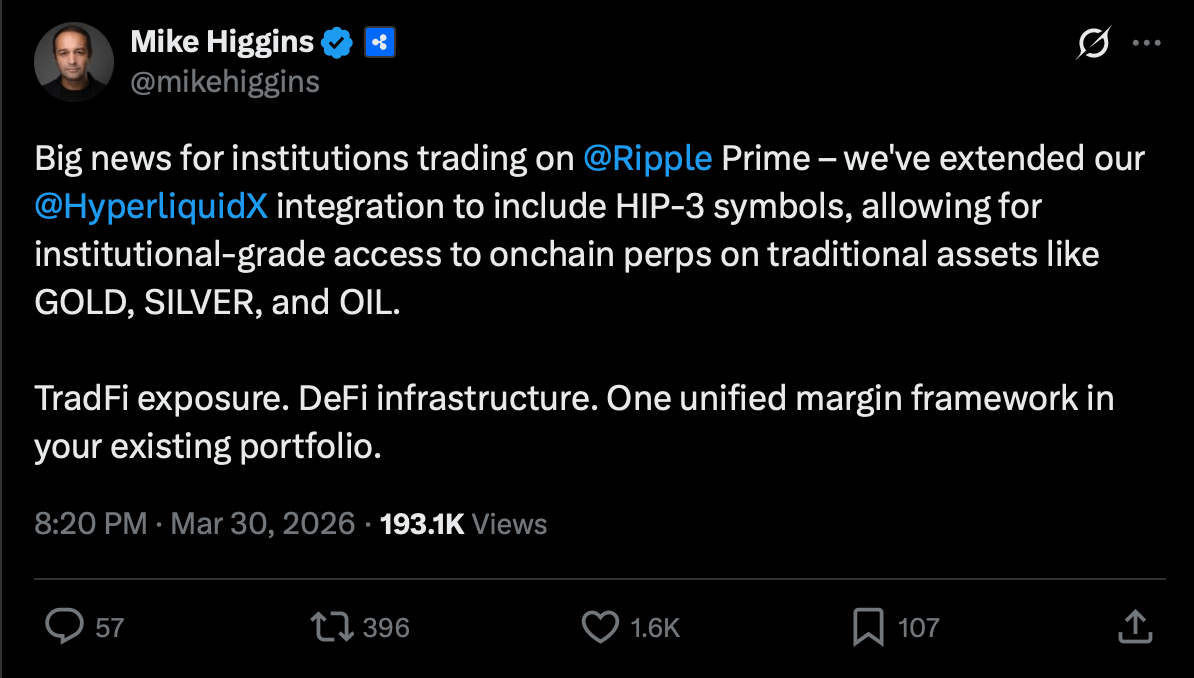
Through that integration, Ripple's institutional clients can trade Gold, Silver, and WTI Crude Oil perpetual contracts on-chain, 24/7, with self-custody of collateral and transparent settlement. The same commodity exposure that NYMEX and COMEX provide during market hours, available continuously, without a centralised intermediary holding the collateral.
Binance will launch WTI crude, Brent crude, and natural gas perpetual contracts on April 1. Bybit, MEXC, and OKX had already launched crude oil products through March. The centralised and decentralised sides of the market converged on the same asset class in the same week, driven by the same catalyst, energy price volatility from the Iran conflict making round-the-clock commodity access financially meaningful for the first time at scale.
Hyperliquid built the position first. The centralised exchanges are now competing for volume it already captured.
The Settlement Layer Underneath Everything
Every trade executed on these platforms settles in something. For most of the on-chain infrastructure launched this week, that something is stablecoins, and their adoption as a settlement layer is moving faster than the trading infrastructure sitting on top of them.
On March 31, VaulFi and Noah launched a stablecoin payment bridge for North African freelancers, converting multi-week SWIFT settlement processes into near real-time receipts. Standard Chartered reported simultaneously that USDC is leading a rise in stablecoin velocity as a direct substitute for traditional finance rails on Solana and Base. Stablecoins are not being adopted because they are crypto. They are being adopted because they settle faster, cost less, and operate continuously in markets where the underlying asset never sleeps.
The trading infrastructure and the settlement infrastructure are building toward the same endpoint from different directions. Every new on-chain equity, commodity, or fund product launched this week needs a settlement layer. That layer already exists and is growing faster than the products being built on top of it.
What This Week Actually Proved
For most of the past decade, TradFi-crypto convergence meant a bank filing a blockchain patent, a hedge fund adding a small Bitcoin allocation, or a payments company exploring stablecoin rails quietly. The announcements were cautious. The commitments were partial. The language was always conditional.
The NYSE did not file a patent this week. BlackRock did not explore. Franklin Templeton did not pilot. They built, integrated, and launched across four regions simultaneously.
Goldman Sachs analysts noted on March 26 that crypto prices may have found a cyclical floor, rating Robinhood and Coinbase as top buy-rated stocks specifically because of their deep financial integration with traditional markets. The institutional conviction is showing up not only in product launches but in how equity analysts are valuing the companies building the infrastructure, which is the clearest signal that this week's activity is being read as structural rather than cyclical.
The US regulatory gap remains the honest constraint on the week's full significance. American retail investors cannot yet access what European investors accessed this week. The GENIUS Act is progressing through Congress. The SEC's approach to digital asset classification is shifting. The commercial pressure created by institutions that have already committed infrastructure resources to on-chain distribution is a force that did not exist at this scale six months ago.
In one week, institutions managing trillions in assets built the on-chain infrastructure for equities, fixed income, gold, oil, and stablecoin settlement simultaneously. The platforms that built it first in Europe will have the distribution advantage when the US window opens.
They already decided the window will open. That is why they built now.