
@SignOfficial There’s a phase almost everyone goes through in crypto at some point.
You start doing more than necessary.
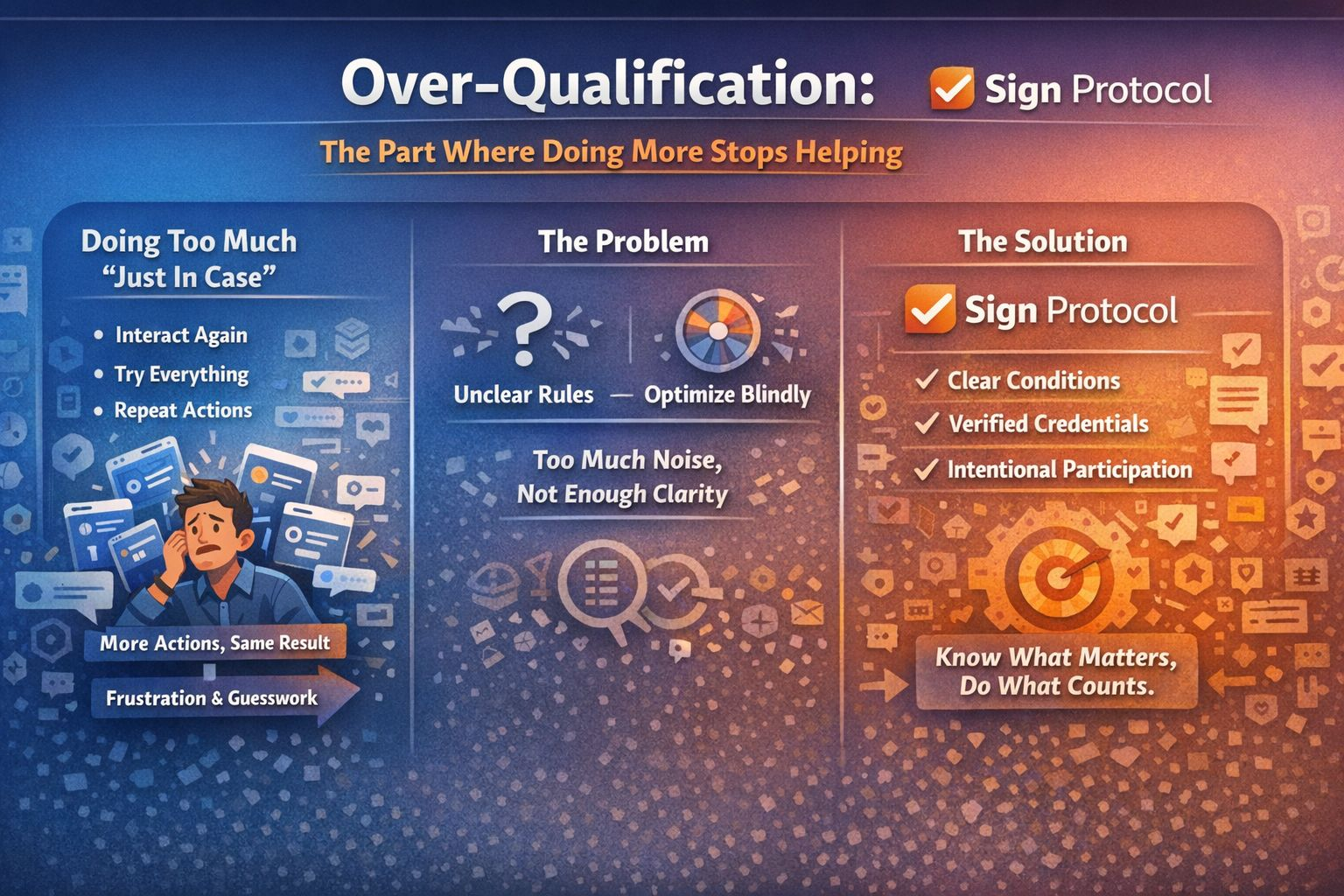
Not because you want to, but because you’re not sure what actually counts.
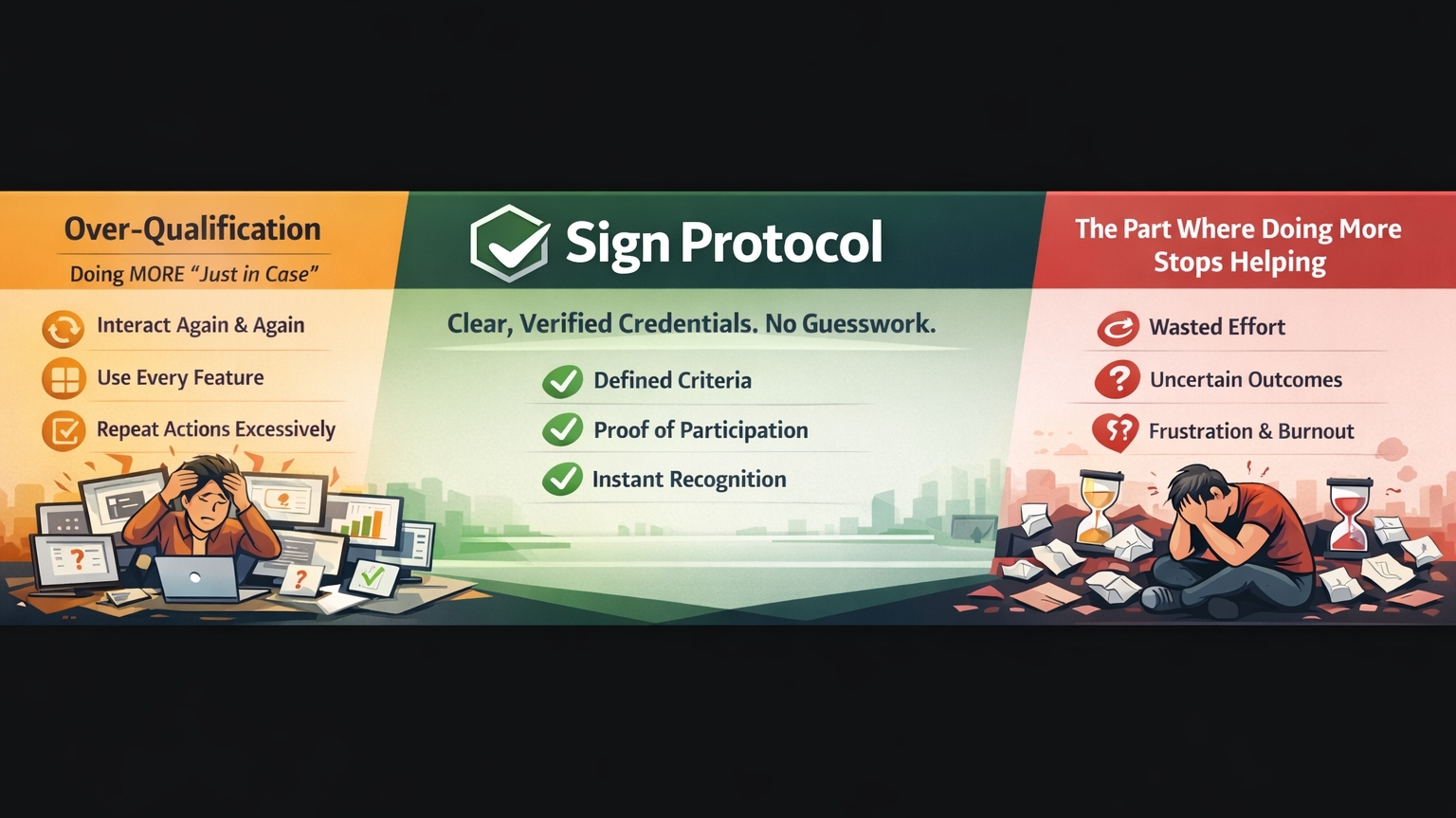
So you cover everything.
Interact multiple times.
Use different features.
Repeat actions just in case.
It becomes a kind of over-participation.
Not driven by curiosity, but by uncertainty.
I’ve done it myself.
Using a product once didn’t feel like enough, so I used it again. Then again. Not because the extra interactions added value, but because I didn’t know where the threshold was.
And that’s the problem.
When systems don’t clearly define what matters, users fill the gap with effort.
More activity.
More transactions.
More noise.
At first, that seems harmless.
But over time, it changes behavior in ways that aren’t always healthy. Participation becomes less about genuine engagement and more about increasing the chances of being recognized.
Not gaming the system exactly.
Just trying not to miss out.
That’s where things start to feel inefficient.
Because effort doesn’t always translate into outcomes.
You can do more and still end up with the same result as someone who did less but happened to meet the right condition.
That disconnect creates frustration.
Not because people expect guaranteed rewards, but because they expect some alignment between effort and recognition.
And when that alignment isn’t clear, behavior shifts.
People stop acting naturally.
They start optimizing blindly.
That’s the part I’ve been paying more attention to.
Not just how systems distribute value, but how unclear rules shape the way people interact with them.
That’s where something like Sign Protocol starts to change the dynamic.
Not by rewarding more activity, but by clarifying what activity actually matters.
Instead of leaving users to guess, it allows conditions to be defined and recorded explicitly. Participation isn’t inferred after the fact. It’s structured as it happens.
That removes the need for over-compensation.
You don’t have to do more “just in case.”
You just have to meet the condition.
That sounds obvious.
But it changes behavior immediately.
When expectations are clear, people stop guessing.
They stop repeating actions that don’t add value.
They stop treating participation like a probability game.
Instead, they interact with intention.
They know what matters, so they focus on that.
That reduces noise.
Not just on the network, but in how people approach the system.
Of course, this introduces a different kind of trade-off.
Clarity can sometimes lead to over-optimization in a more direct way. If conditions are too rigid, people might focus only on what’s measurable, ignoring contributions that don’t fit neatly into the system.
That risk is real.
But it’s also easier to manage than uncertainty.
Because when the rules are visible, they can be adjusted.
When the rules are implicit, they can only be guessed.
And guessing is where most inefficiency comes from.
That’s something I’ve come to appreciate more over time.
Not perfect systems.
Clear systems.
Because perfection is subjective.
Clarity is practical.
If people understand what’s expected, they can decide how to engage. They might still disagree with the criteria, but at least they’re not operating in the dark.
That alone reduces friction.
At this point, I’m less interested in systems that encourage more activity and more interested in systems that make unnecessary activity disappear.
Because more isn’t always better.
Sometimes it’s just a response to not knowing what matters.
If something like Sign Protocol can reduce that uncertainty even partially it shifts participation from quantity to intention.
And that’s a meaningful change.
Not because people will suddenly do less.
But because they’ll stop doing things that never needed to be done in the first place.
@SignOfficial #SignDigitalSovereignInfra $SIGN