
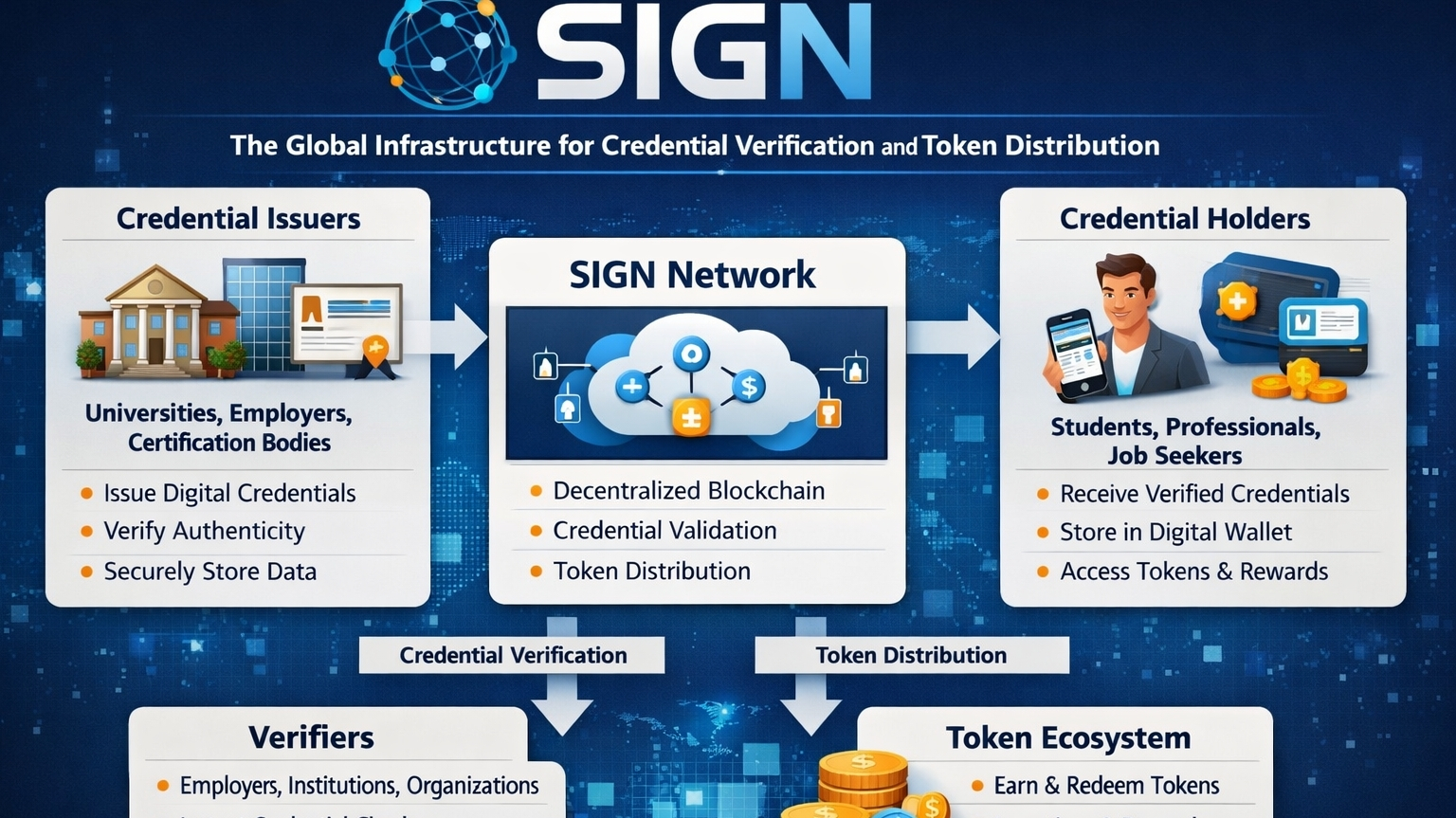

I’ve spent a lot of time exploring blockchain projects, and I’ve noticed a pattern—most of them try very hard to sound revolutionary. They talk about changing the world, replacing systems, or building entirely new paradigms. So when I first came across SIGN, I didn’t expect much. The idea of “credential verification and token distribution” sounded more like plumbing than innovation. But the more I sat with it, the more I realized that sometimes the most important systems are the ones that quietly sit underneath everything else.
What pulled me in wasn’t hype—it was how grounded the idea felt. SIGN isn’t trying to reinvent identity from scratch or declare institutions obsolete. Instead, it’s focusing on something much more practical: how we prove things about ourselves, and how those proofs actually get used in meaningful ways.
When I started looking deeper, I realized how fragmented and inefficient credential systems are today. We rely on degrees, certificates, work histories, online reputations—but none of these are truly portable. A university degree might be respected in one country but require verification in another. A developer’s contributions might live on GitHub but hold little weight outside that ecosystem. Even in crypto, where everything is supposedly transparent, proving real participation or contribution is surprisingly difficult.
And then there’s the issue of distribution. I’ve seen countless token launches and airdrops where the process feels unfair or easily manipulated. Bots farm rewards, multiple wallets exploit systems, and genuine users sometimes get left behind. It creates a strange contradiction—blockchain promises fairness and transparency, yet distribution often feels anything but fair.
This is where SIGN starts to make sense to me. It’s not just about verifying credentials—it’s about making those credentials usable. It creates a system where different entities can issue verifiable credentials, and those credentials can then be used as a basis for decisions, especially when it comes to distributing value. That might mean tokens, access, opportunities, or recognition.
What I find compelling is the shift in perspective. Instead of asking “Which wallet should receive something?”, SIGN allows systems to ask “Which verified individual or contributor actually deserves it?” That subtle shift changes everything. It moves the focus away from anonymous activity and toward meaningful participation.
At the same time, I don’t think this is an easy problem to solve, and SIGN doesn’t magically fix it. One thing I keep coming back to is the issue of trust. Just because a credential is cryptographically verifiable doesn’t mean it’s inherently valuable. The credibility of a credential still depends on who issued it. If an unknown or untrusted entity creates a credential, the system can verify that it exists—but it can’t guarantee that it matters.
That leads to a deeper realization: trust isn’t purely technical. It’s social. It’s contextual. And it takes time to build. SIGN provides the infrastructure, but the meaning of that infrastructure depends on the network of issuers, users, and validators that grow around it.
Adoption is another challenge that feels impossible to ignore. For SIGN to really work, institutions need to participate. Universities, companies, organizations—they all need to issue credentials in a format that the system can use. And historically, institutions don’t move quickly. They’re cautious, bound by regulation, and often resistant to change. So even if the technology is ready, the ecosystem might take years to catch up.
Then there’s the issue of abuse. I’ve learned to be skeptical of any system that claims to eliminate manipulation entirely. If credentials become valuable, people will try to game them. Fake credentials, credential markets, collusion—it’s all possible. SIGN has to constantly balance openness with resistance to abuse, and that’s not a problem you solve once. It’s something you manage over time.
Governance also lingers in the background as a complicated piece of the puzzle. Who decides which issuers are معتبر? Who resolves disputes when credentials are challenged? If the system becomes too centralized, it risks losing credibility. If it’s too decentralized, it risks becoming chaotic. There’s no clean solution here—only trade-offs that need to be carefully managed.
Despite all these challenges, what I respect most about SIGN is that it doesn’t pretend the world is simple. It doesn’t try to force everything into a rigid, idealized framework. Instead, it embraces the messiness of reality. It allows for multiple issuers, different types of credentials, and flexible use cases. It acknowledges that trust comes in layers, not absolutes.
When I think about the token side of things, I try to strip away the noise and look at actual function. In SIGN’s case, the token seems tied to participation and coordination within the network. It can help incentivize issuers, support verification processes, and enable distribution mechanisms. But I don’t see it as the core of the project. The real value lies in whether the credential system gets used.
If people aren’t issuing credentials, if platforms aren’t recognizing them, and if distributions aren’t being built on top of them, then the token doesn’t have much meaning. But if the network grows—if credentials become a standard way to prove and act—then the token naturally gains relevance as part of that system.
From my perspective, SIGN feels like a long-term play. It’s not designed for instant hype or rapid speculation. It’s the kind of infrastructure that, if successful, becomes almost invisible. You don’t think about it—you just use it. And ironically, that’s probably the best sign that it’s working.
What makes it stand out to me is its focus on something real and already broken. It’s not creating a new problem to solve—it’s addressing inefficiencies that exist across education, employment, digital identity, and blockchain ecosystems. It also sits at an interesting intersection between Web2 and Web3, which gives it more practical relevance than projects that operate purely within crypto-native environments.
Still, I don’t ignore the risks. Adoption could be slow. Competing solutions could emerge. Trust networks might fragment instead of unify. And there’s always the possibility that users simply don’t care enough about verifiable credentials to change their behavior.
But even with those uncertainties, I find myself coming back to the same thought: systems like this feel inevitable. As the world becomes more digital and more interconnected, we need better ways to prove who we are and what we’ve done—without relying on isolated platforms or manual verification processes.
SIGN doesn’t fully solve that problem yet, and maybe it never will on its own. But it feels like a step in the right direction—a piece of infrastructure that could quietly shape how trust and value move in the future.
And I think that’s why it stayed with me. Not because it promises something extraordinary, but because it tries to fix something fundamental. The real question I’m left with isn’t whether SIGN succeeds as a single project—it’s whether we, collectively, move toward a world where verifiable credentials become part of everyday life.
If that happens, then projects like SIGN won’t feel experimental anymore. They’ll just feel necessary.