

You know, after more than a decade watching this crypto space swing from wild speculation to these tentative real-world experiments, I’ve started appreciating the projects that don’t chase the spotlight. They just quietly chip away at the frustrations everyone else kind of ignores. SIGN is one of those for me right now. It doesn’t come with big promises or viral marketing. It simply looks at one of the most stubborn headaches in blockchain: how do you actually link what happens on-chain to real-life claims in a way that feels trustworthy, private, and scalable—without falling back on messy spreadsheets, centralized middlemen, or endless manual verifications?
The problem shows up everywhere once you start paying attention. Airdrops get gamed by fake accounts. DAOs waste time arguing over who deserves what. And when governments start experimenting with digital IDs or programmable money, they hit the exact same wall—how do you prove someone qualifies for something without exposing their whole life or rebuilding trust from scratch every single time? It’s the kind of friction that still makes blockchain feel like its own little universe instead of something you could actually plug into everyday systems. What I like about SIGN is that it treats this as a foundational infrastructure issue rather than a feature for one app. It builds a shared way to create and share “evidence” that can power everything from token distributions to national services.
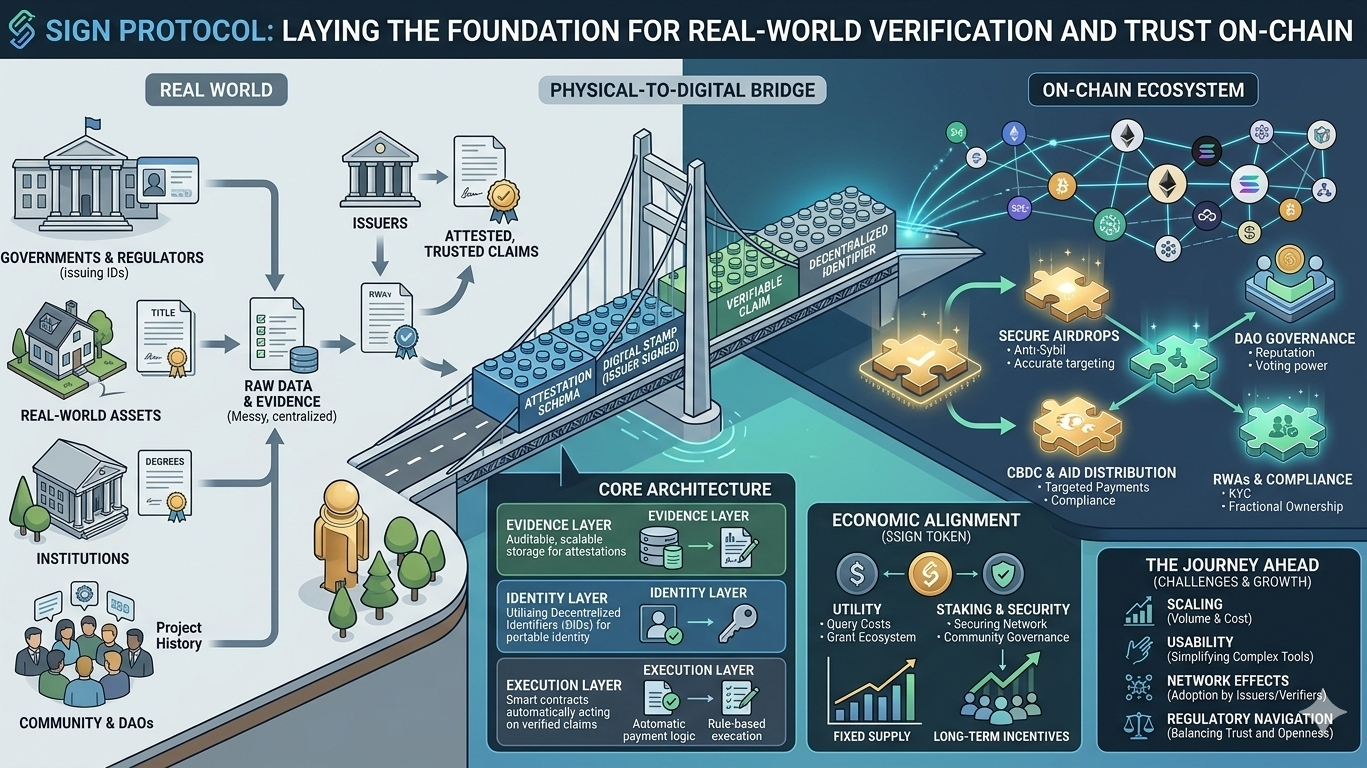
At the heart of it is something they call the Sign Protocol, and honestly, once you strip away the jargon, it’s a pretty straightforward idea that feels overdue. You start with a simple template—a schema—that spells out what a claim should include. Then an issuer (could be a project, a regulator, or even a government office) creates an attestation: basically a cryptographically signed digital stamp that matches that template. These stamps aren’t locked to one chain or one dashboard. They’re designed so anyone can check them instantly, reuse them across contexts, or even prove just the bits that matter using zero-knowledge proofs—without handing over your entire profile. It pulls in familiar standards like verifiable credentials, mixing on-chain permanence with off-chain smarts for anything that needs to stay private. To me, it feels less like building another shiny tool and more like laying down reliable plumbing.
The architecture grows out of that in layers that actually make sense when you think about real adoption. There’s an evidence layer for creating and storing these attestations in a way that’s auditable but doesn’t get bloated. An identity layer that brings in things like decentralized identifiers so your proof of self travels with you. And an execution layer that turns those verified claims into automatic actions—smart contracts that handle payouts or logic without someone babysitting every wallet. It works across different chains, supports public, private, or hybrid setups, and even lets you present things offline with something as simple as a QR code. The whole setup feels thoughtful and modular, like it was built by people who’ve actually wrestled with these problems instead of just theorizing about them.
On the economic side, the $SIGN token doesn’t try to steal the show, which I respect. Fixed supply, heavy lean toward community incentives, and vesting schedules that stretch out over years—it’s clearly designed to keep people aligned around maintaining the network rather than pumping short-term hype. It covers practical stuff like query costs, developer grants, and staking for security. In an industry full of tokenomics that feel like theater, this one comes across as quietly pragmatic.
What really gets me thinking is where this could actually land in the real world. We’ve already seen it quietly power some massive distributions across chains, cutting through the usual fraud and paperwork headaches. But the part that excites me more is the sovereign angle—national digital ID programs, targeted welfare, or even CBDC experiments where a verified claim could automatically trigger the right payment at the right time. It could make compliance for real-world assets or cross-border aid feel less like a nightmare and more like a smooth, auditable process. Stepping back, this fits right into the bigger evolution of blockchain. We started with pure permissionless finance for individuals. Now we’re in this messier phase where institutions and governments want verifiable context from the real world without losing the decentralization benefits. Projects like SIGN act as that quiet bridge, standardizing the “why” behind on-chain moves so the execution layers can finally do something useful with it. If it catches on, blockchain might start feeling less like an extra layer and more like invisible, trustworthy infrastructure for the digital economy.
Of course, I’m not pretending any of this is guaranteed or easy. Scaling attestations to country-level volumes without turning costs or data bloat into problems is a real test. Usability is another big one—most government teams or regular folks aren’t going to dive into schemas unless the tools hide all that complexity completely. Network effects matter hugely too; these attestations only become powerful when enough issuers and verifiers actually show up and trust the system. And then there’s the regulatory side: leaning into sovereign partnerships opens doors, but it also risks softening some of that pure permissionless spirit that got a lot of us into crypto in the first place. Competition from other identity projects and zero-knowledge solutions keeps everyone honest. None of these are fatal flaws, but they’re reminders that infrastructure work moves slowly, measured in steady integrations rather than hype cycles.
When I step back and look at SIGN, it just feels like a snapshot of where the industry might be heading if it wants to grow up. Less about grabbing headlines and more about fixing the unglamorous stuff that decides whether blockchain ever becomes normal infrastructure or stays a niche experiment. It’s the kind of patient, thoughtful build that rarely goes viral but could quietly shape how we handle identity, incentives, and value in the years ahead. In a space that’s still full of noise, that’s the sort of thing I find myself reflecting on a lot these days.
@SignOfficial $SIGN #SignDigitalSovereignInfra
