
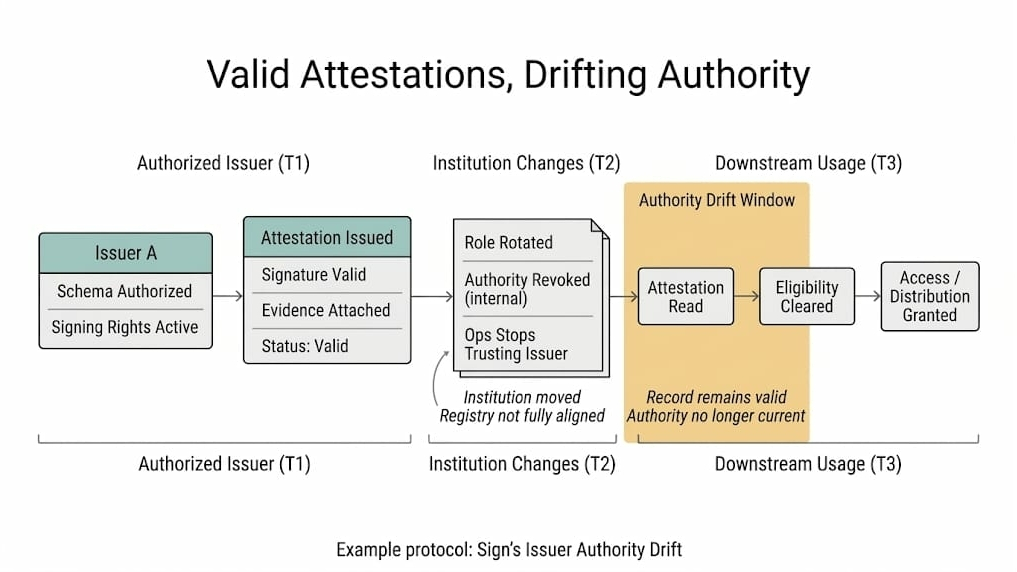
I was looking at one Sign schema label and it kept bothering me for a stupid reason.
It sounded too big.
Not broken. Not wrong on paper. Just bigger than the institution probably deserved.
Thats where this starts.
One local program. One bounded process. One partner flow. One jurisdiction maybe. Something narrow. Administrative. Ugly in the normal way. Then the schema gets written cleanly enough to survive contact with Sign. Nice label. Nice fields. Nice shape. And once it’s there, once it’s sitting in SignScan looking official, it stops sounding local and starts sounding like some broad class of approval.
That shift is quiet. That’s why it’s bad.
Because the institution usually did not mean “global eligibility class” or “general compliance category” or whatever grand thing the schema name starts implying once it leaves the room it was written in. They meant something smaller. Approved for this route. Valid for this local process. Good for this partner. Good under this program's weird little logic and not much else.
Then the schema gets a real surface.
And suddenly the label reads like it belongs to the world.
I keep coming back to that because it's not the same problem as one attestation getting reused too far. This starts earlier. Worse, maybe. The schema itself gets inflated before anyone even touches a specific record. It starts looking like a category when it was really just a local administrative tool somebody cleaned up for Sign.
Nice.
I can picture how it happens because it’s exactly the kind of thing people do when they know the object is going to travel. You don’t call the schema something small and embarrassing and local. You give it a name that sounds stable. Broad enough. Respectable enough. Maybe the fields get cleaned up too. You cut the local qualifiers. Trim the route-specific weirdness. Avoid naming the part where this only really means something inside one institution’s process because, apparently, everything has to look portable before anyone asks whether it should be.
So the schema goes live.
And now another team sees it later and reads it like a universal class instead of what it actually was: one institution’s way of formalizing one bounded decision under one bounded workflow.
That is where the trouble starts.
Not because Sign did something wrong. Sign just preserved the thing nicely. Schema visible. Records visible under it. Queryable. Searchable. Clean. That’s the point. But clean structure makes category inflation really easy. A local tool gets turned into a larger-sounding object just because the label survives well and the shape looks durable enough to trust.
And people trust shapes way too fast.
Maybe the original schema only meant this partner completed onboarding under this one review process. Maybe it only meant approved for one subsidy route under one program. Maybe it only meant compliant enough for one local workflow with side conditions living elsewhere that the original team understood because they were in the mess when it was built.
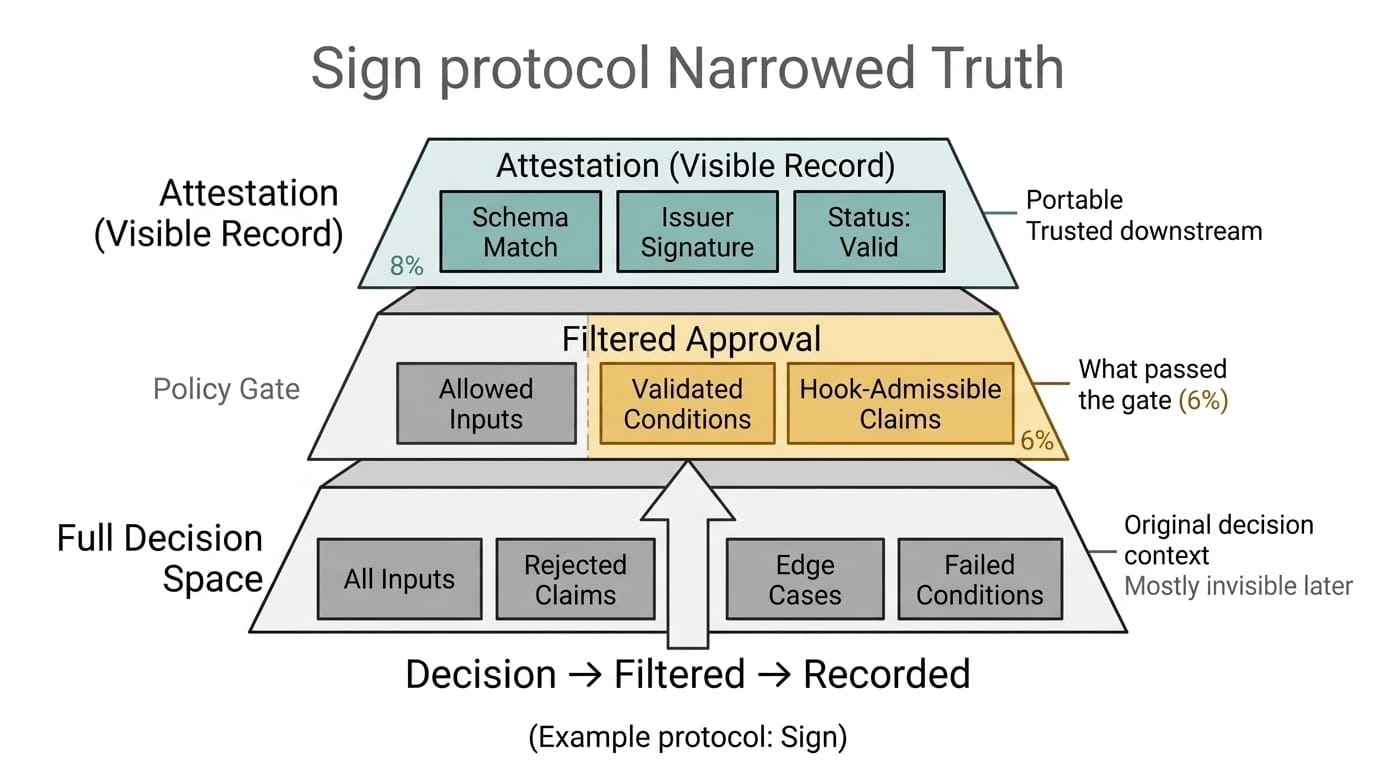
Then somebody later sees the schema family and thinks, good, this looks like the right class of approval.
Right class according to who.
Thats the part that gets lost.
Because once the schema label starts sounding broad, the later systems stop treating it like a bounded construct and start treating it like a general category. Reporting does this. Claims logic does this. Access systems definitely do this because they love simple classes. Partner integrations are worse because they were not even there when the schema got written, so all they have is the surface. Name, fields, issuer, maybe some attestation examples in SignScan. That's enough to build the wrong confidence.
A local schema becomes a global-sounding object.
Then it starts doing global-sounding work.
I’ve seen this shape before in uglier institutional systems, so seeing it here didn’t exactly shock me. Still irritated me. Because the whole value of Sign is legibility. Good. But legibility cuts both ways. If the schema looks broad enough, people start generalizing before they even read the narrower administrative boundaries hiding behind it. Or worse, they never know those boundaries existed.
Then later somebody uses records under that schema for a broader route because the schema name looked right, the field shape looked right, the program name looked close enough, and nobody wanted to be the person saying no, actually, that thing only meant something local and smaller and kind of ugly.
Ugly things don't age well in dashboards. So they get flattened first.
Thats what keeps pulling me back on @SignOfficial . It’s not just that records travel. The category itself starts traveling. Before reuse even gets messy at the attestation level, the schema already did some damage just by sounding wider than the institution meant.
And the institution helps this happen. Of course it does. Nobody writes a schema name like “approved for route one under local pilot criteria pending later review constraints.” They write something cleaner. Then the clean thing survives. Then a later team mistakes the cleaned thing for a real class of approval instead of the dressed-up remains of one local workflow.
Very efficient.
Until finance or compliance or some partner team asks why wallets from this schema are showing up in places the original process never meant to authorize.
Then the answers get dumb fast.
Yes, the schema was valid.
Yes, the attestation under it was real.
Yes, the subject genuinely cleared that original process.
Fine.
What nobody answers is when that one local schema started sounding like it belonged to everybody else too.
That’s the actual Sign pressure here. Sign gives schemas durable structure and visibility. Good. But once the schema looks durable, later systems start over-reading what kind of category it is. Local intent gets dressed up as general meaning. Bounded process starts sounding like universal status. And if the downstream team is moving fast enough, and they usually are, the fact that the original institution meant something smaller disappears behind the neatness of the object.
Then the schema keeps sitting there looking calm.
Bigger than it should.
And by then the damage is not in the wording anymore. It’s in what other systems already felt comfortable building on top of it.