
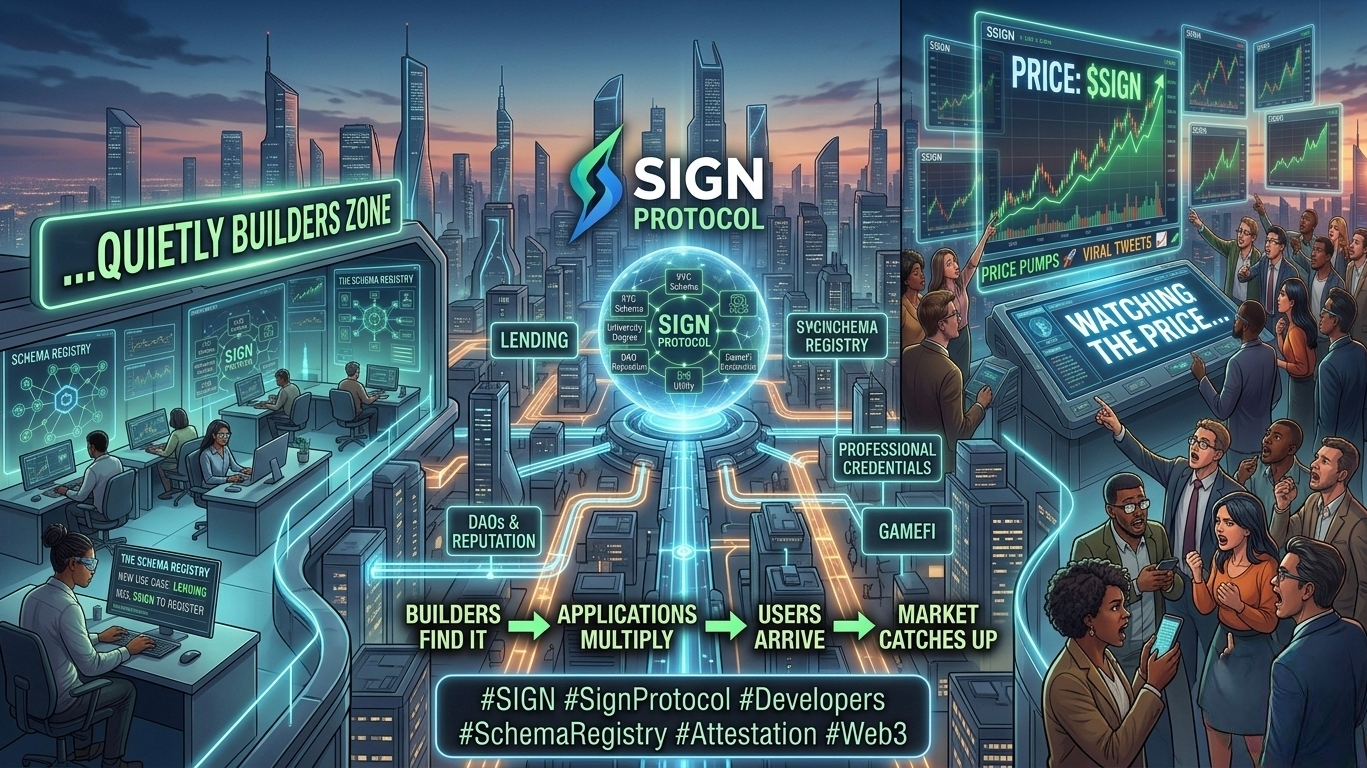
There is a pattern I have noticed with every infrastructure protocol that eventually becomes dominant.
It does not start with price pumps or viral tweets. It starts with developers. A small group of builders who look at a new tool and realize it solves something they have been struggling with for a long time. They start building quietly. Then more builders find it. Then the applications multiply. Then the users arrive. Then the market catches up.
I think that is exactly what is happening with SignOfficial right now and almost nobody in the retail crypto space is talking about it.
Let me explain why the developer side of Sign might be the most important growth engine that is being completely overlooked.
THE SCHEMA REGISTRY — WHAT IT IS AND WHY IT MATTERS
Every attestation on Sign Protocol is built on something called a schema. A schema is essentially a structured template that defines what an attestation contains and how it is formatted.
Think of it like a form. A KYC attestation schema defines what fields need to be filled — name verified, age confirmed, jurisdiction cleared. A university degree schema defines institution, degree type, graduation date, field of study. A professional license schema defines issuing authority, license type, expiry date, holder identity.
The Schema Registry is Sign's open database of these templates. Any developer can browse existing schemas, use them in their applications, or create entirely new ones for their specific use case.
And here is where it gets interesting for Sign specifically.
To register a new schema on Sign Protocol you need SIGN tokens. To modify an existing schema you need $SIGN tokens. Every schema that gets created represents a new use case being built on the protocol — and every new use case creates new demand for $SIGN.
This is not speculative future utility. This is a token mechanic that creates direct demand tied directly to developer activity right now.
WHY DEVELOPERS ARE CHOOSING SIGN PROTOCOL
I spent time going through the developer documentation for Sign Protocol and a few things stood out to me that I think explain why builders are gravitating toward this.
First — it is genuinely omni-chain in a way that most protocols just claim to be. Sign Protocol works natively across Ethereum, BNB Chain, Base, Solana, Starknet, TON and Move based networks. A developer building an application does not have to choose which blockchain their attestations live on. They can deploy the same schema across all of them simultaneously and their users can verify attestations regardless of which chain they happen to be on.
For a developer building a cross-chain DeFi application that needs identity verification this is enormous. The alternative is building separate integrations for each chain and hoping they stay in sync. Sign handles all of that at the protocol level.
Second — the privacy tools are built in. Zero knowledge proofs and trusted execution environments are not add-ons that developers have to figure out themselves. They are native features of Sign Protocol. A developer can build a privacy-preserving verification flow without being a cryptography expert.
Third — the codebase is open source and fully auditable. Every contract is publicly available under the EthSign GitHub organization. Developers can read the code, fork it, contribute to it and audit it before building on top of it. In an industry full of closed source black boxes that transparency matters.
WHAT DEVELOPERS ARE ACTUALLY BUILDING
Let me give you some concrete examples of what Sign's attestation infrastructure enables developers to build because I think abstract descriptions miss the point.
A lending protocol can use Sign attestations to build under-collateralized loans. Right now most DeFi lending requires you to lock up more collateral than you borrow because the protocol has no way of knowing your creditworthiness. With Sign a verified credit score attestation means a protocol can offer better terms to borrowers who have proven their financial history on chain.
A DAO can use Sign attestations to build reputation based governance. Instead of one token one vote — which always ends up dominated by whales — a DAO can weight votes based on verified contribution history, verified expertise credentials, and verified participation records. All attested on chain through Sign Protocol.
A freelance marketplace can use Sign attestations to verify professional credentials without exposing the underlying documents. A developer can prove they have a computer science degree. A doctor can prove they are licensed to practice. A lawyer can prove their bar admission. All verifiable instantly by any platform that reads Sign Protocol — without the professional having to re-submit documents to every new client.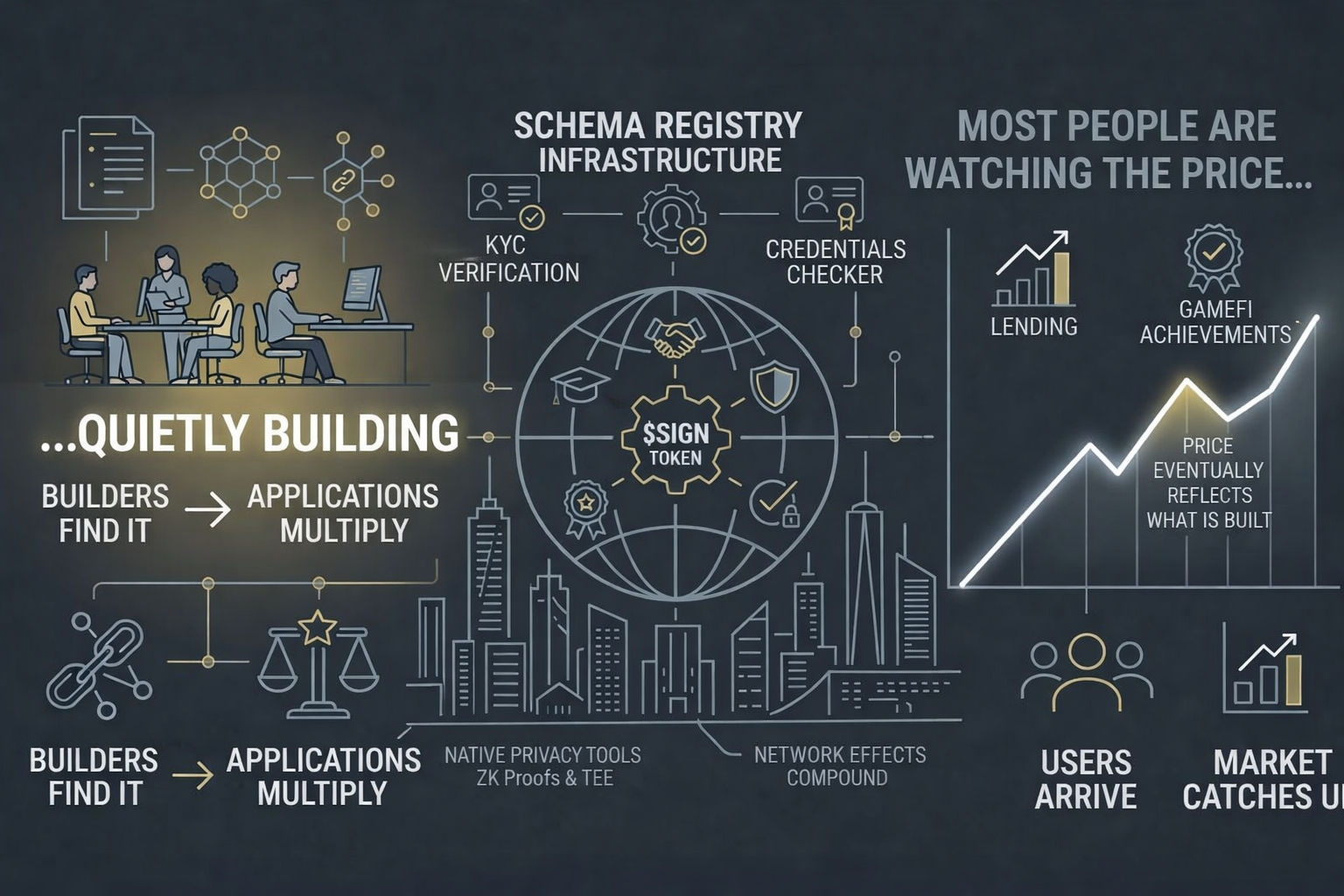
A GameFi project can use Sign attestations to verify that in-game achievements are legitimate and not botted. Tournament organizers can verify player identities without collecting personal data. Cross-game reputation systems become possible for the first time.
Every single one of these use cases requires SIGN to register the schema. Every integration that goes live creates more on-chain attestation activity. More activity means more demand for $SIGN at the protocol level.
THE NETWORK EFFECT NO ONE IS TALKING ABOUT
Here is the thing about attestation infrastructure that I think is genuinely underappreciated from an investment perspective.
Attestations are only as valuable as the network that recognizes them.
If only one platform reads Sign attestations they have limited utility. But as more platforms integrate Sign Protocol each new integration makes every existing attestation more valuable. A KYC attestation that is recognized by ten platforms is ten times more useful than one that is only recognized by one. A professional credential that is readable by a hundred employers is a hundred times more valuable than one that only works on a single platform.
This is a classic network effect — and it compounds aggressively once it reaches a critical mass of integrations.
Sign already has over 200 projects that have used its infrastructure through TokenTable. Each of those relationships is a potential Sign Protocol integration waiting to happen. Each integration that goes live makes the attestation network stronger for every other participant.
The developer community is the engine that drives this network effect. Every schema registered. Every attestation issued. Every application built. All of it expands the network. All of it increases the utility of every Sign token.
SIGN AS INFRASTRUCTURE — NOT JUST A PROTOCOL
I want to make a distinction that I think is important for understanding where Sign sits in the broader ecosystem.
Most blockchain protocols are applications. They do one thing. They serve one specific market. Their growth is bounded by the size of that market.
Sign is infrastructure. It does not compete with DeFi protocols or GameFi projects or identity apps. It sits underneath all of them and makes them more trustworthy, more compliant, and more interoperable.
Infrastructure compounds differently from applications. Every new vertical that adopts Sign Protocol adds to its value without taking away from any existing vertical. DeFi integrations do not cannibalize gaming integrations. Government deployments do not compete with enterprise use cases. They all add to the same attestation network simultaneously.
When I look at @SignOfficial through this lens — as the trust infrastructure layer that any application on any blockchain can plug into — the potential addressable market becomes very hard to put a ceiling on.
And Sign is the token that every single one of those integrations needs to function. Schema registrations. Attestation fees. Governance participation. Network security. Every use case across every vertical on every chain — all of it flows through $SIGN.
THE DEVELOPER SIGNAL I AM WATCHING
There is a metric I have been paying attention to that does not show up in price discussions but tells you a lot about where a protocol is heading.
The number of credential templates and schemas in Sign Protocol has been growing exponentially according to their own product metrics. That growth is not coming from marketing. It is coming from developers finding the tool useful and building with it.
When developer activity is growing during a bear period for the token price it usually means one of two things. Either the developers are wrong about the value of what they are building — or the market has not yet caught up with what the developers already know.
In Sign's case I look at what those developers are building on. An omni-chain attestation layer with $4 billion in proven distribution infrastructure, real government clients, $54 million in institutional backing, and $15 million in annual revenue already flowing.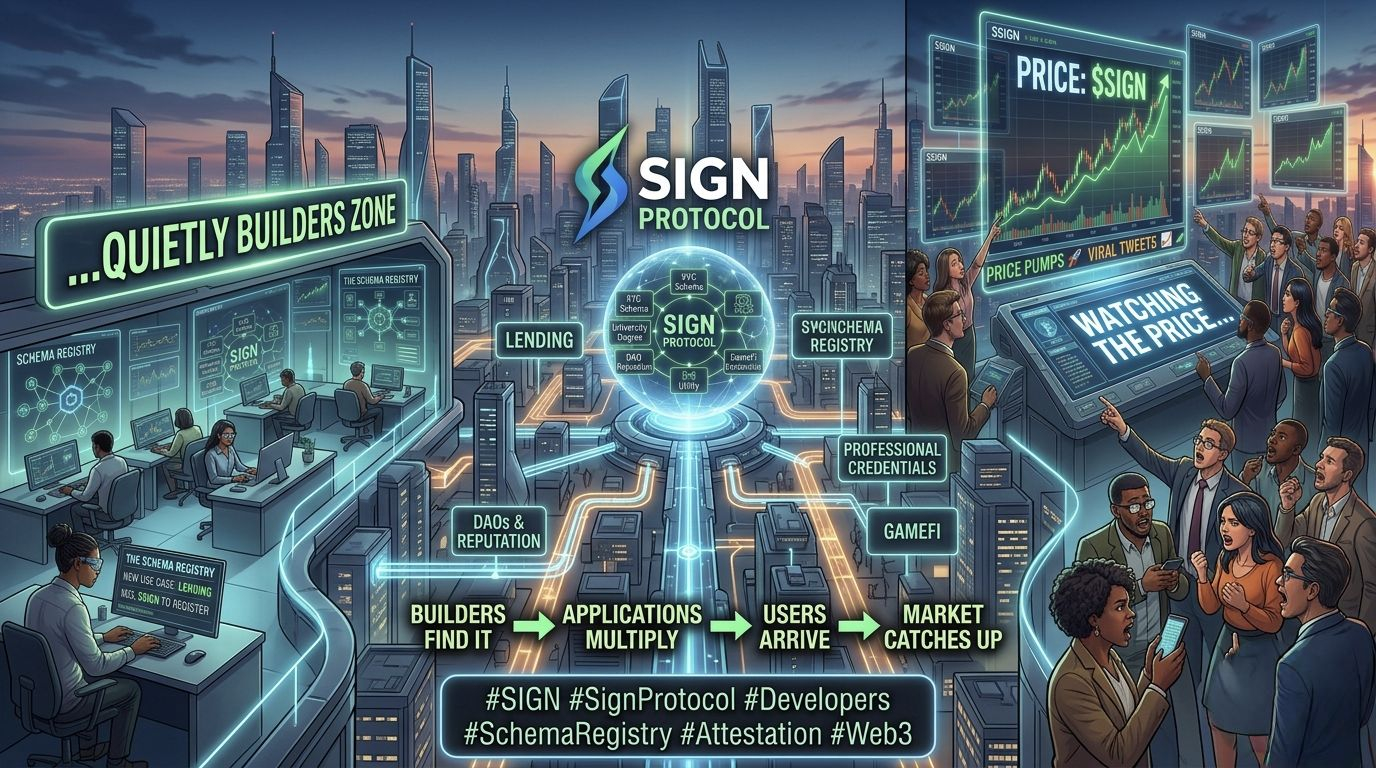
The developers are not wrong.
The projects that win infrastructure races are almost never the ones that pump the hardest in the short term. They are the ones that quietly accumulate developer adoption, build real integrations, solve genuinely hard problems, and let the network effects do the work over time.
Sign Protocol is doing all of those things right now. The Schema Registry is growing. Developers are building. Government clients are integrating. The attestation network is expanding.
The price will eventually reflect what is being built. It always does for real infrastructure.
Go deep on @SignOfficial. Explore the Schema Registry. Read the developer documentation. Look at what is being built on top of this protocol right now while most of the market is still focused on the chart.
The builders found this one already. The question is whether you want to be early or late.