
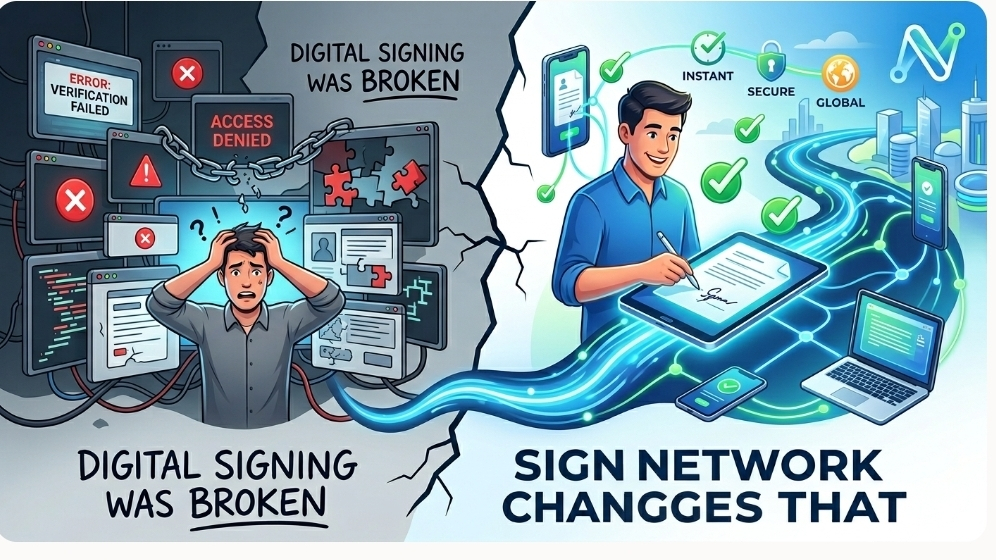
Most people don’t notice broken systems when they still technically work.
You click a button, a wallet pops up, you sign something, and that’s it. No error. No visible issue. Just a quiet sense that you’ve done this before… maybe too many times. The kind of repetition you don’t question at first. It only starts to feel strange later, when you realize none of those actions seem to connect to each other.
I remember helping a friend set up access to a private community. Nothing complicated. Just verify ownership, sign a message, and get in. He did it once. Then again on another app. Then again somewhere else. Same identity, same intent, slightly different flows. At some point he paused and said, half joking, “why am I proving I’m me every five minutes?”
There wasn’t a clean answer to that.
Digital signing, as it exists in most systems, does one thing well. It proves that you agreed to something at a specific moment. That part is solid. Cryptography holds up. The math is not the problem. But outside that moment, the usefulness starts to fade. The signature sits there, tied to a single action, rarely reused in any meaningful way.
So we end up rebuilding trust again and again. Quietly. Inefficiently.
And maybe that was fine for a while. Early systems weren’t designed for constant movement between apps, chains, identities. Things were more contained. Now everything overlaps. Identity travels. Actions depend on past actions. Context matters more than ever, but the tools didn’t quite evolve with that shift.
What Sign Network seems to be doing is less about fixing signatures themselves and more about asking a different question. What if the outcome of a signature mattered more than the signature itself?
That’s where this idea of attestations comes in, though it sounds heavier than it feels in practice.
At a basic level, an attestation is just a claim with proof attached. Something like, this wallet completed a task, or this user meets a condition. The difference is that this claim doesn’t disappear after one use. It stays around. It can be referenced again. It becomes part of a growing record instead of a one-time event.
I didn’t fully get why that mattered until I tried to think of it outside of tech.
It’s closer to how people actually build trust. You don’t introduce yourself from zero every time you meet someone. There’s always some carryover. A shared connection. A past interaction. Even something small. Digital systems, oddly enough, kept ignoring that. Every interaction reset the context.
Attestations don’t completely fix that, but they move things in a more natural direction.
There’s also something slightly unglamorous but important happening underneath. Cost.
Anyone who has spent time interacting on-chain knows that small actions can add up. Not always in obvious ways. Sometimes it’s just hesitation. You think twice before clicking confirm. You delay an action because it doesn’t feel worth the cost right now. Over time, that changes behavior more than we admit.
Sign Network tries to keep these attestations light. Not everything needs to sit fully on-chain. That’s the simple version of a more complex design choice. Data can exist off-chain while still being verifiable when needed. Anchored, but not heavy.
It sounds like a technical detail. It isn’t. It’s the difference between something being used occasionally and something becoming part of everyday flow.
There’s another small shift that I didn’t expect to find interesting, but it stayed with me.
Identity stops feeling like a login process.
In most systems, identity is something you repeatedly prove. You sign in, sign again, confirm again. It’s almost defensive, like the system doesn’t trust its own memory. With attestations, identity starts to look more like a timeline. A set of verifiable moments that build on each other.
Not perfectly. There are still gaps. But the direction is different.
You verify something once, and instead of that proof disappearing into a single app, it can quietly exist in the background, ready to be referenced somewhere else. Not copied blindly, but acknowledged.
It’s a small comfort. You don’t notice it immediately. Then one day you realize you didn’t have to repeat yourself, and it feels… smoother, but not in an obvious way.
Payments change shape a bit too.
Usually, a transaction is final the moment it happens. Simple. Direct. But what if a payment depends on something else? Not a human checking it, but a condition being met. An attestation makes that easier to express. The payment can wait. It doesn’t move until the right proof exists.
I tried to explain this to someone using a simple example. Imagine paying a freelancer, but the payment only completes when a specific milestone is verified. No back and forth. No manual confirmation. Just a condition tied to a verifiable statement.
He nodded, then asked, “so the system trusts the proof instead of the person?”
That stuck with me for a bit.
Because it’s not entirely true. The system still depends on who issues the attestation, how it’s verified, what standards are used. Trust doesn’t disappear. It just shifts layers. Becomes a bit more structured, maybe less personal, but also less ambiguous.
And then there’s the part that developers probably notice more than regular users. Interoperability.
Different environments don’t always play nicely together. Even when they claim to. Moving data across them can feel like forcing pieces to fit. Attestations, when designed carefully, act more like neutral objects. They don’t belong entirely to one system. They can be checked anywhere that understands the rules.
That doesn’t solve everything. But it reduces friction in places where it used to feel unnecessary.
I wouldn’t call any of this a dramatic shift. It doesn’t feel like one.
It’s more like noticing that a process you’ve repeated dozens of times suddenly requires fewer steps. You don’t celebrate it. You just keep going, slightly less annoyed than before. And over time, that small reduction in friction starts to matter.
There are still open questions. How widely will this be adopted? Will developers actually design around attestations, or will they fall back into older patterns? Will users even notice the difference, or will it all stay invisible?
Hard to say.
Something a bit messy, with gaps and overlaps, but still continuous.
And maybe that’s closer to how things should have been from the beginning.
Digital signing wasn’t exactly broken. It just stopped short of where things were heading.
What Sign Network is doing feels less like replacing it and more like extending it quietly, giving those one-time proofs a kind of memory they didn’t have before.
#signdigitalsovereigninfra $SIGN
