
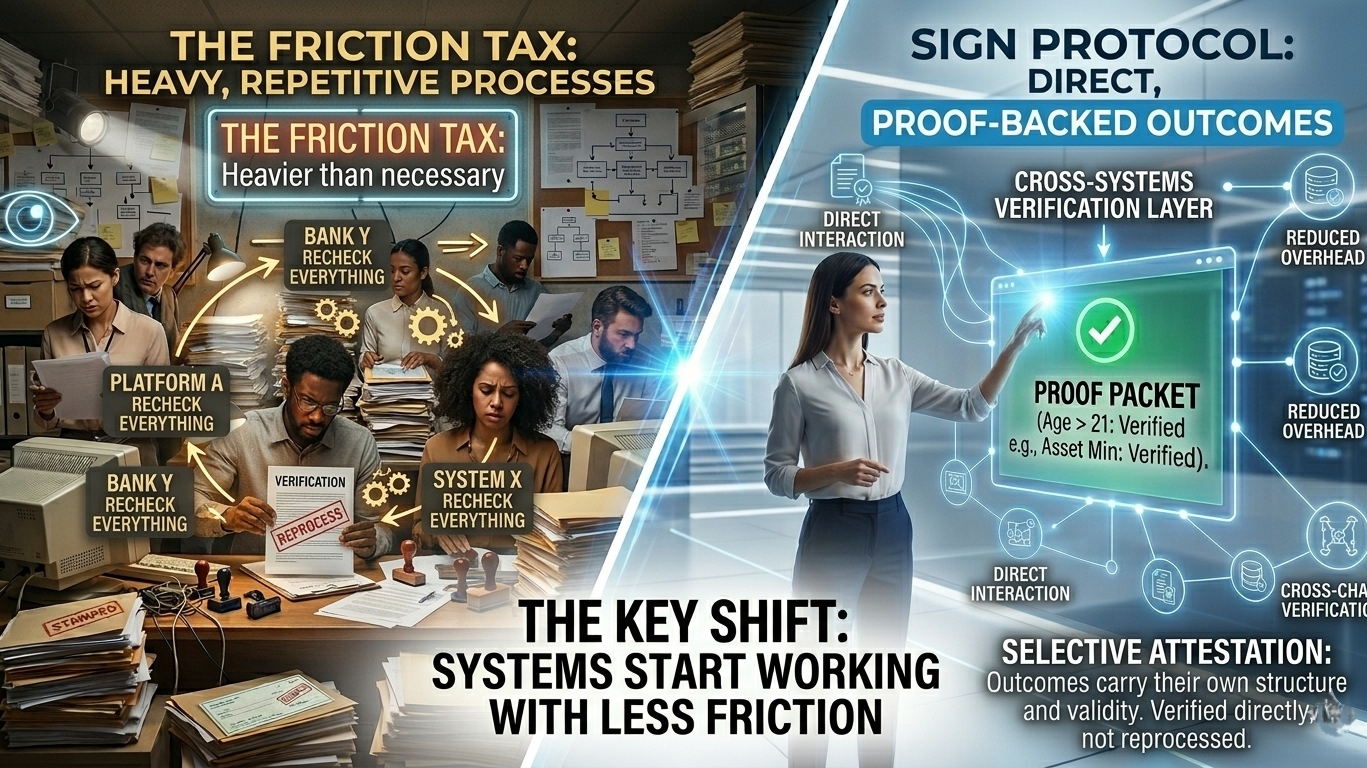


Something I’ve been noticing is that a lot of friction in crypto doesn’t come from lack of technology it comes from how systems interact with each other. Every platform has its own rules, its own structure, and when those systems meet, things slow down. Not because they can’t connect, but because they don’t easily align. One system doesn’t fully understand or trust what comes from another, so it ends up rechecking or rebuilding things again. That’s where Sign Protocol started to make more sense to me not as another feature layer, but as something that reduces that friction at the points where systems meet.
Right now, most interactions between systems feel heavier than they should be. Even simple things turn into multiple steps verification, confirmation, interpretation. A lot of that comes from the fact that systems don’t share a clean way to accept something as already valid. So instead of moving forward, they pause and reprocess. That’s why things don’t scale as smoothly as expected. It’s not always about performance, it’s about how much extra work is being done just to reach the same conclusion.
What Sign seems to be doing is making those interactions more direct. Instead of forcing systems to rebuild trust every time, it allows certain outcomes to carry their own proof. That way, when something moves from one place to another, it doesn’t lose its validity. It arrives with enough structure to be understood and verified without repeating everything again.
I think this also changes how systems evolve. When friction is high, growth naturally becomes slower because every new interaction adds more overhead. But if that friction is reduced, systems can expand without constantly increasing complexity. It’s not about making everything faster it’s about removing the parts that slow things down unnecessarily.
At the same time, this doesn’t force systems into one unified structure. They can still operate independently, define their own rules, and decide what they accept. The difference is they don’t have to treat every external interaction as something that needs to be rebuilt from scratch.
What stands out to me is how practical this approach feels. It’s not trying to redesign how everything works it’s just making interactions smoother where they usually break.
And sometimes, reducing friction is more important than adding new features. @SignOfficial