
Most people do not notice how much of their digital life depends on trust they do not actually control.
Every day, we sign up, log in, verify, submit documents, wait for approvals, and hand over personal information just to prove something simple.
We prove who we are, what we own, what we qualify for, or what we have already done. In Web2, this process feels normal because we have lived with it for so long.
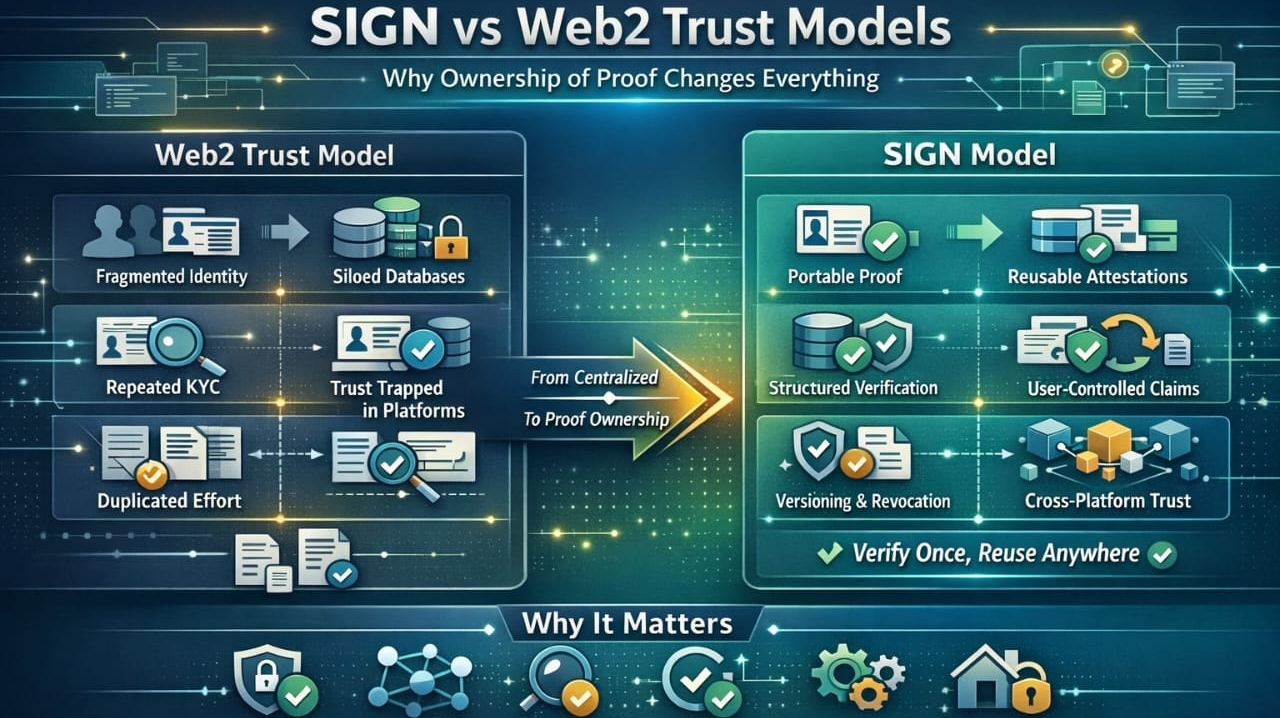
But if you stop and really look at it, the system is deeply inefficient. Your proof lives inside platforms, not with you.
Your identity is fragmented. Your records are scattered. And every new app, service, or institution often asks you to start from zero again.
That is exactly why SIGN feels important.
At its core, SIGN is not just another crypto project trying to add noise to the market. It is trying to solve a very real digital problem:
trust is everywhere, but ownership of proof is missing. In Web2 systems, trust is usually locked inside centralized databases.
A company, institution, or platform becomes the keeper of records, and users are forced to rely on that gatekeeper each time they need to prove something.
You may have the history, the work, the credentials, or the eligibility, but the proof is rarely portable. It belongs to the system that issued it, not to the person who earned it.
SIGN changes that model in a meaningful way.
Instead of treating proof like something trapped inside one platform, SIGN treats it like something that can be created, verified, and carried across systems.
That shift may sound technical on the surface, but its impact is very human. It means a person, community, or institution can issue attestations that hold value beyond a single website or company.
It means proof becomes reusable. It means trust can move with the user instead of being constantly rebuilt from scratch.
And that changes everything.
This is where SIGN stands apart from traditional Web2 trust models. Web2 says, “Trust us, we have your data.”
SIGN says, “Own your proof, and let it work wherever it is needed.” That is a much stronger foundation for the digital future.
When proof is portable, the internet becomes less dependent on repeated verification, less dependent on over-sharing private data, and less dependent on centralized approval systems that control access from the top down.
There is also something deeper happening here. SIGN is not only improving efficiency.
It is redefining digital power. In old systems, institutions hold the evidence, and users request access. In a proof-based model like SIGN, users and entities can interact through verifiable claims that are transparent, structured, and reusable.
That creates a new kind of digital relationship, one built less on blind trust and more on provable truth.
This matters because the internet is evolving. We are moving into a world where online identity, credentials, community participation, governance rights, financial access, and even reputation will matter more than ever.
In that world, the projects that win will not just be the loudest. They will be the ones building infrastructure that makes digital trust scalable and useful.
SIGN is entering that conversation from a strong position because it is building around a fundamental need, not a temporary trend.
From an investment and coin perspective, that is what makes SIGN worth watching. A token tied to hype can rise quickly, but it can also fade just as fast.
A token connected to infrastructure has a different kind of potential.
Its long-term value depends on whether the network becomes part of how digital systems actually function.
If SIGN continues growing as a layer for attestations, verification, and trust coordination, then its value may come from relevance, not just speculation.
That is an important difference.
The real promise of SIGN is not simply that it exists on-chain.
The real promise is that it helps move trust away from closed platforms and toward user-controlled proof.
In a digital world filled with repeated checks, endless forms, and fragmented identity, that is not a small improvement. It is a structural change.
And that is why SIGN deserves attention.
Web2 made the internet usable, but it left trust trapped inside institutions.
SIGN points toward a future where proof becomes portable, ownership becomes real, and trust becomes something people can actually carry with them.
If that future continues to unfold, then SIGN may not just be another project in the market. It may become part of the foundation of how the next internet works.
