
Yes — this needs to sound less like a write-up and more like a real person thinking out loud.
Here’s a much more human version:
I’ve been thinking about how broken trust actually is, and how weird it is that people still pretend it isn’t.
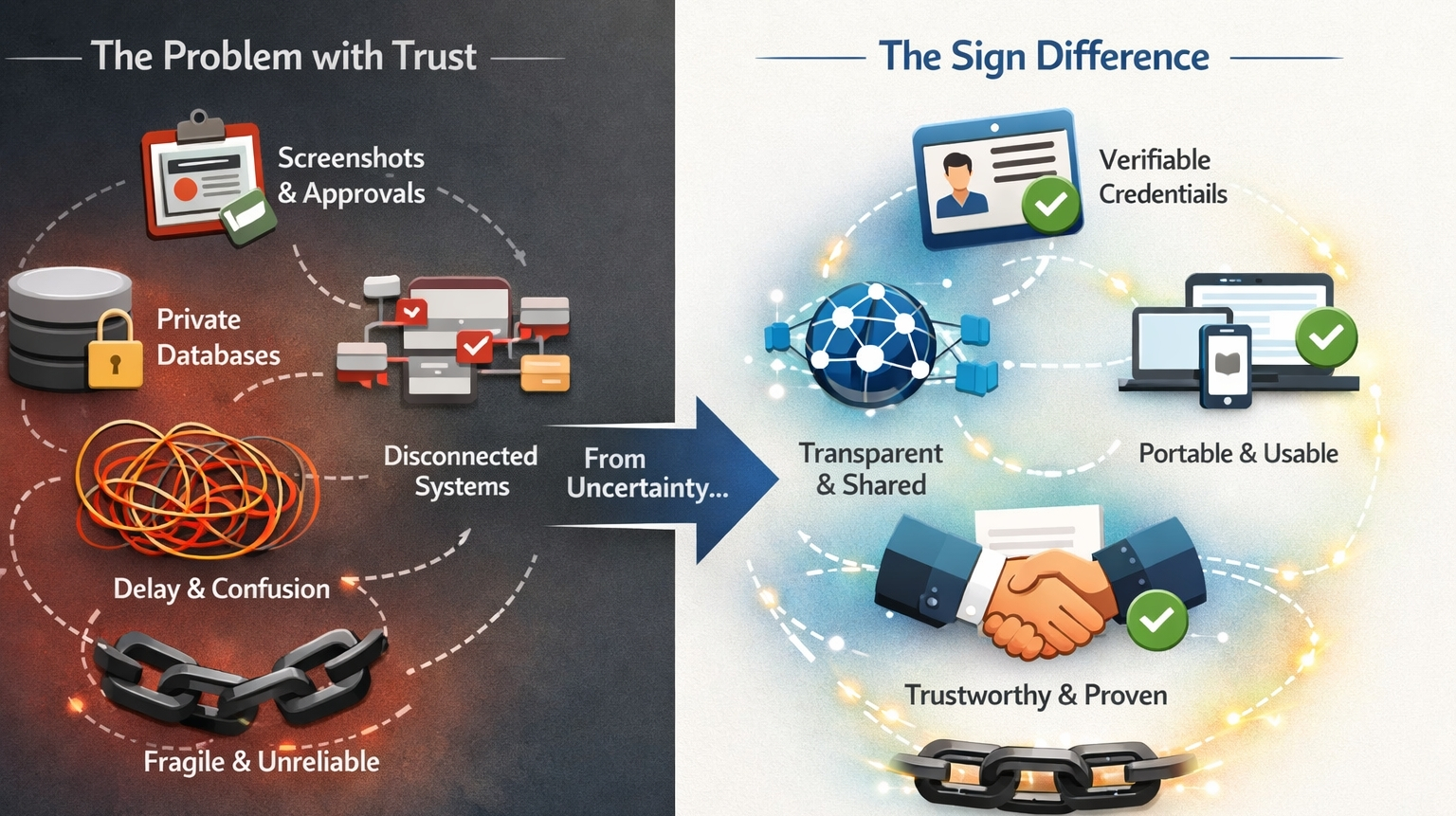
Everyone talks like verification is already handled. Like distribution is already fair. Like the systems behind identity, credentials, and access are solid enough to rely on. But that’s just not true. Most of it is patched together. Half of it depends on screenshots, private databases, manual approvals, and someone somewhere saying yes, this looks right.
That’s not infrastructure. That’s habit.
And the thing that gets me is how normal this has become. People are so used to delays, confusion, bad records, missing context, and systems that don’t speak to each other that they barely react anymore. A person proves who they are in one place and has to do it all over again somewhere else. A team distributes tokens and calls it transparent, but nobody outside the circle can really check what happened. A credential exists, but only inside the platform that issued it, which means it’s not really portable, not really useful, not really proof in the way people pretend it is.
This is where Sign starts to feel different to me.
Not because it comes with some huge fantasy about changing the world overnight. Honestly, I trust it more because it doesn’t need that kind of performance. The idea is simple in a serious way: if something matters — a credential, a claim, a distribution, an entitlement — then it should be verifiable, usable, and able to move across systems without turning into a mess.
That sounds obvious. It isn’t.
Most systems are built around appearances. Sign feels built around consequences. What happens when a business needs to prove something clearly. What happens when a user needs access based on a credential that should already count. What happens when tokens are distributed and the process actually needs to hold up under scrutiny instead of just looking clean in a thread or a dashboard.
That’s real life. That’s where most of the shiny ideas start falling apart.
And maybe that’s why this stands out. It’s not trying to hypnotize people with abstraction. It’s dealing with one of the most practical problems there is: how do you make proof usable? How do you make distribution credible? How do you build systems that don’t collapse the second trust gets tested?
Because that’s the truth underneath all of this. Trust is easy to talk about when nothing is at stake. It gets harder when money moves. When access is limited. When recognition matters. When someone needs to prove they belong, or earned something, or should receive something, and the system in front of them shrugs.
Sign makes sense to me because it seems focused on that moment. The moment where the claim has to become real.
And I trust that a lot more than hype.