
The Middle East is undergoing a decisive shift toward economic diversification—and at the heart of this transformation lies the need for advanced digital infrastructure. Existing deployment models fall short, often requiring a difficult trade-off between total public transparency and isolated private networks. Sign (@SignOfficial ) introduces a new approach: a protocol engineered for practical, real-world solutions. This article examines how $SIGN could become the foundation for the digital future of the region.
The Power of Real-World Hybrid Models
Many blockchain solutions are designed for a theoretical, decentralized world, but true enterprise and governmental adoption requires flexibility. Sign (available on Binance as $SIGN ) is built for the complexity of the modern digital sovereign infrastructure. The key is in its adaptable deployment models. Instead of forcing a one-size-fits-all solution, Sign enables organizations to deploy where it makes the most sense. This is critical for the Middle East, which balances rapid modernization with strict sovereign data and payment regulations.
Unlocking Efficiency through Custom Deployment
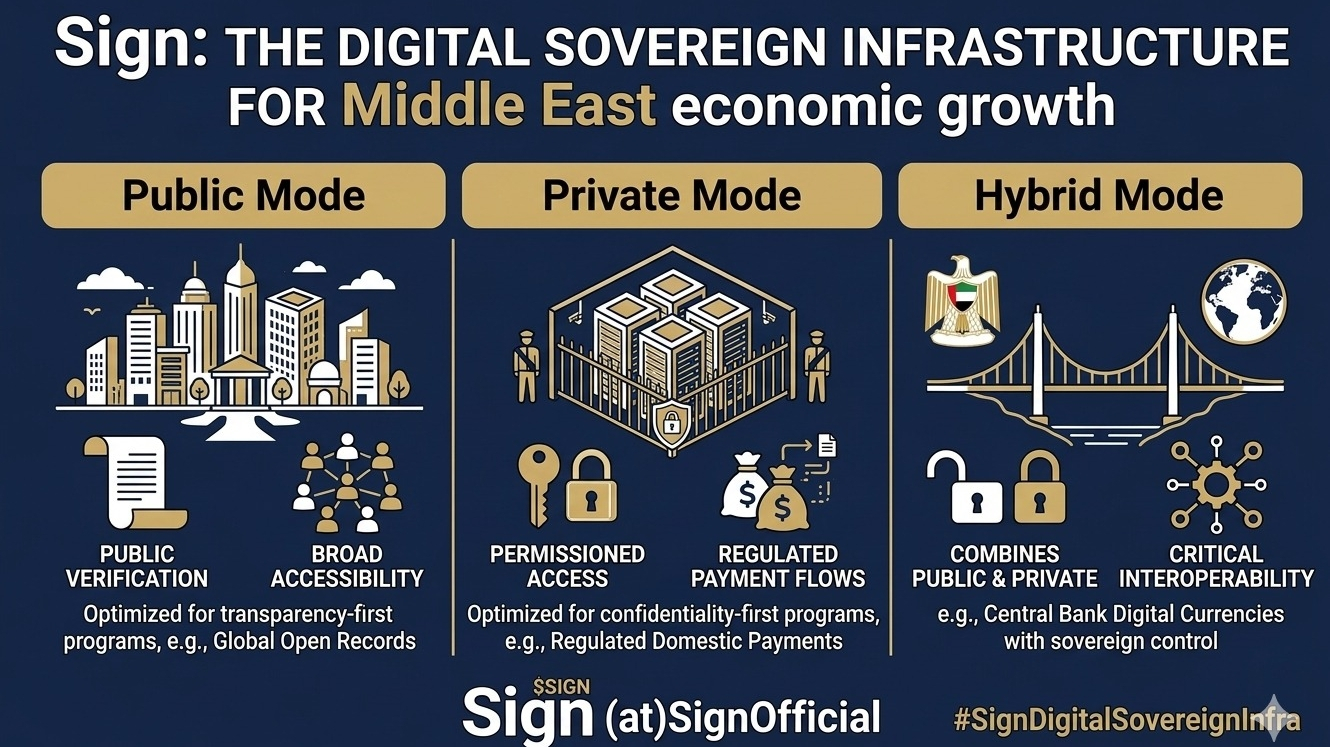
Sign provides a spectrum of choices, each tailored for specific needs:
Public Mode: The Foundation for Global Openness
Public Mode provides transparency and wide accessibility, making it suitable for public records, cross-border remittance, or streamlined procurement, with governance managed through chain or contract mechanisms.
Private Mode: Securing Domestic Operations
When it comes to highly sensitive data, such as regulated domestic payment flows or specific government programs, Public Mode is often a non-starter. Private Mode handles this scenario with precision. Governance is enforced through complex per missioning, membership controls, and detailed audit access policies. This provides a high-security, permissioned ledger for internal operations.
Hybrid Mode: The True Catalyst for Sovereignty
The real strength of Sign lies in the Hybrid Mode. This allows a nation to combine public verification with private execution. For example, a central bank digital currency (CBDC) could have private transactional data that stays within the country (Private Mode), while the overall monetary supply and critical public-facing events are verifiable by all (Public Mode). In a Hybrid deployment, interoperability is treated not as a bonus but as critical, explicit infrastructure with clear trust assumptions.
Sign ($SIGN ) provides the technological bridge that can fuel the Middle East's economic engine, offering the precise blend of transparency and control needed to build true digital sovereign infrastructure.
Here is the image that visually summarizes the core concepts of the article.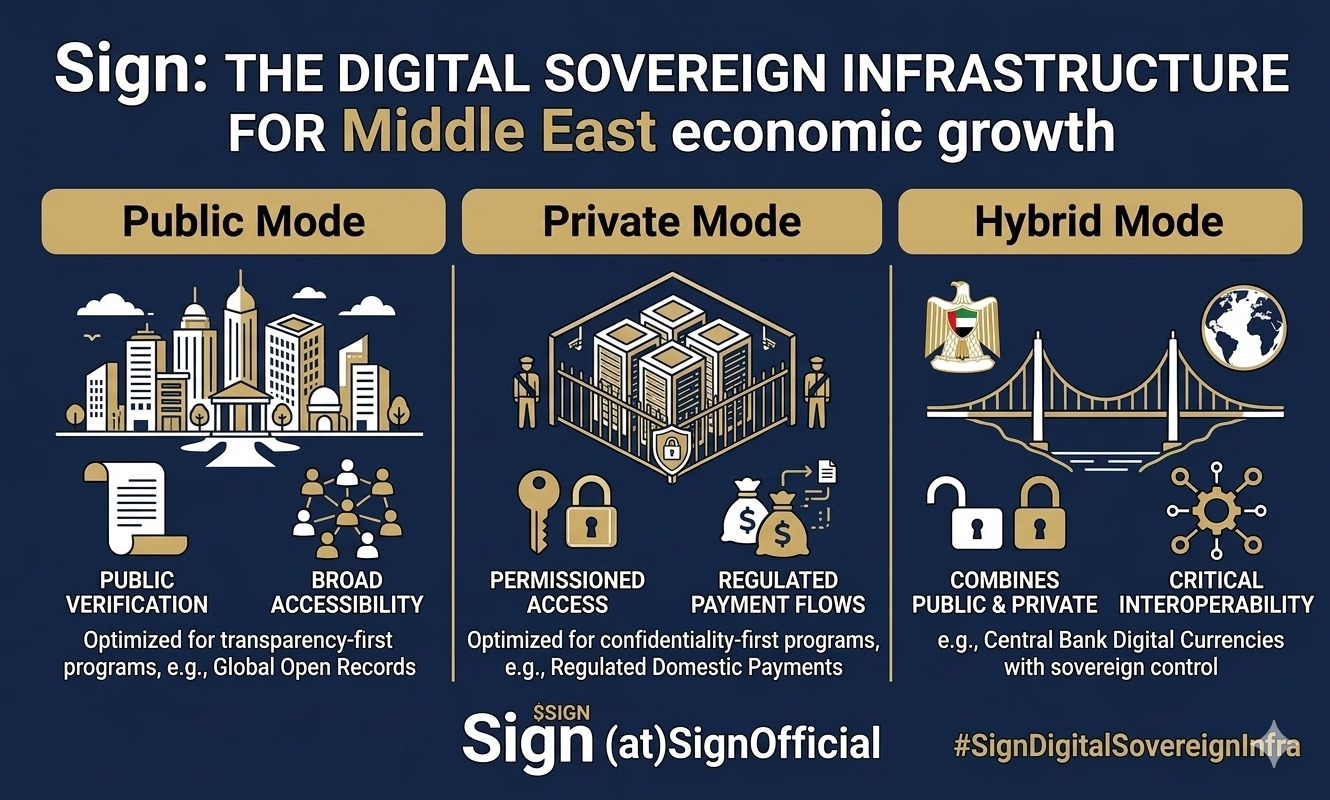
@SignOfficial #signdiditalsovereigninfra #SİGN #BTC #bnb


