
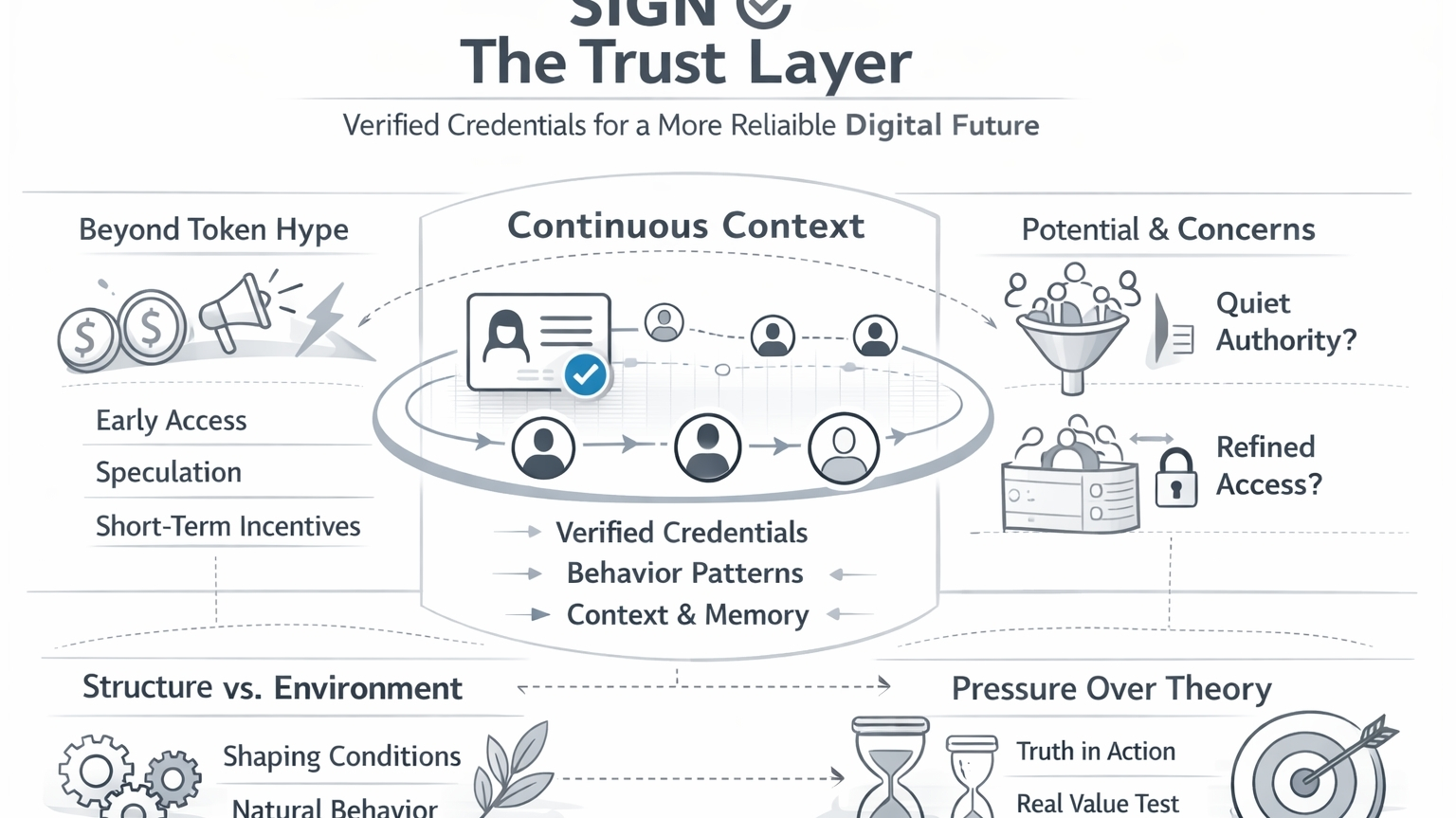

I didn’t come across SIGN at a moment of excitement. If anything, I found it during one of those quieter phases where the noise had already settled and what remained was a kind of dull repetition. New projects still appeared, but they felt familiar in a way that made me question whether anything structural was actually changing. So when I first looked at SIGN, I didn’t approach it with optimism. I approached it with fatigue.
I’ve seen enough systems built around token distribution to recognize the pattern. At the surface, they talk about fairness, alignment, and community. But underneath, I usually find the same mechanics—early access, asymmetrical information, and incentives that quietly push people toward short-term decisions. I’ve participated in those systems myself. I’ve exited early when it made sense. And each time, I couldn’t really blame the system or the participants. The design made those outcomes rational.
That’s where SIGN started to feel slightly different to me—not because it promises to fix behavior, but because it seems to look at the layer before behavior begins. I find that important. Most systems react to outcomes. Very few try to shape the conditions that lead to those outcomes in the first place.
When I think about credential verification in SIGN, I don’t see it as just identity. I see it as context. And I think context is something this space has been missing for a long time. We reduce everything to wallets and transactions, as if participation can be understood in isolated moments. But I’ve never experienced it that way. People carry patterns. They repeat behaviors. They move through cycles with memory, even if the system ignores it.
If SIGN is actually capturing that layer—if it’s recognizing participation as something continuous rather than fragmented—then it’s not just building infrastructure. It’s redefining how value gets assigned. And I think that’s where things become interesting, but also uncomfortable.
Because I’ve learned that the moment you start verifying credentials, you’re also deciding what counts as valid participation. And I don’t think that’s a neutral act. I think it introduces a form of quiet authority, even if it’s decentralized on paper. I’ve seen how easily systems drift from open participation to filtered access, not through explicit rules, but through subtle design choices.
So I can’t look at SIGN and feel completely convinced. There’s a part of me that sees the potential, and another part that remains cautious. I’ve been in this space long enough to know that good ideas don’t always translate into resilient systems. Sometimes they just create more refined versions of the same problems.
I also find myself questioning whether better distribution actually solves anything long-term. I’ve watched systems with “fair launches” still end up in the same place—concentrated ownership, declining engagement, and eventual disillusionment. It makes me wonder if we overestimate how much structure can influence behavior.
At the same time, I can’t ignore the possibility that structure does matter—just not in the way we usually expect. Not as control, but as environment. I think about systems outside crypto that work well, and I notice they don’t force outcomes. They make certain behaviors feel natural. If SIGN is moving in that direction, then its impact won’t be obvious at first. It will show up slowly, in how people choose to act without being told.
What I keep coming back to is this: I don’t think SIGN is something I can evaluate in isolation. I need to see it in motion. I need to see how people interact with it when there’s real value at stake, not just theory. Because I’ve learned that systems reveal their truth under pressure, not in design.
@SignOfficial #SignDigitalSovereignInfra $SIGN
