
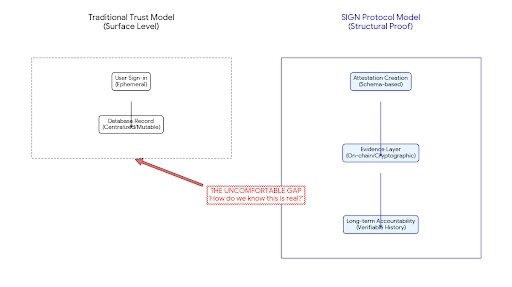
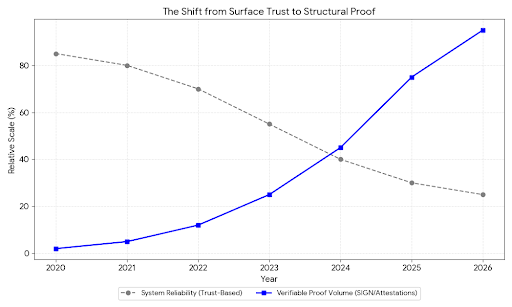
 I have been circling around this idea for some time now and I cannot really point to the exact moment it clicked. It just kept showing up in small ways across different systems I have seen or worked around. Everything seems smooth on the surface. People sign in things get approved data flows from one place to another and no one really questions it. It all feels normal until someone asks a very basic question later on how do we actually know this was real. That is usually where things start to fall apart a little
That uncomfortable gap is what slowly got me paying attention to SIGN. Not because it was being hyped everywhere but more because it seemed to be looking directly at that exact problem most people tend to ignore
At the beginning I was honestly a bit skeptical. I have seen too many projects claim they are fixing trust only to end up creating another system that still requires trust anyway just in a slightly different form. It becomes more layers not less confusion. But as I spent more time trying to understand what is actually being built here it started to feel less like a surface level idea and more like something structural quietly sitting underneath everything
The way I see it SIGN is not trying to be an app people interact with every day or a flashy identity tool that promises quick verification. It feels more like a base layer that focuses on recording proofs in a way that does not fall apart later. Instead of simply saying you can trust this person or this data it tries to preserve the reason behind that trust so it can still be checked long after the moment has passed
That shift sounds small when you first hear it but it actually changes how systems behave over time. Right now most platforms are built around speed and ease. They want things to work instantly and smoothly which makes sense but it also means they are not really designed for long term accountability. Information gets updated replaced or disconnected from where it originally came from. So when something needs to be verified later there is often no solid trail to follow
SIGN seems to be approaching things from the opposite angle. It treats information like something that might be questioned in the future not just something that needs to work right now. That alone makes it feel more aligned with how real world systems should probably operate
Of course a big part of this relies on blockchain and that part is not surprising. Blockchains are already known for keeping records that are hard to change once they are written. But what stands out here is not just the use of blockchain itself but how the data is being structured. It is not about dumping information onto a chain and calling it secure. It is about creating attestations that other systems can read and verify without needing to blindly trust each other
That detail matters more than it seems because most systems today still operate in isolation even when they claim to be connected. There is always some level of dependency on a central authority or a single source of truth which becomes a weak point over time
When I step back and look at the bigger picture it starts to make more sense why something like this is being built now. The market feels noisy again with constant shifts in attention and fast moving narratives. It is easy to get caught up in that surface level activity but underneath it there is a quieter effort happening where people are still building the foundations
Blockchain adoption has always felt a bit uneven. There is a lot of talk and a lot of tools but when it comes to real world reliability things still feel fragmented. Identity is not consistent data does not always connect properly and verification often depends on who you choose to trust rather than what can actually be proven
That is where SIGN begins to feel relevant in a more grounded way. It is not trying to replace everything or promise some perfect solution. It is just focusing on making the underlying logic stronger so that systems can hold up better over time
I do not think it solves every problem and there are still open questions about how widely it will be used or how developers will build around it. But it has that feeling of something that could slowly become important without making a lot of noise
Maybe that is the part I find most interesting. If it really works it probably will not look like a big breakthrough moment. It will just feel like fewer things break when someone asks for proof and honestly in a space where so much relies on assumptions that kind of quiet improvement might matter more than anything loud ever could.