
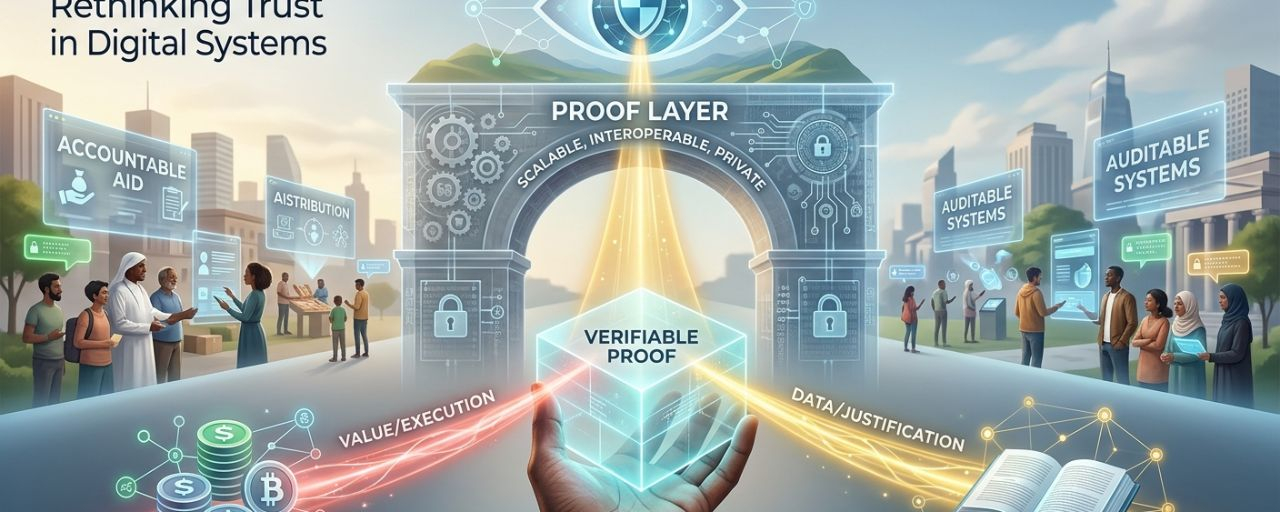
I’ve been thinking a lot about how we build systems that actually help humanity move forward, and I keep coming back to this idea of a “proof layer.” To me, it challenges a common belief in tech that simply digitizing something automatically makes it better.
We’ve already seen the limits of that thinking. Blockchain solved real problems like double-spending and made value more portable, but it didn’t automatically solve trust or governance. In many cases, onchain systems just recreate old inefficiencies, only faster leakage still happens, transparency is often selective, and control can still be abused. What stands out to me about the proof layer is that it’s not just about adding cryptography it’s about making systems verifiable while still respecting privacy and human dignity.
That’s why I find @SignOfficial approach interesting. It feels like it reframes how we think about institutions. Instead of treating governments or organizations as all-seeing authorities, it positions them more as coordinators within a system. I like the separation of roles data provides justification, money handles execution, and proof connects the two. That kind of structure feels more scalable and less prone to abuse.
At the same time, I try to stay grounded. Any system like this depends heavily on execution. If the proof layer becomes centralized or controlled by a single entity, it could end up creating the same risks it’s meant to solve. That’s why open, omni-chain attestations matter. They allow different governments or communities to run their own systems while still staying interoperable globally.
If this is done right, the real-world impact could be meaningful. Public systems could become more precise and accountable, with aid reaching the right people more efficiently. It could reduce waste, improve auditability, and still protect people’s privacy instead of exposing them to unnecessary risk.
I also think about the broader environment we’re in. Trust is getting harder to establish. With misinformation, deepfakes, and fragmented systems, it’s increasingly difficult to verify what’s real. In that sense, a proof layer isn’t just a nice-to-have it feels like foundational infrastructure for the next stage of digital systems.
For me, it’s less about hype and more about whether this can actually deliver real improvements in how systems work in practice. Early sovereign pilots and real-world use cases will be important in proving that.
If you’re building in GovTech, FinTech, or Web3 public goods, this is a space worth paying attention to. Money without proof is just faster paper. Proof without money is just static data. But together, with the right structure, they can form something much more meaningful a system that’s both efficient and more human-centered.
In Conclusion:
Ultimately, what excites me most is the direction this represents. A system where trust is verifiable, privacy is preserved, and outcomes are more accountable feels like a necessary evolution not just for crypto, but for how we design public infrastructure. We’re still early, and execution will decide everything, but the foundation being built here has the potential to reshape how trust and value move in the digital world.