
That feeling says a lot more about these systems than any whitepaper ever could.
Because if you listen to how people usually talk about global credential verification, it sounds almost too clean. The idea is simple: prove something once, store it on-chain, and now it’s trustworthy everywhere. Identity, reputation, eligibility all turned into neat little proofs that any app can read.
And yeah, systems like SIGN are genuinely pushing that idea forward. They’ve already handled millions of on-chain attestations and distributed billions in tokens to tens of millions of wallets.
That’s not theoretical anymore that’s real usage at scale.
But here’s where things get more interesting.
I remember watching one of those big airdrop campaigns. People were excited, checking if they qualified, comparing results. Some got rewards, some didn’t. And almost immediately, questions started popping up:
“Why did this wallet qualify but not mine?”
“I did the same tasks why is my reward different?”
Technically, everything was verified correctly. The system did what it was supposed to do. But the experience didn’t feel fully fair or clear.
That’s the gap no one really talks about.
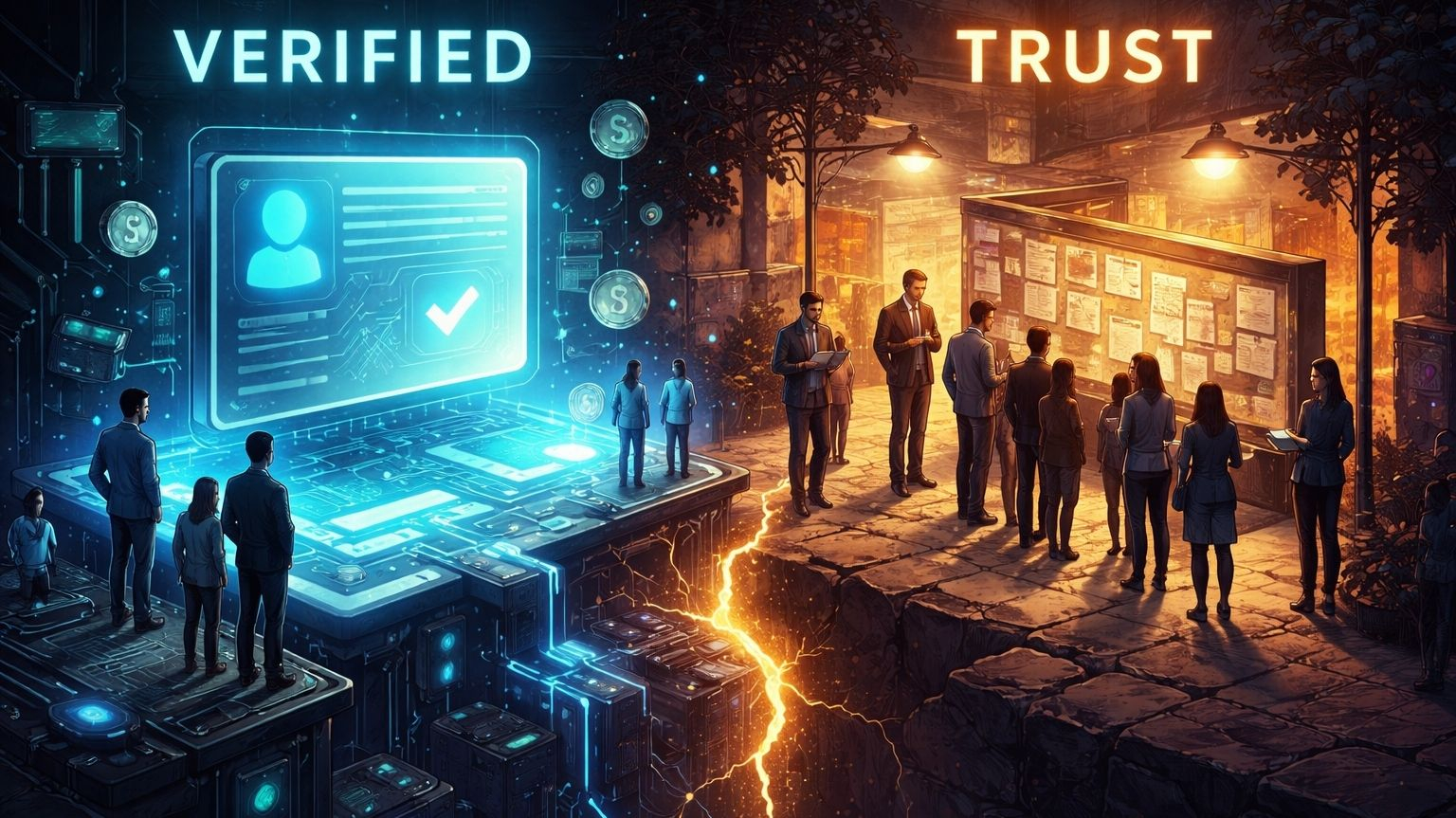
We assume verification equals trust. But in reality, verification just means the system can prove something happened. It doesn’t mean people will agree with how that proof is used.
Take a simple example. Imagine a DAO using SIGN to verify contributors. You complete tasks, earn credentials, and later those credentials decide whether you get tokens. On paper, it’s perfect: transparent, on-chain, verifiable.
But in practice, things get messy.
Maybe one contributor worked deeply on one task while another did ten smaller ones. Both get “proofs,” but how do you compare them? The system has to simplify that complexity into something measurable. And the moment it does that, it starts flattening reality.
That’s the trade-off.
SIGN is built around this idea of turning identity, actions, and eligibility into reusable on-chain attestations basically making trust composable across apps.
It sounds powerful, and it is. But it also means very different kinds of human activity get translated into the same language: structured data.
And translation always loses something.
Another example: think about KYC-style verification. One user proves their identity through a strict government process. Another earns reputation through community activity. Both can exist as credentials in the same system.
But are they equal? Should they be treated the same in a token distribution?
The system doesn’t answer that. It just processes what it’s given.
This is where things start to feel less like technology and more like judgment.
What I find interesting about SIGN is that it doesn’t just stop at verification. It connects that layer directly to token distribution through tools like TokenTable that handle airdrops, vesting, and rewards at scale.
So now, proofs don’t just sit there. They do something. They unlock value.
And that changes the pressure on the system completely.
When nothing is at stake, verification can afford to be imperfect. But when rewards, money, or access depend on it, every edge case suddenly matters. Every small inconsistency becomes visible.
At smaller scale, you don’t notice this much. But when you’re distributing to millions of users across different chains, different behaviors, and different assumptions… things stretch.
Even if the logic is correct, people will still question the outcome.
That’s where most systems quietly struggle not in proving things, but in making those proofs feel right.
I think that’s why SIGN is moving toward something bigger than just a protocol. The recent direction talking about national-level infrastructure, identity systems, even capital distribution shows they’re trying to plug into real-world systems, not just crypto-native ones.
And that’s a whole different level of complexity.
Because now you’re not just dealing with users and wallets. You’re dealing with governments, regulations, and different definitions of identity and fairness. What counts as a valid credential in one country might not mean anything in another.
So the system has to balance two forces that don’t naturally fit together.
On one side, you have opennessanyone can create and verify credentials.
On the other side, you have authority
some credentials matter more because of who issued them.
You can’t fully optimize for both.
And that’s probably the most honest way to look at all of this: not as a clean solution, but as a constant balancing act.
What makes a system like SIGN interesting isn’t that it solves trust. It’s that it tries to operationalize it
turn it into something that can run at scale, across different environments, with real consequences attached.
The real test isn’t whether it can verify millions of credentials. It already can.
The real test is what happens when those credentials start to shape outcomes in messy, human systems—when people depend on them, question them, and push against them.
Because in the end, trust isn’t just about being provable.
It’s about being accepted.
And that part is still very much in progress.
#SignDigitalSovereignInfra $SIGN @SignOfficial
