
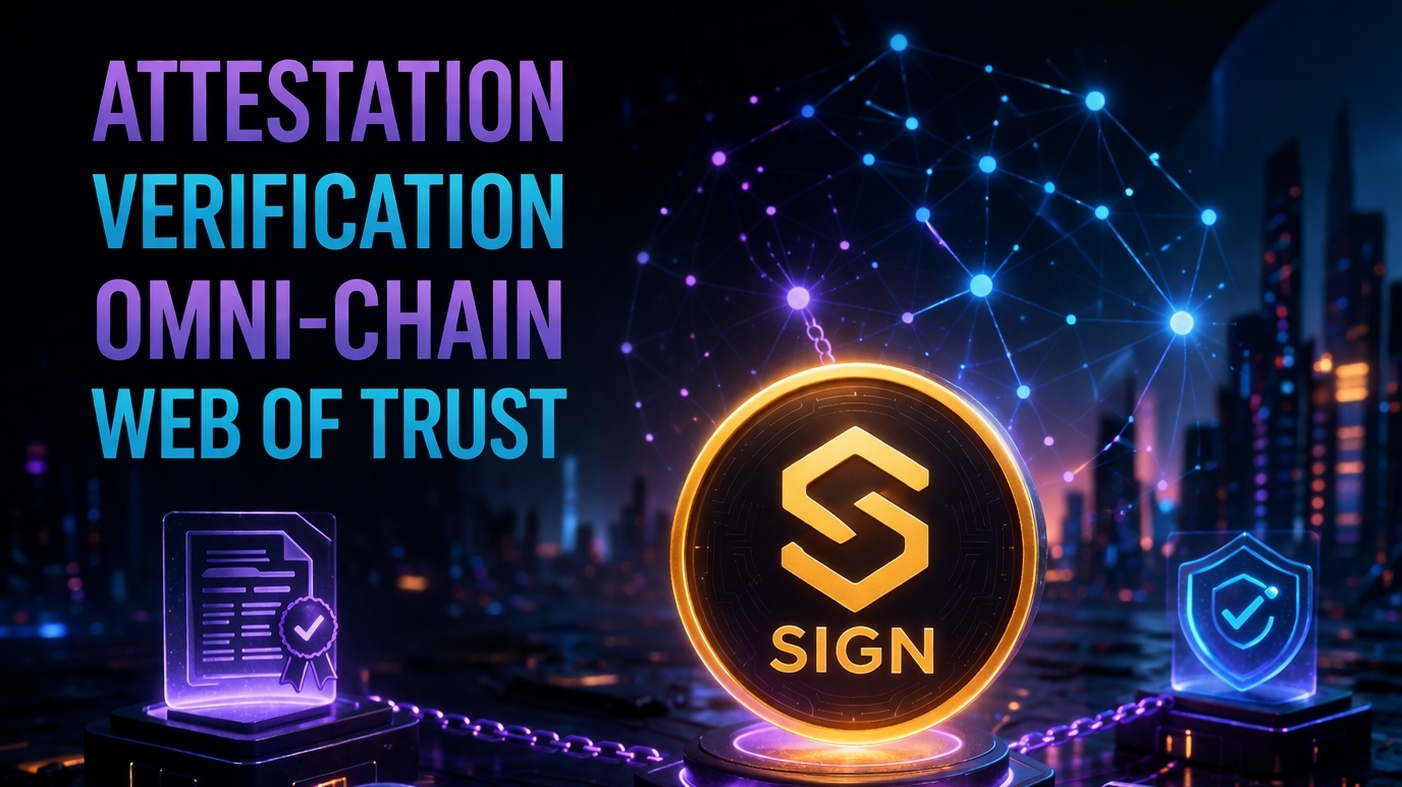
#signdigitalsovereigninfra $SIGN
In an era where information is ubiquitous but authenticity is scarce, Sign Protocol (SIGN) emerges not merely as a technical utility, but as a philosophical answer to the "Crisis of Truth" in the digital age. Based on its whitepaper, the project seeks to build a universal attestation layer—a decentralized ledger designed to verify the integrity of data across the fragmented landscapes of Web3.
The Logic of Attestation
At its core, Sign Protocol operates on a simple, yet profound logical premise: If it isn’t verifiable, it isn’t a fact. In our current digital existence, we rely on centralized gatekeepers to validate our identities and achievements. Sign Protocol disrupts this by decentralizing the "stamp of approval." Whether it is a professional certification, a social reputation score, or a complex financial audit, the protocol allows these "attestations" to be recorded on-chain, making them immutable and globally accessible.
A Philosophical Shift: From Trust to Verification
Philosophically, Sign Protocol moves us away from blind trust toward programmatic certainty. In a world of deepfakes and data manipulation, the protocol acts as a digital "anchor." It doesn't just store data; it provides a framework for Social and Technical Consensus. By being "Omni-chain," it acknowledges that truth should not be siloed. If a fact is true on Ethereum, it remains true on the BNB Chain. This creates a unified "Web of Trust" that transcends individual networks.
The Interactive Future
Imagine a future where your digital interactions—the DAO votes you cast, the code you contribute, the credentials you earn—are all woven into a verifiable "On-chain Resume." This is the interactive potential SIGN offers. It empowers developers to build applications where reputation actually matters and where sybil attacks (fake accounts) become economically and logically impossible.
Final Verdict
Sign Protocol is more than a token; it is the infrastructure for integrity. It challenges us to rethink how we prove our reality to a machine and to each other. By turning abstract trust into tangible, cryptographic proofs, SIGN is laying the foundation for a more honest and interconnected digital civilization.