
What keeps bothering me about digital systems is not what they show on the surface, but what they quietly fail to preserve underneath. Everything looks organized at first glance—there are dashboards, exports, approval chains, and final reports. But the moment someone asks a simple question like why did this person receive funds, the system starts to feel incomplete. Not broken in an obvious way, but fragmented enough that no single place holds the full answer.
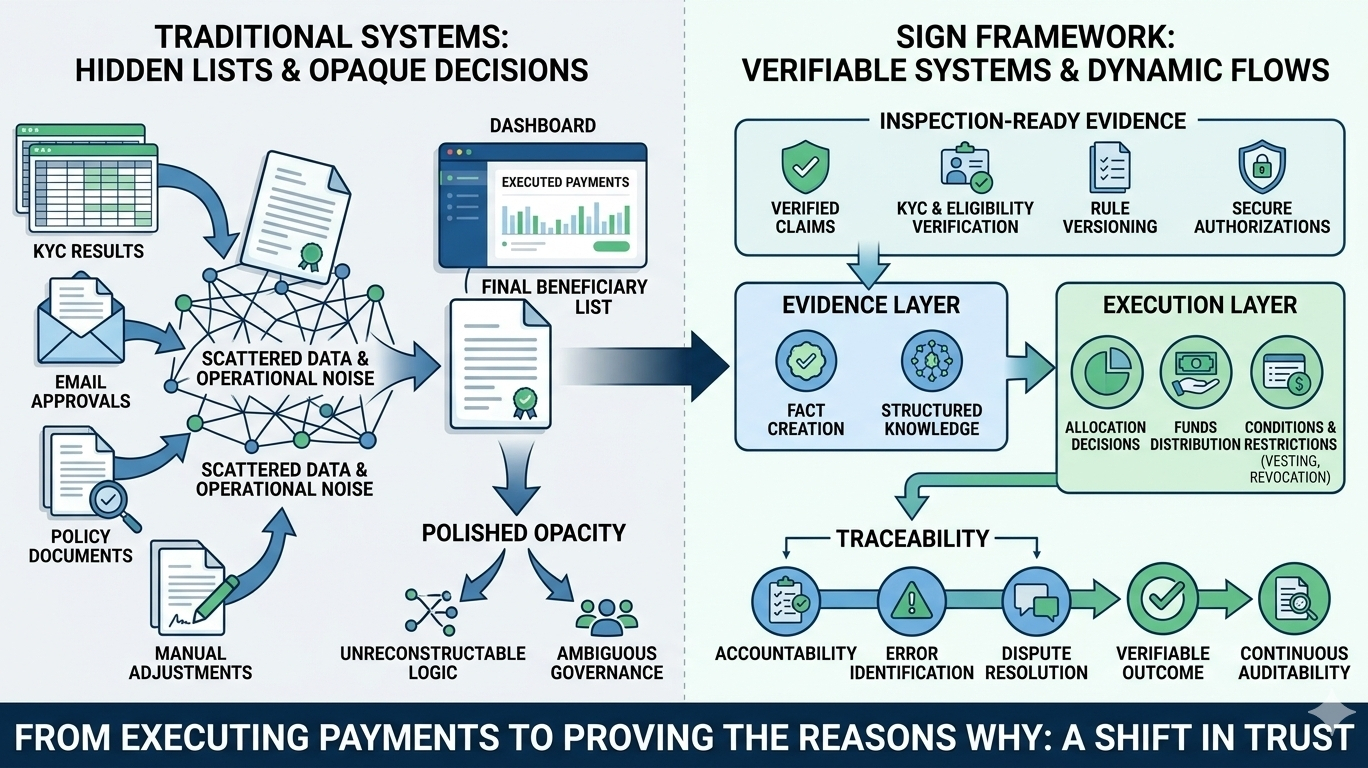
I’ve seen this pattern repeat more than it should. A beneficiary list gets finalized, funds are distributed, and everything appears to move smoothly. But when you try to trace the reasoning behind that list, it becomes scattered across multiple layers. Some of it exists in spreadsheets, some in KYC results from external providers, some in email approvals, and some in policy documents that may or may not still be relevant. Each piece tells part of the story, but none of them carry the full picture. The system records the outcome, but not the thinking that led to it.
That’s why beneficiary lists feel more authoritative than they actually are. By the time a list is complete, most of the decision-making process has already disappeared into operational noise. Someone marked an applicant as eligible. Someone else approved it. A field might have been adjusted at the last moment. But the final list doesn’t reflect any of that context—it simply presents the result as if it speaks for itself. And over time, that result starts being treated as truth, even when its foundation is unclear.
From what I understand, this is exactly the kind of structural gap Sign is trying to address. Instead of focusing only on making distributions faster or more automated, the emphasis seems to be on making them explainable. The idea of “inspection-ready evidence” stands out here, because it shifts attention away from outputs and toward the underlying process. It suggests that every step—claims, approvals, authority, rules, and execution—should remain visible and reconstructable, even long after the transaction is complete.
This approach feels different because it separates what most systems tend to combine. On one side, there is the evidence layer, where facts are created, verified, and structured. On the other, there is the execution layer, where decisions are applied—allocations are made, funds are distributed, and conditions like vesting or revocation are enforced. That separation matters. It means the system isn’t just acting; it is also preserving the logic behind its actions.
What makes this more meaningful to me is that it addresses a deeper issue than efficiency. Most discussions around digital infrastructure focus on speed or automation, but those are not always the real bottlenecks. Systems can already move money quickly when required. The harder challenge is being able to explain, with clarity and confidence, why a specific decision was made. And that is where many existing systems struggle—not because they lack data, but because they lack continuity.
Automation, in fact, can sometimes make this worse. A system-generated output often looks cleaner and more reliable than a manual one, but it can also hide more of the underlying logic. Decisions become embedded in code, approvals become abstracted into workflows, and the reasoning becomes harder to inspect. What you get is not transparency, but a more polished form of opacity—one that is harder to question precisely because it looks so complete.
Thinking in terms of flows instead of lists changes that dynamic. A list is static—it captures a moment. A flow, on the other hand, captures a sequence. It forces the system to account for each step: how evidence was created, how eligibility was determined, how authorization was granted, and how execution followed. It also leaves room for what happens after—reporting, auditing, and even reversal if necessary. This kind of structure does not just produce results; it preserves the path that led to them.
That preservation is what makes traceability possible. And traceability is where the real value lies. When a system can clearly show who made a decision, under what authority, using which version of the rules, it becomes much easier to understand outcomes. Errors can be identified more accurately. Disputes can be resolved more fairly. And accountability becomes something that is built into the system, rather than reconstructed after the fact.
There is also a governance dimension to this that is easy to overlook. Opaque processes do not just create technical inefficiencies—they create space for ambiguity. When decisions are not fully traceable, it becomes difficult to distinguish between intentional actions and unintended consequences. Bias, exceptions, or operational mistakes can all blend together. A system that preserves its decision flow does not eliminate these risks, but it makes them more visible and harder to ignore.
At the same time, it’s important to recognize that better architecture does not automatically lead to better outcomes. A system can be designed to capture evidence and maintain traceability, but whether that transparency is actually used depends on the people operating it. Institutions still make choices about what to expose, what to audit, and how much accountability they are willing to embrace. Technology can enable clarity, but it cannot enforce it on its own.
That’s why this problem feels larger than just fixing messy beneficiary lists. It touches on how systems handle memory, responsibility, and trust. When the reasoning behind decisions is preserved, trust can be grounded in evidence. But when that reasoning is lost, trust becomes something that has to be assumed or performed. The list exists, the funds are distributed, and the report is filed—but the underlying legitimacy remains difficult to reconstruct.
In the end, distributing funds is not the hardest part of the process. The real challenge is being able to prove, later on, that everything was done correctly and according to the right rules. Most systems today are optimized for execution, not explanation. That imbalance is what creates long-term friction.
What makes this direction interesting is that it tries to correct that imbalance. It shifts the focus from static outputs to dynamic, verifiable processes. It treats distribution not as a final artifact, but as a sequence of accountable steps. And if that approach is implemented well, it could change how institutions think about trust—not as something declared after the fact, but as something built into the system from the beginning.
Because in the end, giving money is not the hardest part.
Proving later that it was given for the right reasons—that’s where most systems fail.
@SignOfficial #SignDigitalSovereignInfra $SIGN
