
The more I think about it the more it makes sense.
On-chain money is not special.
It is signed claims.
Every blockchain system, whether it is Bitcoin, Ethereum or any stablecoin works on an idea: statements about ownership and state secured by cryptographic signatures. Who owns what, who transferred what what is valid and what is not. If we remove the complexity everything comes down to signatures.
This changes how we think about stablecoins. They are not just tokens in wallets. They are constantly changing signed states, records of value that are created, updated and verified through proof. Every time we mint transfer or burn something it is not a transaction it is a signed statement that anyone can verify.
That is where real trust comes from.
Not from what we believe.
Not from a brand name.
From verification.
On blockchains this process is completely transparent. Anyone can check the system validate signatures and confirm the integrity of the ledger. This openness is what makes decentralized systems strong it removes the need for trust and replaces it with certainty.
On the hand permissioned systems, like private networks, institutional ledgers and enterprise blockchains operate with restricted access. Not everyone can. Write data and participation is controlled.. Nothing really changes state transitions still depend on signatures and participants still attest to what is true. The difference is not in the logic. In how things are managed.
This is where SIGN becomes important.
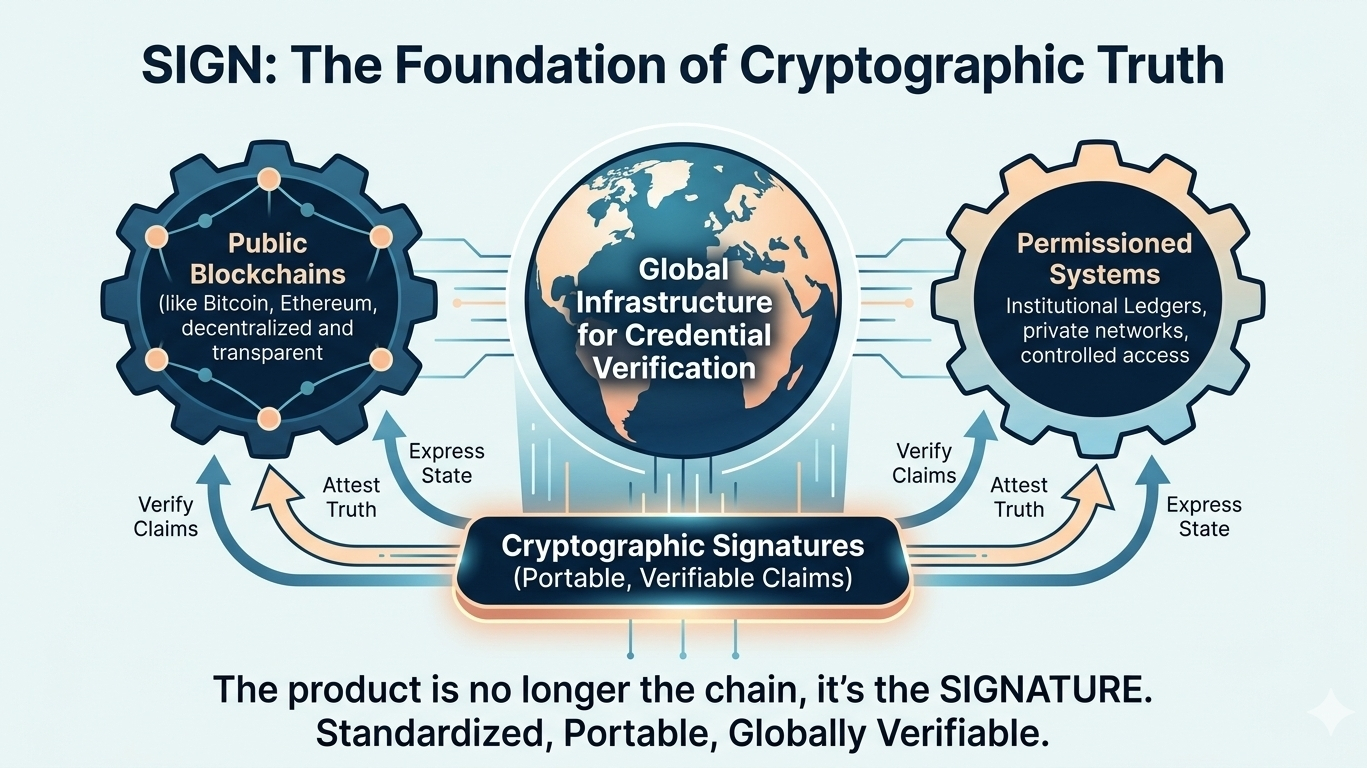
SIGN is not another blockchain or protocol. It is a layer for signed truth, a common infrastructure that allows both public and permissioned systems to speak the same language. Whether a transaction happens on a network or in a controlled environment it can still be expressed as a signed statement that is portable and verifiable across contexts.
This changes how we think about systems.
Of two separate worlds, public and private we start to see one system of truth expressed in different environments. Public systems focus on openness and auditability while permissioned systems focus on speed, privacy and control.. Both rely on the same basic idea: verifiable signatures.
This also changes how we think about scaling. High throughput is often seen as the goal, more transactions per second faster execution, lower latency.. If transactions are seen as lightweight signed statements the problem becomes less, about computation and more about managing and synchronizing signed data.
Speed is important. It is not the hardest problem.
Consistency is.
Because the moment public and permissioned states do not match trust breaks down. It does not matter how fast a system is if different parts of it disagree on what's true. The real challenge is ensuring that all systems regardless of where they operate converge on a shared state.
That is the role SIGN can play.
Not replacing existing systems. Connecting them. Not redefining trust. Standardizing how truth is expressed and verified. A transfer becomes a signed statement a balance becomes a signed truth and a system becomes a network of claims.
Maybe that is the shift happening here:
The product is no longer the chain the product is the signature.
Portable, verifiable and universal.
If we build around that idea if we treat signatures as the core infrastructure than a background detail everything else starts to fall into place. Chains become execution layers networks become coordination environments. Truth itself becomes independent cryptographically secured and globally accessible.
That is where things start to get interesting.
@SignOfficial #SignDigitalSovereignInfra $SIGN
