
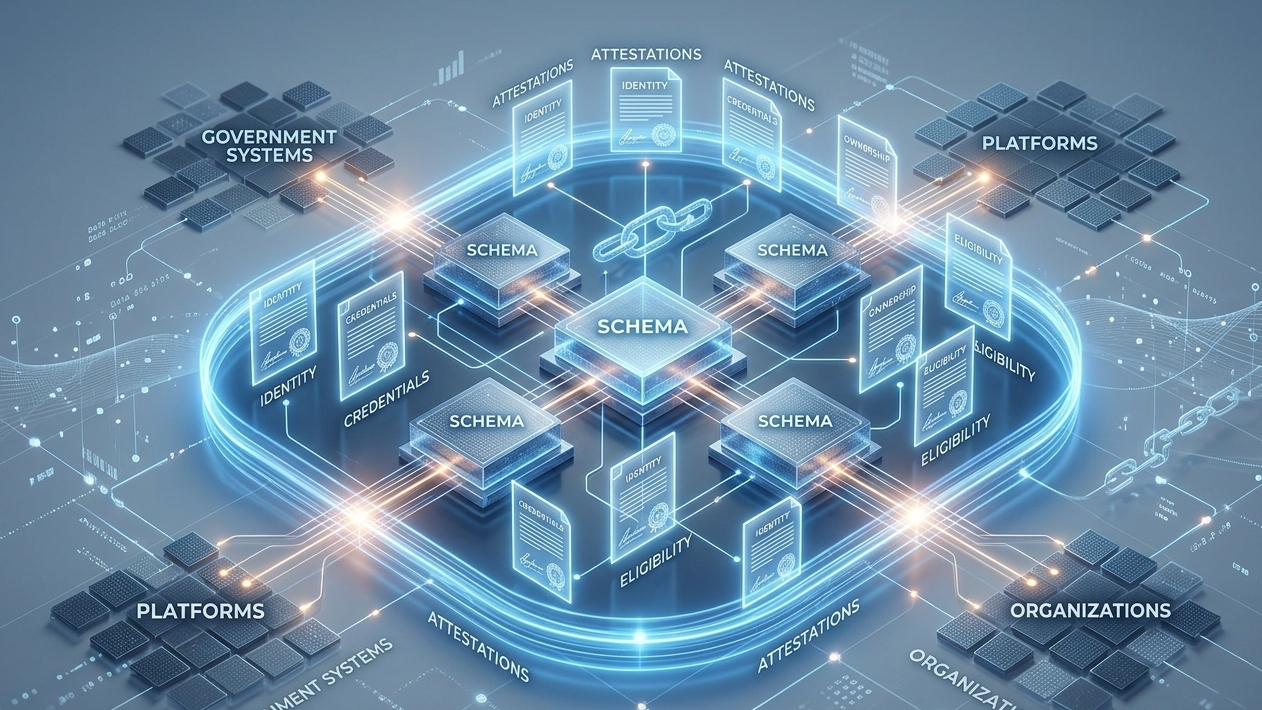
@SignOfficial #SignDigitalSovereignInfra $SIGN I often find myself wondering why something as simple as proving a fact online—who I am, what I own, or whether a claim is valid—still feels so uncertain. In a digital world that moves instantly, verification remains surprisingly fragile.
From what I’ve observed, much of this problem comes from fragmentation. Governments, platforms, and organizations all maintain their own systems, each acting as a separate source of truth with little connection to others.
This lack of interoperability creates friction. I may verify something in one system, only to repeat the same process elsewhere. It’s not that the data is wrong—it’s that systems don’t easily trust each other.
Traditional verification models reinforce this dynamic. They depend on centralized authorities to confirm and validate information. While these institutions can provide reliability, they also introduce delays and dependencies that limit efficiency.
When blockchain technology emerged, I initially saw it as a potential solution. The idea of immutable, transparent records suggested a shared foundation for trust that didn’t rely on a single authority.
But over time, it became clear to me that immutability alone wasn’t enough. Storing data securely does not automatically make it useful or understandable across different systems.
The deeper issue, as I see it, is structure. Data can exist on a blockchain, but without a consistent format, different applications may interpret it in completely different ways.
I’ve also noticed that earlier attempts to solve this problem—through identity protocols or verification services—often fell short. Some remained too centralized, while others struggled to gain meaningful adoption.
In many cases, these solutions focused on verifying individual facts rather than creating a system where verification itself could be reused. This kept processes repetitive and inefficient.
This is where I began to see the approach taken by Sign as somewhat different. Rather than focusing only on storing data, it attempts to create a framework where claims can be structured and shared.
At the center of this approach is the concept of attestations. I understand these as signed statements that confirm specific pieces of information, such as identity, credentials, or eligibility.
What stands out to me is the use of schemas. By defining how data is structured, schemas aim to ensure that different systems can interpret the same information consistently.
This focus on standardization addresses a gap I’ve seen in earlier solutions. If data follows shared formats, it becomes easier to move across platforms without needing to be constantly reverified.
Another aspect I find notable is the flexibility in data storage. Some information can be stored on-chain, while other data remains off-chain but linked through cryptographic references.
To me, this reflects a practical trade-off. Fully on-chain systems offer transparency but can be costly, while off-chain approaches improve efficiency but may raise concerns about reliability.
Even with these design choices, I remain cautious about the challenges. Standardization is not purely technical—it requires coordination between different stakeholders, which is often difficult to achieve.
Privacy is another area I think about. While selective disclosure can help limit data exposure, implementing it effectively requires careful balance and user understanding.
Adoption, in my view, is the most uncertain factor. Developers and institutions may see clear benefits, but widespread integration depends on whether different systems are willing to align.
For everyday users like myself, the benefits may not be immediately visible. Much of this infrastructure operates behind the scenes, only becoming noticeable when it reaches a certain scale.
Ultimately, I see Sign as part of a broader shift—from simply recording data on-chain to structuring how trust itself is expressed digitally. It’s an interesting direction, but not without open questions.
And the question I keep coming back to is this: in a world where every system defines trust differently, can a shared framework for verification truly emerge—or will fragmentation simply take on a new form?
