
Headline: BRICS-led yuan settlements are already rerouting oil flows — and digital rails are the engine The shift away from the dollar is no longer a theoretical debate — it’s reshaping energy markets in real time, powered by yuan-denominated trade and digital payment rails that let countries sidestep the dollar entirely. Real barrels, real money: India and Iran lead the charge - In March 2026 Indian refiners bought roughly 60 million barrels of Russian crude, and a meaningful share was settled in yuan rather than dollars. Indian Oil Corporation reportedly paid directly in yuan for two or three cargoes, avoiding any intermediary conversion. That month marks the largest single surge of non-dollar oil settlement activity India has processed to date. - Iran is pushing the yuan into one of the world’s most strategic chokepoints. A senior Iranian official told CNN Tehran wants tankers transiting the Strait of Hormuz to trade cargoes in yuan. An Iranian lawmaker said tolls have climbed to about $2 million per voyage, and lawmakers are preparing legislation to cement yuan-denominated charges. Digital rails: BRICS payment systems are moving huge volumes - The BRICS alternative payment ecosystem is already processing hundreds of billions in yuan transactions that bypass the dollar. The mBridge cross-border CBDC platform — which continued operating after the Bank for International Settlements stepped back — has handled roughly RMB 387.2 billion (about $55 billion), with 95% in digital yuan. - China’s CIPS network reportedly settled the equivalent of $245 trillion in yuan transactions in 2025, underscoring how large-scale yuan plumbing is quietly expanding. - Central banks are also diversifying reserves: the dollar’s share has fallen from about 71% in 2008 to 56.3% today, while many central banks have bought over 1,000 metric tons of gold per year for three consecutive years. Why policymakers are alarmed — and why others are cautious - Russian President Vladimir Putin framed the shift bluntly: “The US has weaponized the dollar.” - David Lubin, senior research fellow at Chatham House, says the perception of dollar “weaponization” helps explain why countries are exploring escape routes from dollar exposure. - Yet significant constraints remain. The BIS 2025 Triennial Survey found the dollar was on one side of 89.2% of all FX transactions (up from 88.4% in 2022). China maintains capital controls that restrict how freely the yuan moves across borders, and BRICS members have ruled out a shared currency — Russia confirmed in January 2026 that talks on a unified currency “have not taken place and are not taking place now.” Outlook: A long-term pivot accelerating - Some analysts, including ING, see de-dollarization as a multi-decade shift toward a multipolar currency landscape — perhaps a world where the dollar, euro and renminbi dominate different regions. But recent developments in early 2026 suggest the petrodollar’s decline may be accelerating faster than those decade-long forecasts, driven in part by India’s and Iran’s jump into yuan-denominated oil trade. What this means for crypto and digital payments - For crypto and digital-asset ecosystems, the rise of CBDC rails and alternative payment networks is a live signal that legacy dollar-denominated plumbing can be bypassed at scale. That creates new opportunities — and competition — for tokenized FX, cross-border stablecoins, and payment-layer innovation. At the same time, capital controls and policy constraints mean any transition will be uneven and regionally fragmented for the foreseeable future. Bottom line: De-dollarization is moving from talk to transactions. The combination of yuan-denominated oil deals, digital yuan rails and growing BRICS payment infrastructure is already shifting how energy is paid for — and that has consequences for global finance, reserves, and the digital payments landscape. Read more AI-generated news on: undefined/news

Artikel
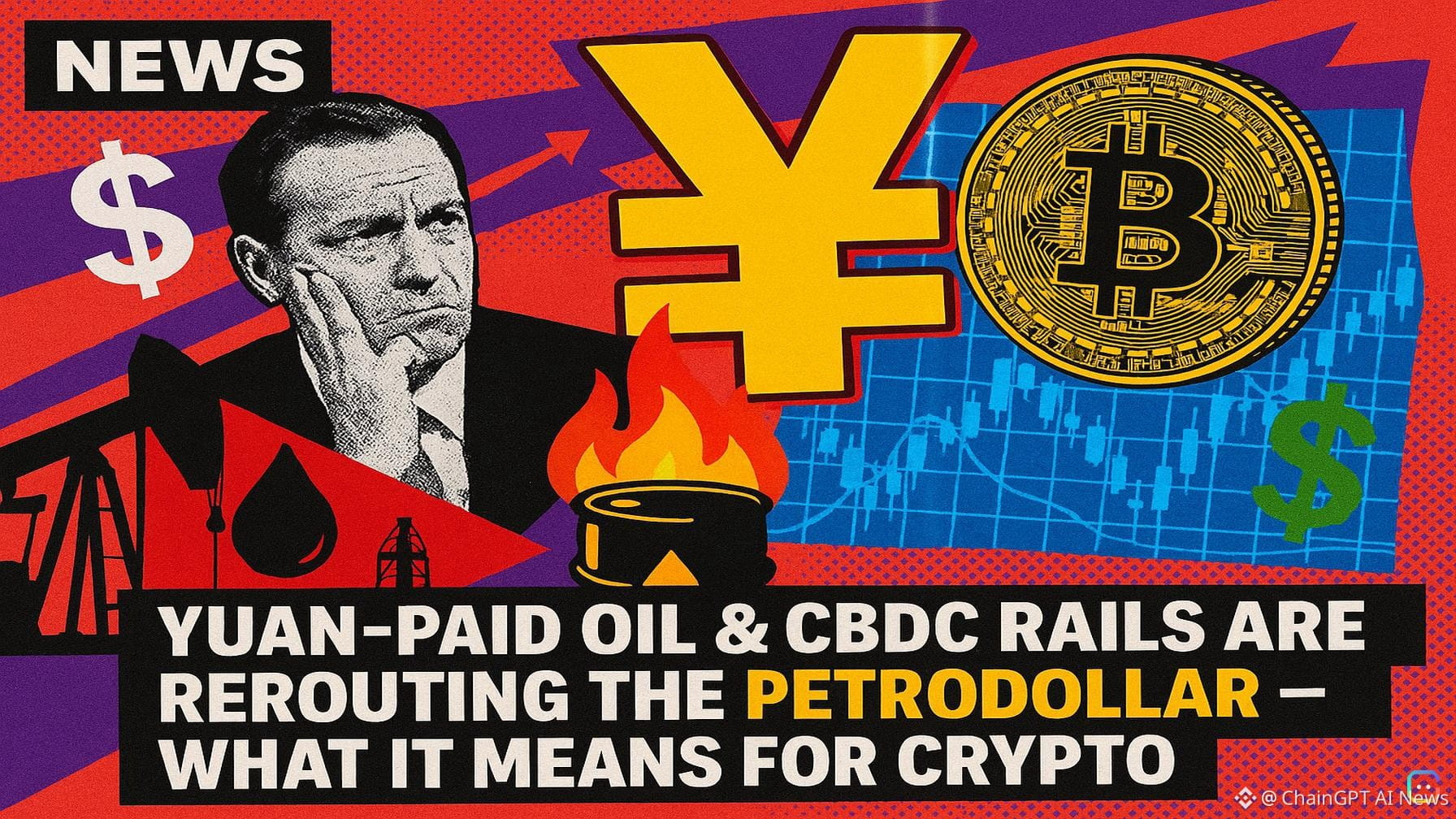
Yuan-Paid Oil & CBDC Rails Are Rerouting the Petrodollar — What It Means for Crypto
Haftungsausschluss: Die hier bereitgestellten Informationen enthalten Meinungen Dritter und/oder gesponserte Inhalte und stellen keine Finanzberatung dar. Siehe AGB.