
So I have been reading about this thing called Boundless and honestly the first time I saw it mentioned I kind of skimmed past it. The crypto space throws around so many big sounding infrastructure projects that it all starts blending together after a while. But the more I looked into it the more it started making a bit of sense in my head. Not perfectly clear or anything but enough to see why people are paying attention.
The basic idea as I understand it is that Boundless is trying to solve a very specific but pretty important problem in blockchain systems. A lot of modern chains and applications are starting to rely on zero knowledge proofs. Those proofs are powerful because they allow something to be verified on chain without the chain needing to redo all the heavy computation itself. Sounds great in theory. The problem is that generating those proofs can be ridiculously expensive in terms of computing power. Like really heavy work. And not every blockchain team wants to build their own entire proving system from scratch just to handle that.
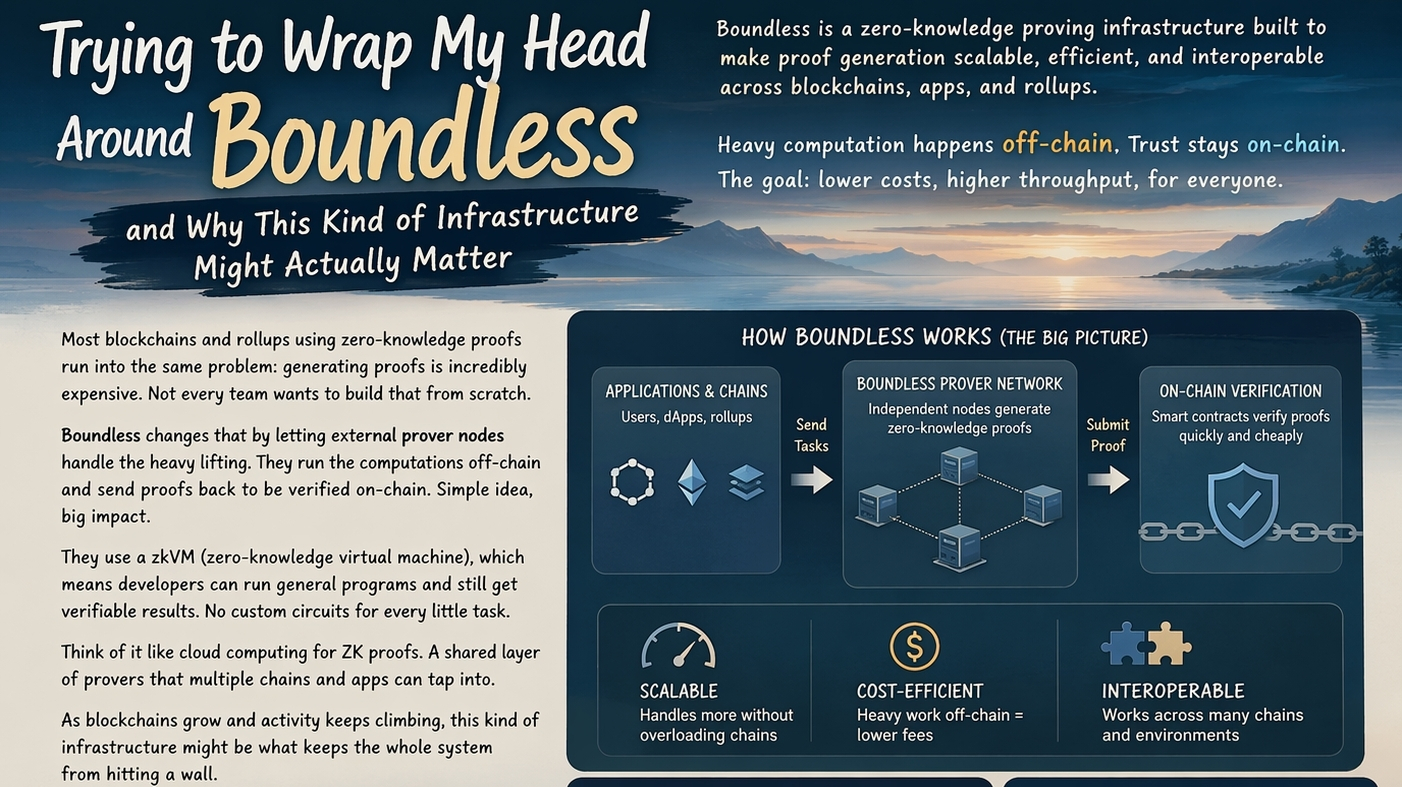
That is where Boundless kind of steps in. Instead of every project building its own complicated proof infrastructure they are trying to create a shared environment where outside prover nodes handle the hard work. These nodes generate the proofs off chain and then the results get verified on chain. The blockchain still gets the security benefit but it does not have to burn through massive resources to compute everything itself. In simple terms the chain checks the result instead of doing the full calculation.
And the interesting piece here is the zkVM approach they are using. A zero knowledge virtual machine basically allows developers to run programs in an environment that can produce proofs of execution. So instead of designing a special circuit for every little task developers can run more general programs and still get verifiable results. It is kind of like moving complicated processing to a separate layer but keeping the final trust anchored to the chain.
When I think about the infrastructure side of things it actually feels a bit similar to how cloud computing changed traditional software years ago. Back then every company was trying to run their own servers and data centers. Eventually services appeared that handled the heavy infrastructure so developers could just build applications. Something about Boundless gives me that same feeling but inside the blockchain world. Not exactly the same of course but the direction seems familiar.
Another thing that stands out is interoperability. Different chains are experimenting with different scaling systems and proof models. Some use rollups. Some rely on their own custom setups. What Boundless seems to be aiming for is a shared proving layer that works across many environments. If that actually works in practice then suddenly projects do not need to reinvent the wheel every time they want zero knowledge capabilities. They just plug into the network of provers and move forward.
And honestly when you step back and look at the bigger picture of where blockchains are heading it almost feels necessary. Activity across chains keeps increasing. More applications. More users. More transactions. Everyone keeps talking about scalability but scalability is not just about faster block times or bigger blocks. It is also about where the heavy computation happens. If everything stays on chain the system eventually hits limits. Moving certain tasks off chain while still verifying them securely might be one of the few realistic paths forward.
Right now the overall market still feels like it is in that strange phase where people swing between excitement and skepticism almost every week. One day everyone is talking about institutional inflows and ETF numbers and the next day sentiment shifts because of a sudden liquidation cascade somewhere. Underneath all that noise though the infrastructure side keeps quietly evolving. New proving systems. Better rollup designs. More efficient cryptography. Stuff that most traders barely look at but that might shape the next few years of the ecosystem.
Boundless sits right in the middle of that infrastructure layer. It is not a flashy consumer product and it probably will not be the thing casual users talk about at first. But if networks start relying more heavily on zero knowledge systems then something like this could become extremely important behind the scenes. Think of it as plumbing rather than decoration. You rarely notice plumbing when everything works but the whole building depends on it.
Another detail that keeps coming back to my mind is how this design spreads the workload across external prover nodes. Instead of a single centralized system generating proofs you potentially have a network of independent participants doing the computation. That could open the door for a new type of ecosystem where proving itself becomes a specialized service. People running hardware specifically optimized for these tasks. Markets forming around proof generation. It sounds a little strange at first but crypto has created entire industries out of weirder things.
At the same time I keep reminding myself that infrastructure projects always take time to show their real impact. They often launch quietly then slowly get integrated into developer tools and frameworks. Months pass before people realize how much they are actually being used. Sometimes they never quite reach that level. The technology world is full of ambitious ideas that looked great on paper but struggled in real conditions.
Still there is something interesting about the direction Boundless is pointing toward. A shared proving layer. Heavy computation pushed off chain. Verification staying on chain where trust lives. If the whole blockchain space is trying to scale without losing security then approaches like this feel like a logical step in the evolution.
And maybe that is the bigger takeaway for me. The conversation around crypto often focuses on price charts and short term market moves but under the surface there is a slow architectural shift happening. New layers are forming. New types of infrastructure are being built. Boundless is just one piece of that puzzle but it represents a broader idea about how decentralized systems might actually grow without collapsing under their own weight.
I am still piecing it together in my head to be honest. The deeper technical details can get pretty complex pretty quickly. But even from a high level view the concept is easy enough to appreciate. Instead of every blockchain struggling alone with massive proof generation costs there could be a shared proving environment doing the heavy lifting in the background. Quietly powering applications rollups and networks while the chains themselves focus on verification and security.
And if that vision ends up working the way its designers hope then Boundless might not just be another infrastructure experiment. It might become one of those invisible layers that slowly ends up everywhere across the ecosystem without most people even realizing it.