
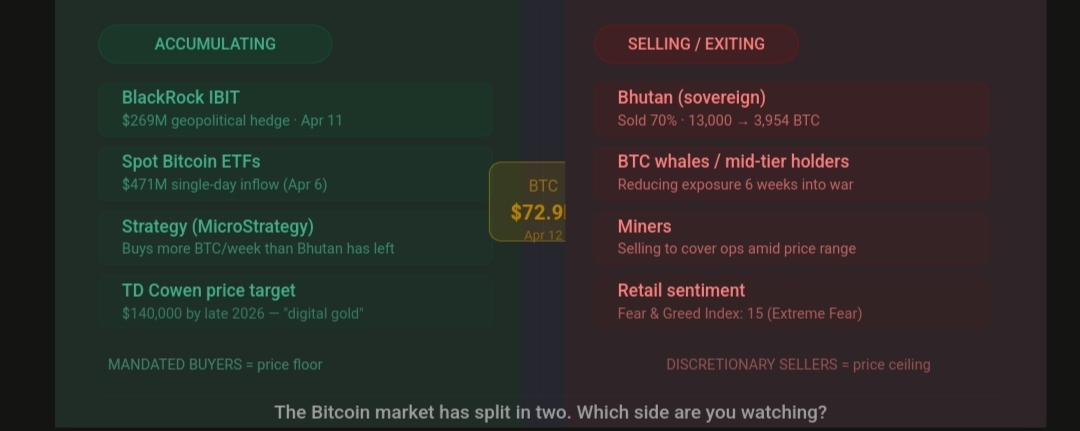
Six weeks of war. Six weeks of fear. And the Bitcoin market has revealed something important about how it actually works now.Bitcoin's price has stayed in a relatively tight range around $65,000 to $73,000 during six weeks of war, but that stability masks a market increasingly dependent on a small group of mandated institutional buyers. Strategy, US spot Bitcoin ETFs, and a few other institutional channels now provide most of the sustained buying, while whales, mid-tier holders, miners, and even Bhutan's sovereign holdings have been selling or sharply slowing accumulation.
Let that sink in. Bitcoin has been holding up not because the market broadly believes in it right now — but because a handful of large, committed buyers are absorbing everything everyone else is trying to offload.BlackRock clients purchased $269.37 million in Bitcoin explicitly as a hedge against geopolitical instability and fiat currency risks. This is part of a long-term strategy, with the firm's total Bitcoin acquisitions exceeding $3 billion since the conflict began.
On the other side: The Fear and Greed Index spent over a month pinned between 8 and 14 — the most sustained period in extreme fear territory since the 2022 bottom. Santiment data showed five bearish social media posts for every four bullish ones last weekend, the most negative skew since the war began.
Here's the honest read: this two-sided market is actually a sign of maturity, not weakness. In 2018 or 2022, a macro shock like this would have sent BTC down 40–50%. The fact that it's holding a $65K–$73K range under genuine geopolitical stress tells you that institutional demand has become a real structural force.But it also means the upside is capped until retail and discretionary sellers exhaust themselves. The range breaks when one side runs out. Right now, institutions have deeper pockets. That's the bet.
#Bitcoin #BTC #InstitutionalCrypto #MarketStructure #CryptoAnalysis