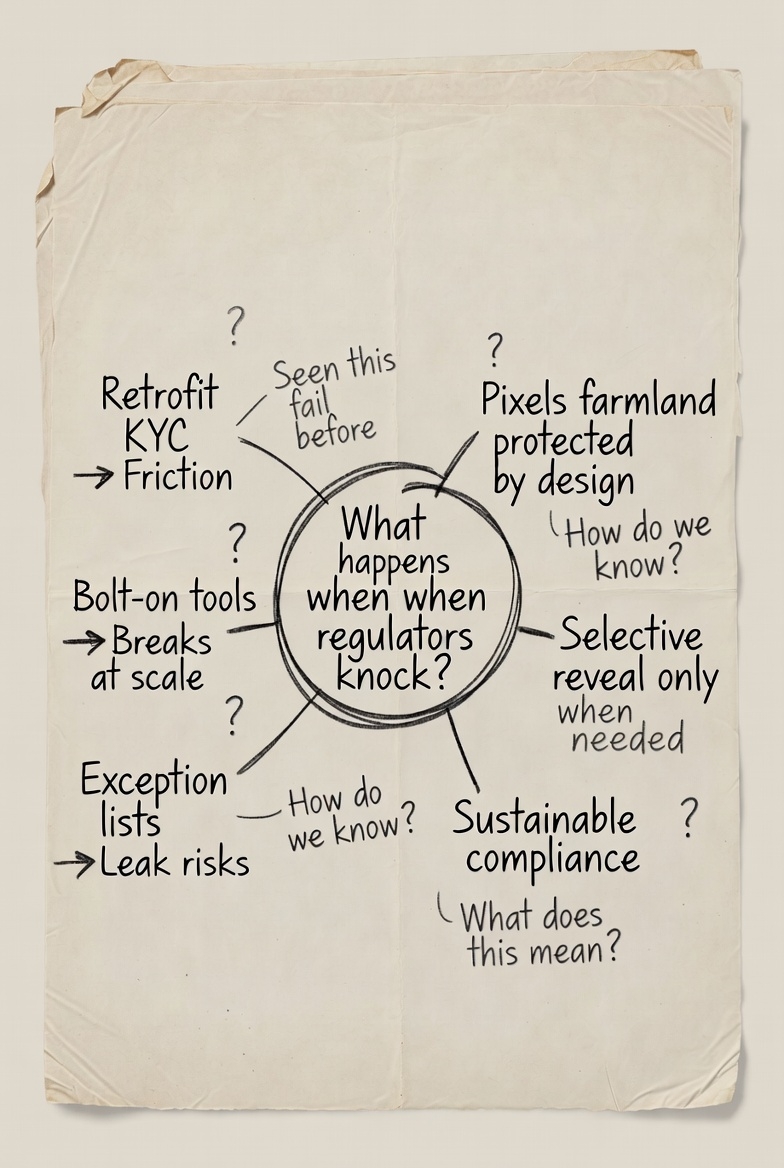
I've been chewing on this one for days now, staring at the same kind of mess that shows up in every on-chain project once it actually gets traction. You know the friction I'm talking about. Someone builds a real economy people logging in daily, swapping resources, claiming plots, building little communities and suddenly the regulators knock. Not because anyone's doing anything obviously wrong, but because the ledger is public by default. Every move is visible. Every wallet can be traced if someone tries hard enough. And the usual response? Patch it later. Add a KYC gate here, a selective disclosure toggle there, promise the auditors you'll flip a switch when they ask. It feels like the digital version of those old bank buildings with marble floors and hidden back rooms pretty on the outside, but everyone knows the real decisions happen behind bolted doors that only open on command.
The problem isn't new. I've watched it play out in DeFi pools, NFT drops, even early DAO experiments. The moment activity scales, compliance teams start sweating because they can't prove they know their users without turning the whole system into a surveillance tool. Builders hate it because every new rule adds gas costs, slows settlement, and kills the smooth flow that made the thing fun in the first place. Users feel it too sudden login walls, wallet verifications that break immersion, the nagging sense that their little farm plot or resource trade is now part of some audit log. Institutions on the other side aren't any happier; they get the data dumps but still worry about what slips through the cracks when the "exception list" grows long enough to hide real risks like wash trading or layered laundering. Human behavior doesn't change just because you add a checkbox. People route around friction. They create new wallets, use mixers, or simply drift to chains where no one asks questions. The system ends up more fragile, not less.
That's the part that keeps me up. Privacy bolted on as an afterthought always feels incomplete because it treats the core ledger like something that was never meant to be watched in the first place. You design for openness, then try to carve out dark corners later. It adds complexity, raises costs, and still leaves regulators asking the same follow-up questions six months down the line. In practice it turns into this awkward dance: builders maintain two versions of the truth one for users, one for compliance and users learn to distrust both. Settlement slows. Legal exposure lingers. The whole thing starts to feel like those legacy financial rails we were supposedly escaping slow, expensive, and full of points where trust can break.
Now zoom in on something like Pixels. Not the hype, just the day-to-day infrastructure. You've got actual land ownership changing hands, resources flowing between players, social economies forming around shared farms and towns. PIXEL isn't some abstract token; it's the fuel for ongoing loops crafting, trading, expanding. Real usage, real stakes. When regulators eventually circle (and they will, because any economy that moves real value eventually draws eyes), the question becomes whether the system can give them what they need without grinding the experience to a halt. Privacy by exception means waiting for the request, then scrambling to expose only the bits that matter. Privacy by design means the architecture itself assumes scrutiny is coming and builds the selective reveal in from the start. No retrofitting. No growing list of hacks that eventually crack under scale or clever adversaries.
I've seen the retrofits fail before. They add maintenance burden, create new attack surfaces, and still don't fully satisfy anyone. The cost isn't just technical it's behavioral. Players who came for the relaxed, creative vibe start treating the game like work once every move feels logged. Builders burn out maintaining compliance patches instead of improving the core loops. Institutions get noisy data but little real assurance because the exceptions become the rule. In a regulated world, this tension only grows. Laws around AML, KYC, and data protection aren't going away; they're tightening. Settlement finality matters when real money or assets are involved. Human nature stays the same people want agency over their data, but they also want the system to work without constant friction.
The reflective part for me is how this isn't about being anti-regulation or pro-privacy absolutism. It's about alignment.
A project like pixels sits right at the intersection: on-chain enough to be transparent and verifiable, but lived-in enough that constant visibility starts to feel invasive. Treating privacy as structural—zero-knowledge where it counts, selective reveal only when law or compliance actually demands it might let the economic loops keep running without forcing everyone into the same awkward compromises. It doesn't promise perfection. Nothing does. But it feels like the kind of infrastructure that could actually survive real-world pressure instead of folding when the first major audit hits.
Who would actually use something built this way?
The serious players and long-term builders in ecosystems like Pixels. The ones who aren't chasing quick flips but are investing time, creativity, and capital into land, resources, and community. They want the game to feel like a persistent world, not a temporary experiment that might get shut down or crippled by the next regulatory wave. Regulators might come around too, once they see they can get the patterns that matter without demanding total transparency that drives activity offshore. Even institutions scouting for compliant on-chain exposure could breathe easier knowing the rails were designed with their requirements in mind rather than patched afterward.
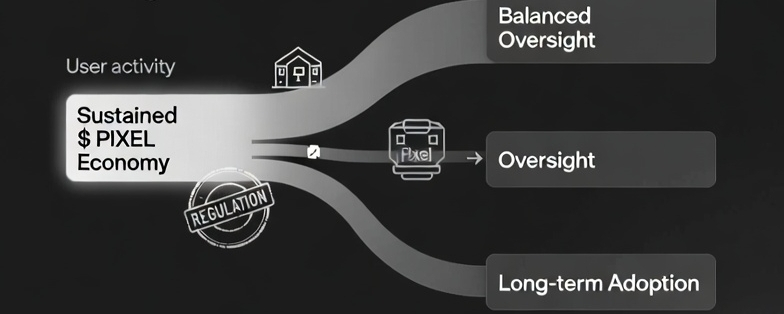
It might work because it respects the reality of both sides: activity needs to flow, oversight needs to exist, and neither should destroy the other. What would make it fail? The usual suspects poor implementation that adds more latency than it removes, or teams that treat it as marketing theater instead of deep architectural choice. Or if human behavior shifts faster than expected and people simply don't trust any on-chain system anymore. Or if regulators decide they want everything visible regardless of cost. I'm not certain. I've watched too many "revolutionary" designs bend under real pressure.
Still, watching pixel and PIXEL move beyond the launch phase, this feels like the quiet question that actually matters. Not the next token unlock or viral event, but whether the underlying rails can hold up when the world stops watching with excitement and starts watching with scrutiny. That's the part worth thinking about. Not loudly. Just honestly.