
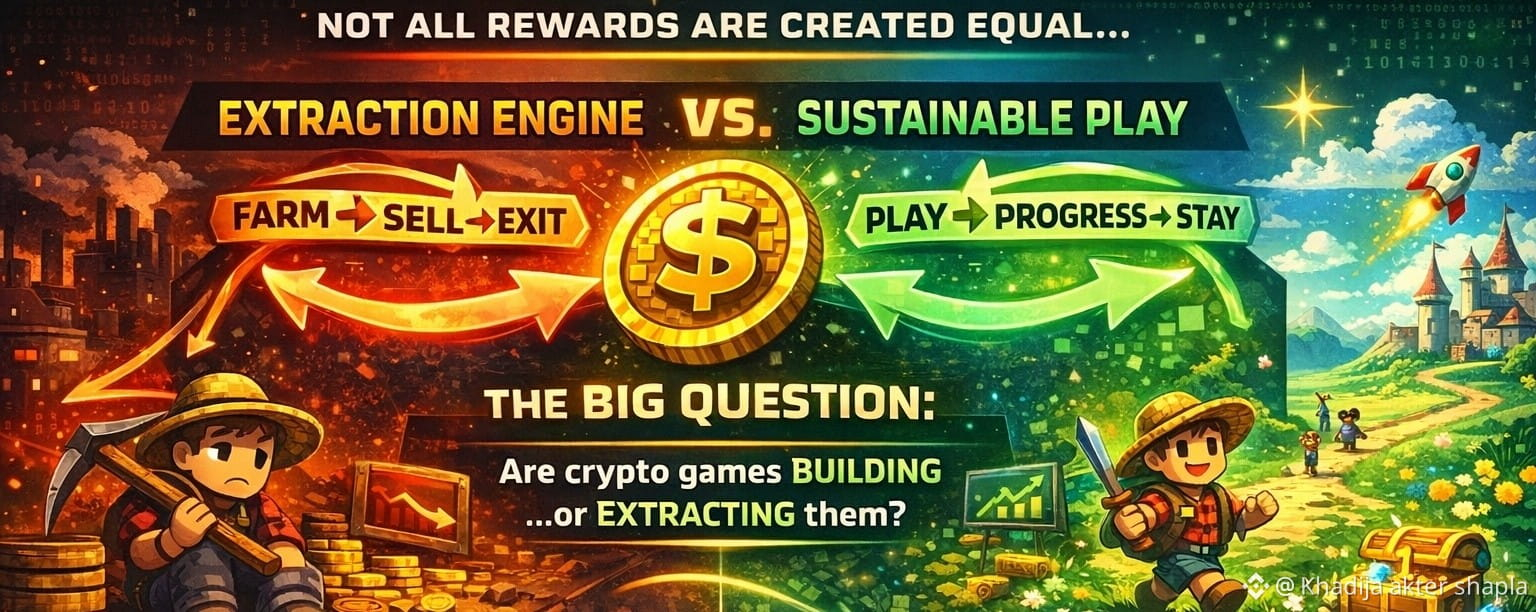
Maybe It's just me, but the deeper I go into crypto gaming rewards, the more one persistent question refuses to leave me alone:
Are most of these systems genuinely designed to create real player loyalty, or are they simply sophisticated extraction machines wrapped in reward packaging?
That question became even sharper for me after spending time with Stacked.
On the surface, it looks familiar — another rewards layer with tokens, incentive loops, farming mechanics, and a community focused on earnings. We’ve seen this story play out again and again: early hype fueled by speculation, followed by fading interest once the payouts start drying up. I honestly expected the same cycle here.
But the more time I invested, the more I realized Stacked was approaching things from a noticeably different foundation.
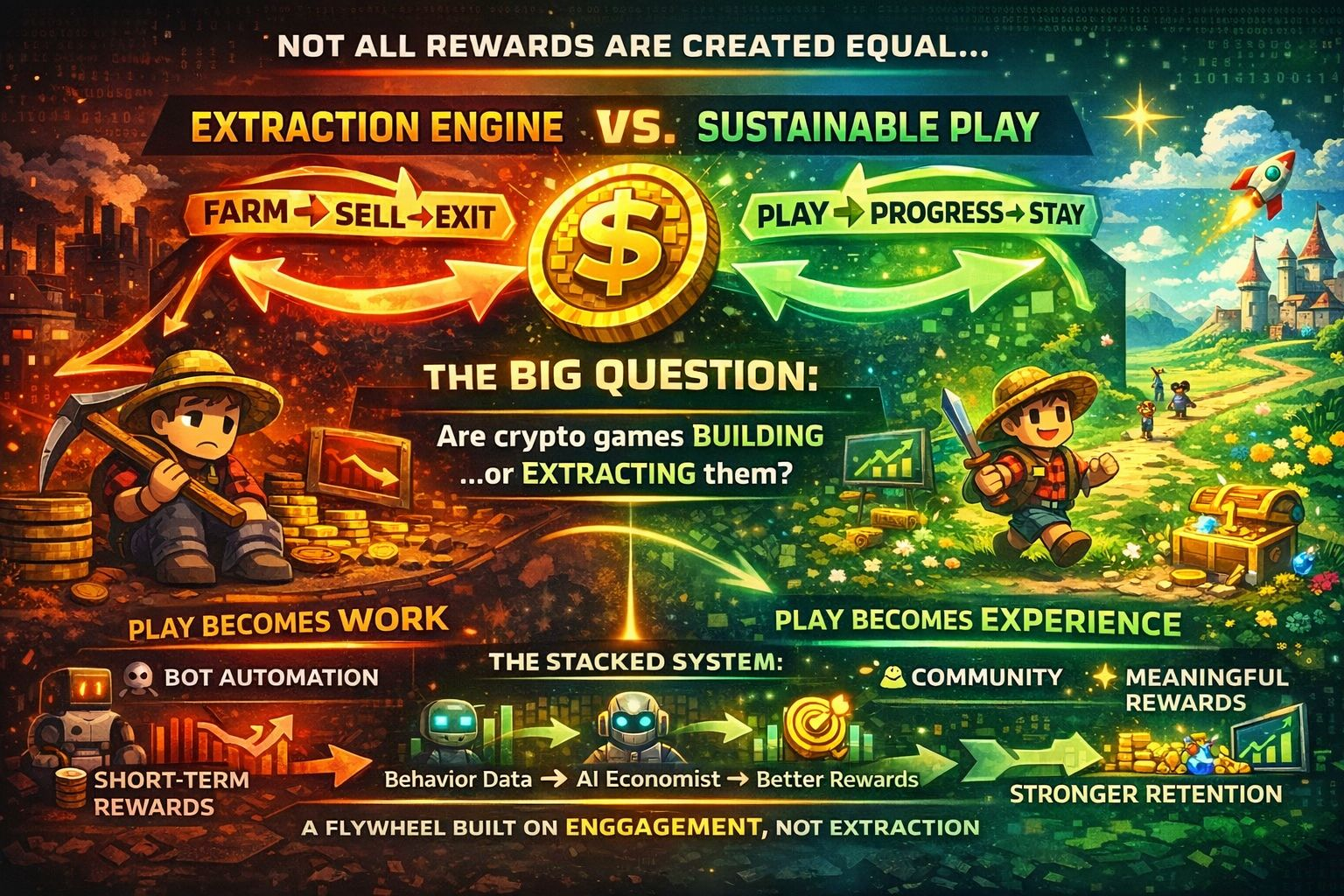
The core flaw in most crypto reward models isn’t boring gameplay or clunky mechanics. It’s that they are built for extraction right from the beginning. They draw people in with attractive payouts, but offer almost no compelling reason to stick around once those payouts become less generous. In those setups, the rewards don’t support the experience — the experience is forced to serve the rewards.
That’s usually where everything begins to fall apart.
A reward system that truly works keeps players coming back because the activity feels meaningful on its own. Progress feels satisfying. The ecosystem feels vibrant. People return because they enjoy being part of it, not because they’re running payout calculations in their head. In far too many play-to-earn models, that genuine spark is missing. Play turns into routine. Discovery becomes repetition. Fun gets replaced by optimization. Before long, it stops feeling like a game and starts feeling like another chore.
What sets Stacked apart is that it clearly gets this fundamental problem.
Its approach puts meaningful engagement first, with the economics designed to support it rather than dominate it. That may sound straightforward, but in this space it represents a real shift in thinking. Too many projects begin with token mechanics and only later attempt to build actual player value around them. Stacked, on the other hand, was developed through years of real-world trial and error inside the Pixels ecosystem. It’s battle-tested infrastructure that already powers Pixels, Pixel Dungeons, and more — not just another concept on paper.
That foundation feels refreshing.
Yet I remain cautious.
It’s one thing to claim you’re building for sustainability. It’s something else entirely to maintain that balance once real financial incentives are introduced. The moment tangible rewards enter the picture, player behavior shifts dramatically. People start optimizing every angle. Systems get stress-tested. The community naturally gravitates toward the most profitable paths rather than the most enjoyable ones. That subtle change can alter the entire atmosphere.
Stacked appears conscious of this risk, particularly through its emphasis on rewarding genuine participation over blanket farming incentives. It layers on an AI game economist that helps studios analyze cohorts, identify churn patterns, and pinpoint which experiments are actually worth running. In theory, this is a smart way forward: support real contribution, discourage bots and short-term extractors, and keep the ecosystem healthier for everyone who truly engages.
It’s an intelligent direction.
But executing it well is far from easy.
The boundary between a passionate player and a highly efficient optimizer can be surprisingly thin. Someone can genuinely enjoy the game and still maximize every advantage available. So the real difficulty lies not just in detecting abuse, but in doing so without accidentally penalizing legitimate users. The more sophisticated the systems become, the easier it is to make occasional misjudgments.
This is exactly why strong execution will always matter more than elegant theory.
What also stands out is Stacked’s larger vision. It doesn’t aim to be just another standalone rewards tool. The broader ambition points toward building a platform that connects multiple games, players, rich behavioral data, and actionable studio insights. If successful, this could prove far more powerful than any single title. Better experiences attract more players, richer data strengthens the AI, smarter reward targeting improves retention and revenue, and that in turn draws even stronger projects into the ecosystem.
On paper, it’s a compelling flywheel.
But flywheels are notoriously difficult to get spinning in the early days.
They only look impressive once real momentum is already there. In the beginning, everything hinges on quality, retention, and actual user scale. Without enough strong games or deeply engaged players, the loop remains mostly theoretical. Data only becomes truly valuable with sufficient volume, and smart distribution only gains power when attention is already flowing.
That’s why I don’t view Stacked as a sure thing, yet I also refuse to dismiss it as just another generic rewards app.
What I see instead is a project that genuinely grasps the real pressure points in crypto gaming incentives. It understands that rewards can’t keep feeling like labor indefinitely. It recognizes that uncontrolled incentives pull in the wrong kind of behavior. It knows token emissions alone won’t deliver long-term sustainability. These insights already place it ahead of many projects that never reach this level of self-awareness.
And unlike most, it comes with proof — Stacked has already processed hundreds of millions of rewards inside the Pixels ecosystem and contributed to over $25M in revenue. That’s real production experience, not a deck.
As for $PIXEL, the same logic holds. If it functions only as something to be farmed and sold, selling pressure will eventually mount. For it to maintain real strength, it must evolve into the core fuel for cross-game rewards and loyalty across a growing ecosystem — capturing value, not just distributing it.
That is the ultimate test.
So my perspective remains balanced.
The thinking here is clearly stronger than the typical crypto rewards narrative.
The awareness is refreshing.
The ambition is bold.
But the challenges ahead are very real.
In this space, promising ideas are everywhere. Consistent, durable execution is still rare.
Stacked has a genuine opportunity to demonstrate how reward systems in crypto gaming can mature beyond pure extraction. Or it could face the same pressures that have tripped up so many others. At this stage, both paths remain open.
But one thing feels certain: it is asking sharper, more honest questions than most.
And in the world of crypto gaming rewards, that alone makes it worth keeping a close eye on.
