
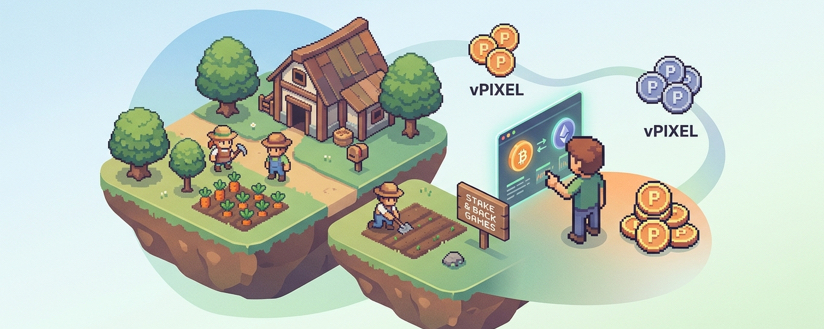

I wasn’t going to look at Pixels, but something clicked. Maybe it was boredom. Maybe it was the hundredth “play-to-earn” pitch that all sounded the same and made me want to close the tab before the first sentence finished loading. But I opened Pixels anyway… and weirdly, I didn’t bounce.
At first glance, it looks harmless. A farming game. Soft colors. Simple UI. You click around, plant stuff, harvest stuff. Nothing new. But then you start noticing the loop underneath it, the way it works, and it doesn’t feel like those dead-on-arrival GameFi experiments where everyone’s just farming tokens to dump on the next guy.
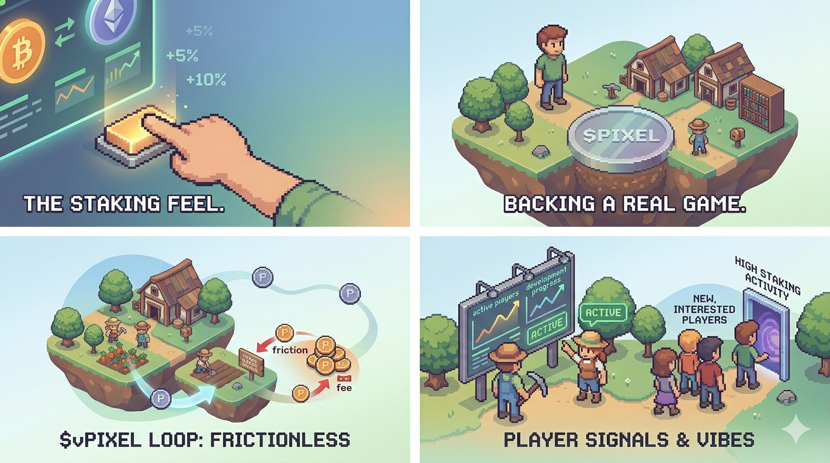
Honestly, the first moment it felt “different” wasn’t some big feature announcement. It was smaller. I staked a bit of $PIXEL into a game and watched the dashboard update. There’s this slight delay—like half a second—before the numbers refresh, and the button gives this soft, almost rubbery feedback when you click it. It’s subtle, but it made me pause. Someone actually thought about how this interaction should feel. Most crypto games don’t even get that right. They feel like spreadsheets pretending to be games.
Here’s the thing. Pixels isn’t just asking you to play. It’s quietly pushing you to take sides.
Instead of staking tokens into some invisible validator you don’t care about, you’re basically backing a game. A real one. You’re saying, “yeah, this one might actually get players.” And if it does, you win. If it doesn’t, well… you picked wrong. That shift sounds small, but it messes with your brain in a good way. You stop thinking like a yield farmer and start thinking like someone who actually wants a game to succeed. Weirdly, that’s rare in crypto.
And then there’s this whole split-token thing. $PIXEL and this other version, $vPIXEL. At first, I rolled my eyes. Another token gimmick, right? But here’s the kicker! It kind of makes sense when you use it. If you pull out regular $PIXEL, there’s friction. Fees. You feel it. But if you’re using $vPIXEL inside the game loop, everything flows. No penalty, just movement. So naturally, you hesitate before cashing out. Not because you’re forced to—but because the system nudges you to stay. It’s not elegant, but it’s effective.
Still, I wouldn’t pretend it’s all clean.
The publishing side—the idea that players decide which games grow by where they stake—sounds great until you actually try to figure out where to put your tokens. The data isn’t always clear. Some games look active but feel empty when you jump in. Others have traction but almost no explanation of why. You end up guessing more than you’d like. And yeah, that’s a problem if the whole premise is “let players decide.” Players need better signals, not vibes.
Another thing that bugged me a bit: the reward logic isn’t always obvious. You do stuff, you get rewards, sure—but sometimes it’s not clear why one action paid more than another. You can feel there’s a system behind it, probably tied to behavior tracking and all that, but from the outside it can feel a bit… opaque. Like the machine knows more than you do, and you just have to trust it. I don’t love that.
But I get what they’re trying to do.
Instead of pouring money into ads and hoping random users stick, they’re redirecting that spend into players. You complete tasks, you bring friends, you stay active—you get paid. Not in some abstract “points” way, but in something that actually loops back into the game. So the growth doesn’t come from outside hype alone. It feeds itself. Slowly. Messily. But it feeds.
And yeah, there’s NFTs in the mix too. Land, boosts, small advantages. Nothing shocking. But when you stack it with the staking layer, it creates this quiet incentive structure where having skin in the game—actual assets—tilts things just enough to matter without completely breaking it. At least for now.
What I keep coming back to is the feeling. Not the pitch. Not the tokenomics slide. The feeling of using it.
Most GameFi projects feel like they’re begging you to believe in them.
Pixels doesn’t beg. It just kind of… runs. You poke it, it responds. You commit a little, it gives something back. Not perfectly. Not always clearly. But consistently enough that you don’t feel scammed after ten minutes.
And look, I’m not sold on it becoming some massive gaming hub or whatever people are already hyping it up to be. That depends on execution, and execution is where most of these things die. If the games inside this loop aren’t actually fun, no amount of clever token design is going to save it.
But I’ll admit this.
The idea of backing games instead of just farming tokens stuck with me more than I expected. It changes how you look at the whole thing. Less “what’s pumping?” and more “what’s actually being used?”
That’s a better question. And Pixels, for all its rough edges, is at least trying to answer it.