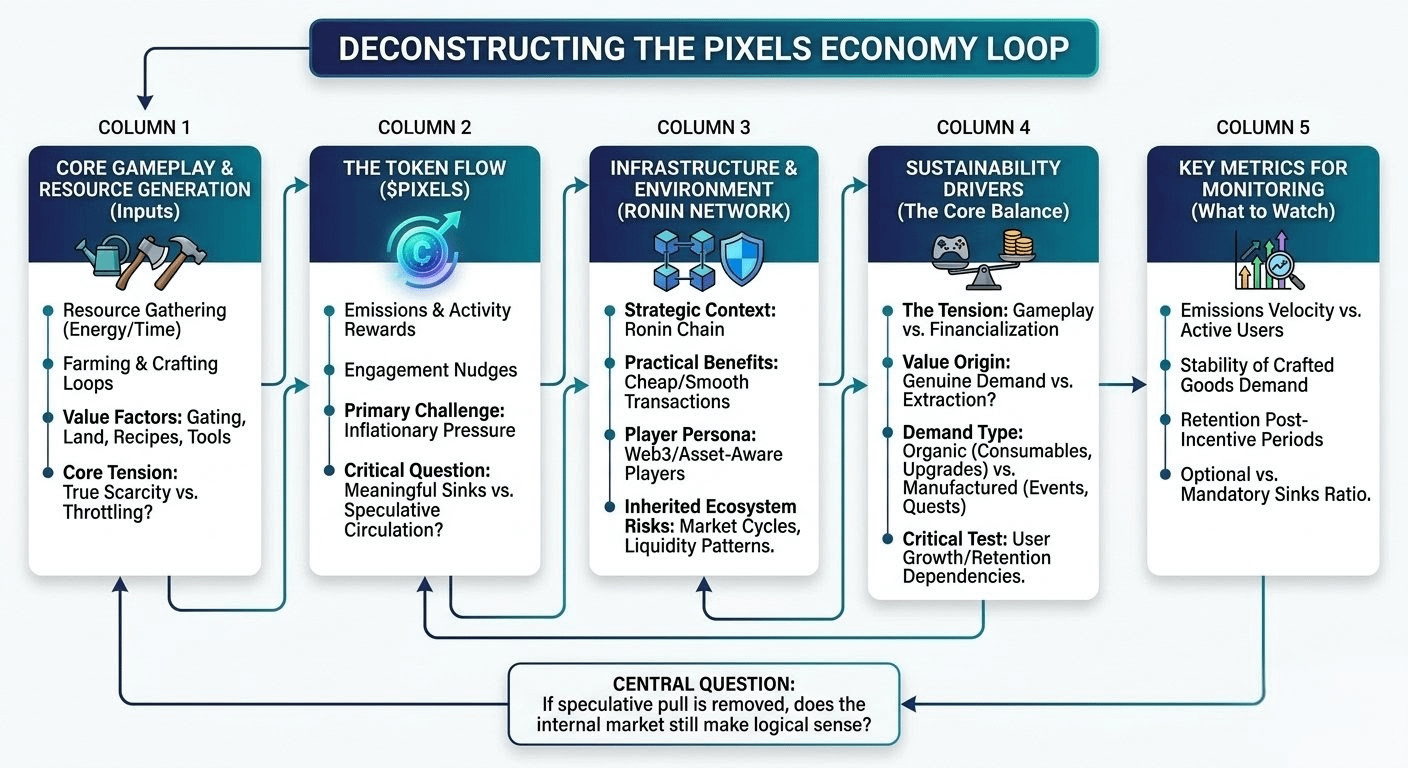
most people think it’s just a farming game with a token attached, and honestly that’s the first read i had too. but the more i poke at it, the more it feels like a system that’s trying to turn ordinary gameplay into a self-feeding market loop. the interesting bit isn’t just that players earn $pixels — it’s how the game keeps asking them to transform one thing into another: farm, gather, craft, upgrade, sell, repeat. that sequence sounds simple, but it’s doing most of the economic work.
on the resource side, pixels seems built around small, repeatable actions that accumulate into something tradable. a player plants crops, gathers inputs, crafts materials or items, and then either uses them for progression or sells them into the player economy. what stands out is that this only really matters if there’s actual demand downstream. if crafted goods are being consumed because they’re useful, that feels like an economy. if they’re mostly being moved around because the game needs activity, then it starts to feel more like throughput. same loop, very different meaning.
and here’s the part i’m thinking about: $pixels has to sit between reward and drain without getting stuck on either side. emissions push tokens outward through play, quests, and incentives. sinks pull them back in through crafting costs, upgrades, marketplace activity, maybe land or utility systems depending on where the economy is at. in theory, that should create a steady circulation. in practice, inflation pressure is always lurking. if too much token value is minted through gameplay, then rewards get diluted and the whole thing turns into a grind with worse economics over time. if sinks are too aggressive, then the game starts to feel like it’s charging players for participation, which is a different kind of problem. i’m not sure there’s a clean equilibrium here, and i suspect it shifts depending on how many new users are coming in.
the ronin layer matters more than it might seem at first. pixels isn’t running on chain infrastructure as a side note — it depends on it. ronin gives the project lower friction for wallets, asset movement, and trading, which is kind of essential when the game relies on lots of small transactions rather than a few big ones. if every craft, transfer, or sale felt expensive or slow, the whole resource loop would break down fast. the infrastructure choice makes the economy usable. it also makes the game more tightly tied to the health of the broader ronin ecosystem, which is a nice setup when things are working and a real dependency when they aren’t.
what i keep coming back to is whether players are generating value or just extracting it from the system. if one player farms wheat, crafts bread, and sells it to another player who actually needs bread for progression, that’s one thing. if the bread only exists because someone needs to convert emissions into market activity, that’s another. pixels can probably support both modes at once, but the balance matters. a game economy like this often looks healthiest when player-to-player demand is active, yet that same activity can also hide dependence on constant growth. new players absorb supply, create demand, and keep prices from drifting too hard. once that slows, the whole model gets more exposed.
that’s where the tension sits for me: gameplay versus financialization, retention versus incentives, growth versus durability. pixels does seem more thought through than a lot of web3 games, especially on the infrastructure side, but i’m still not sure whether that means it can last or just that it can run longer before the pressure shows. the loop is real. the question is whether it’s self-sustaining or just well-paced.
watching:
- player retention after the first few weeks, especially around farming fatigue
- whether $pixels sinks keep pace with emissions over time
- how much trading is actual gameplay demand versus token movement
- whether ronin keeps the asset layer smooth enough to avoid friction spikes
no clean conclusion yet. maybe the real test is whether people keep showing up when the token stops being the main reason to log in.