

I’ve looked at enough Web3 games to stop taking first impressions seriously. They all feel smooth at the start. Clean UI, simple loops, a bit of charm… and for a while, it works. Then more people show up, expectations rise, and suddenly the cracks aren’t small anymore. They’re everywhere. So when I look at Pixels, I’m not rushing to call it special. But I’m not ignoring it either. It’s doing a few things differently, and that’s enough to make me pay attention… cautiously.
At a glance, Pixels is easy to get into. Farming, exploring, building. Nothing complicated. You log in, you do your tasks, you move around a shared world. It leans into that slow, almost routine-based style of gameplay. And honestly, that’s probably the right move. Not everything needs to be fast, competitive, or overwhelming. Sometimes people just want something they can return to without thinking too much.
But here’s the part that always gets overlooked. Simple systems don’t stay simple when pressure builds. They just hide complexity better… until they can’t.
A farming loop sounds harmless. You plant, you wait, you harvest. Repeat. But that loop depends on timing being consistent, data being accurate, and actions being recognized without delay. If something breaks in that chain, even slightly, the whole experience starts feeling off. You don’t always notice it instantly. It’s more like a quiet frustration that builds over time. Something feels unreliable, even if you can’t explain exactly why.
And in Web3, that feeling hits harder. Because now it’s not just “game progress.” It’s ownership. It’s assets tied to a system that’s supposed to be transparent and persistent. If a player starts doubting whether their actions are being properly recorded, that’s not a small issue. That’s a trust problem.
Pixels runs on Ronin, which is clearly chosen to reduce friction. Lower fees, faster confirmations, smoother overall experience. I’ve seen how bad things can get without that kind of setup, so yeah, this part makes sense. But infrastructure choices are always trade-offs, not solutions. You remove one bottleneck and another one shows up somewhere else.
Instead of users worrying about cost, now they start noticing timing. Instead of failed transactions, it becomes delayed responses or inconsistent updates. The system might technically be working, but if it doesn’t feel responsive, players won’t care about the technical explanation. They’ll just feel like something is off.
And that’s where most systems struggle. Not in functionality, but in perception.
Pixels tries to keep things light, almost invisible. The blockchain side is there, but it’s not shoved in your face constantly. That’s important. Most players don’t want to deal with wallets, signatures, or network conditions every time they interact with a game. They want it to feel normal.
But hiding complexity doesn’t remove it. It just moves it behind the scenes. And when something goes wrong, it’s harder for users to understand why. That confusion can turn into frustration pretty quickly.
I’ve seen players drop off not because something completely broke, but because small inconsistencies kept piling up. A delay here. A missing update there. Maybe rewards don’t show up exactly when expected. Individually, these things seem minor. Together, they change how the system feels.
And once trust starts slipping, it’s hard to rebuild.
The social layer adds another level of unpredictability. Pixels isn’t just a solo experience. It’s a shared world. People interact, collaborate, observe each other. That’s where things get interesting… and complicated.
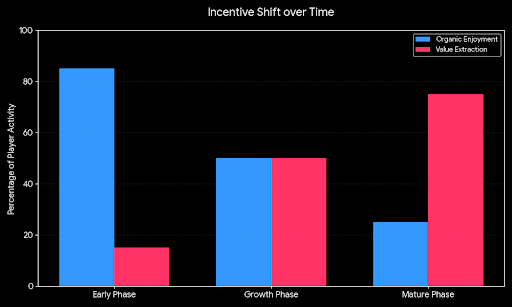
In the early phase, communities usually feel genuine. People explore together, help each other out, figure things out collectively. It feels organic. But once value enters the system in a more serious way, behavior changes. Not dramatically at first, but enough to notice.
Players start optimizing. Efficiency becomes more important than enjoyment. Some focus on extracting value rather than participating in the world. It’s not even malicious. It’s just how incentives shape behavior over time.
Pixels has to manage that carefully. If the economy becomes too dominant, the game loses its identity. It stops feeling like a place and starts feeling like a system to be exploited. On the other hand, if rewards don’t feel meaningful, players disengage. Effort needs to connect to outcome in a way that feels fair, even if it’s not perfectly balanced.
That balance is fragile. And it’s never permanent.
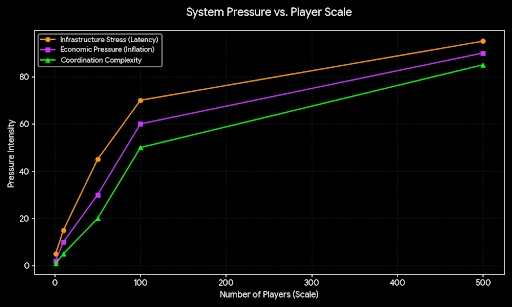
Another thing worth thinking about is scale. Everything works differently when a system grows. What feels smooth with a few thousand players can become unpredictable with tens of thousands. Coordination becomes harder. Timing issues become more visible. Edge cases become common cases.
It’s like a small town turning into a crowded city overnight. Roads that once felt empty are now packed. Systems that worked quietly in the background are suddenly under pressure. And the fixes aren’t always simple. Sometimes they require redesign, not just adjustment.
Pixels hasn’t fully faced that level of stress yet, at least not consistently. That’s the part I’m watching. Not how it performs in controlled conditions, but how it behaves when things get messy. When activity spikes. When players push the system in ways it wasn’t perfectly designed for.
Because that’s when the real character of a project shows.
There’s also the issue of expectations. Web3 games carry a different kind of weight. Players expect more control, more transparency, more fairness. But at the same time, they expect the experience to feel as smooth as traditional games. That combination is difficult to deliver.
You can’t fully control network conditions. You can’t prevent market-driven behavior. You can’t guarantee that every user will have the same experience at all times. There are limits to what the system can manage, no matter how well it’s designed.
And being honest about those limits matters.
Pixels doesn’t need to promise perfection. That would be unrealistic. What it needs is consistency. A sense that even when things aren’t ideal, they’re still understandable. Still predictable enough that players don’t feel lost.
From what I’ve seen so far, it’s trying to build that kind of environment. A slower, more grounded experience that doesn’t rely purely on hype or rapid rewards. That’s a good direction. But direction alone isn’t enough. Execution under pressure is what matters.
I’m not overly optimistic. I’ve seen too many projects lose their footing once real demand hits. But I’m also not dismissing Pixels. It feels more aware of its role as a system, not just a product.
And that gives it a chance.
At the end of the day, this isn’t about whether Pixels looks good when everything is calm. Most things do. The real question is whether it still feels stable when the environment changes. When more players arrive. When expectations shift. When small issues start stacking up.
That’s when a game stops being an idea and becomes a system people rely on.
And that’s the part that’s always harder than it looks.
